An Anthropic vs. OpenAI Comparison
As technology and AI continue to advance, businesses have two choices: adapt and integrate these lucrative tools or risk falling behind competitors.
According to Census.gov, in 2025, around 78 % of organizations report using AI in at least one function, up from 55 % the year before. Additionally, executives expect 92% of companies to increase AI investment over the next three years. This rapid growth has also led to a rise in professionals responsible for choosing which AI tools to integrate into their tech stacks and ensuring they align with company goals.
In 2025, Anthropic and OpenAI dominate the AI industry. Both provide capable models well-suited for enterprise use with similar performance. However, they differ in safety practices, business strategies, and future goals, which affects the user experience and which tool best suits your needs.
OpenAI strives to make AI more approachable to all through multimodal capabilities for text, image, and video generation, as well as accessibility features, parental controls, and global availability.
Anthropic emphasizes responsible AI development by prioritizing safety, interpretability, and alignment. The company focuses on developing robust safety mechanisms to ensure these advanced systems operate with human interests in mind.
This guide breaks down everything you need to know about choosing a model, including comparing features, performance, safety, pricing, and how they can transform workflows.
Anthropic vs. OpenAI Comparison at a Glance
Anthropic and OpenAI both lead the AI industry with their Claude and GPT models. While both are formidable tools capable of advanced reasoning, multilingual processing, and code generation, the companies differ in corporate structure and focus.
OpenAI was initially founded by Sam Altman and Elon Musk in 2015 with a mission to deliver artificial general intelligence that benefits humanity. Anthropic is a competing AI company founded in 2021 by Dario Amodei and his sister, Daniela Amodei, former OpenAI VPs of research and safety and policy, respectively. Anthropic strives to enhance the safety and reliability of AI systems.
Here’s how the two compare:
Anthropic:
- Current flagship model (2025): Claude Opus 4.1
- As of 2025, Anthropic currently holds 32% of the enterprise LLM market share based on usage, up from 12% in 2023
- Major partners and investors include Amazon, Google, Databricks, and Palantir.
Anthropic operates with a research-first approach. It utilizes its Constitutional AI framework to ensure AI systems align with human values.
OpenAI:
- Current flagship model (2025): GPT-5
- As of 2025, OpenAI holds 25% of the enterprise LLM market share based on usage, down from 50% in 2023
- Major partners and investors include Microsoft, Apple, NVIDIA, and Reddit
OpenAI began as a research-first organization but later shifted toward a product-first framework, which enables stronger product organization and capitalization. However, OpenAI still utilizes extensive research, creating a feedback loop in which research drives products and products inform research.
Model Capabilities and Access
Several AI model benchmarks help developers, researchers, and users determine performance and accuracy.
MMLU (Massive Multitask Language Understanding) evaluates AI responses on their multitask capabilities for several metrics. This benchmark requires models to answer prompts on 57 topics at levels ranging from elementary to professional.
Each prompt assesses the model’s reasoning, knowledge retrieval, and comprehension. A high benchmark score for MMLU indicates that a model can handle complex problems that require contextual understanding and that it applies real-world knowledge to generate accurate responses. Here’s how they stack up in 5-shot tests:
- Claude 3.5 Sonnet: 88.7%
- Claude 4: 86.8%
- GPT-5: 86.4%
- GPT-5o: 88.7%
Anthropic vs. OpenAI Pricing
OpenAI and Anthropic take different approaches to model availability, pricing, and rate limits, which can also sway users with specific needs. Both provide chat and Application Programming Interface (API) integration options for flexible use.
Chat interfaces allow users to interact directly with AI models, while API integration requires code to interact with them. APIs are more suited for integrating AI into other applications used by programs rather than human interaction.
Anthropic sells tailored tools and services on an annual basis. Costs tend to be higher than OpenAI systems, but Anthropic also takes a more comprehensive approach to user safety. Companies using OpenAI pay for credits used every time a request is processed. Various tiers and price points affect AI speed.
Anthropic:
- Model availability: Chat and API integration
- Individual Plan Pricing: Free for basic access to Claude; access to more advanced features ranges from $20 to $100 per month
- API rate limits: Depends on the subscription, but standard maximum requests per minute range from 50 to 4,000
OpenAI:
- Model availability: Chat and API integration
- Individual Plan Pricing: Free for basic access; costs for advanced features and unlimited access to certain models range from $20 to $200 per month
- API Rate limits: Depends on the subscription and model
Safety, Alignment, and Transparency
Safety, alignment, and transparency ensure models are sufficiently trained to avoid hallucinations and misuse. Through transparency policies, including model disclosures, red teaming, and ethical reviews, companies reassure users that their models are safe and reliable.
Anthropic’s Constitutional AI approach streamlines the development and training of AI systems by enlisting other AIs to oversee the process based on a human-written set of principles. It scales efficiently and promotes consistency but may offer less flexibility, making it suitable for teams that value automation and strong governance.
OpenAI favors reinforcement learning with human feedback (RLHF) to maintain safety, alignment, and transparency. Human labelers review model responses, rank outputs, and make adjustments to demonstrate desired responses. It allows more control and adaptability but requires more human input, appealing to teams that prioritize precision and oversight.
User and Developer Experience
Developers and enterprise users favor Anthropic and OpenAI for their overall flexibility.
GPT-5 offers a more versatile AI experience, complete with image generation. While Claude 3 isn’t capable of image generation, it provides extensive analytical capabilities and generates more natural text.
Claude 4 has a much larger context window, which allows it to handle extensive, multi-turn tasks while providing intricate responses that require complex reasoning. GPT-5 often requires clear and precise prompts.
How Professionals Are Using OpenAI and Anthropic Tools in Real-World Workflow
Numerous industries have adopted AI to improve efficiency, and Anthropic’s Claude and OpenAI’s GPT models are both popular choices.
Marketing and Content Strategy
GPT-5 and GPT-5o are popular with marketers looking for shorter-form content, such as blog articles, product descriptions, ad copy, and email sequences. GPT models make search engine optimization (SEO) easier by performing keyword research, providing outlines for content, and schema markup. GPT plugin tools can also generate images and support campaign reporting and content analysis.
Claude 4 excels in long-form content generation and planning since it can draw from larger documents and datasets to maintain tone consistency.
Because Claude 4 doesn’t draw from real-time web data, it isn’t the best option for time-sensitive content. It also lacks integrated image generation. Some content creators find it somewhat repetitive, as it frequently reuses sentence structures or words.
Coding and Development
Claude 4 models can work with longer, more detailed code, and their HumanEval scores tend to be higher than those of GPT-5. They’re particularly useful for technical interviews, API walkthroughs, and test writing. However, some developers find the responses to be more verbose than GPT.
Many developers prefer GPT-5 and GPT-5o for code generation, debugging, and documentation. Because GPT-5 and 4o use smaller context windows, they often produce shorter code. This can be advantageous for simple applications, but if you need a more comprehensive output, Claude 4 can provide it in fewer responses.
GPT has a Code Interpreter function to support developers, which enables users to create and test Python code in a sandboxed environment. This is ideal for building and reviewing scripts in real time. OpenAI also powers GitHub Copilot, which can analyze code in real-time and make suggestions for improvement.
Data Analysis and Business Intelligence
Analysis used to require immense human effort to review and interpret data. With AI models, you can analyze information in much shorter time frames since computers can process data much quicker.
GPT-5 and GPT-5o allow users to input datasets with plain-language questions. It translates these requests into SQL queries and can provide responses in numerous ways, including Excel formulas and chart interpretations. If users enable Code Interpreter, GPT-5 can also run Python code, which allows it to plot graphs and summarize CSV data.
Claude 4’s larger context window, which allows it to process and generate longer reports, gives it an edge over GPT-5. This is ideal for analyzing trends and creating executive-friendly summaries. Claude also tends to outperform GPT for use cases where interpretability and tone control matter.
Which Ecosystem Is Better for You?
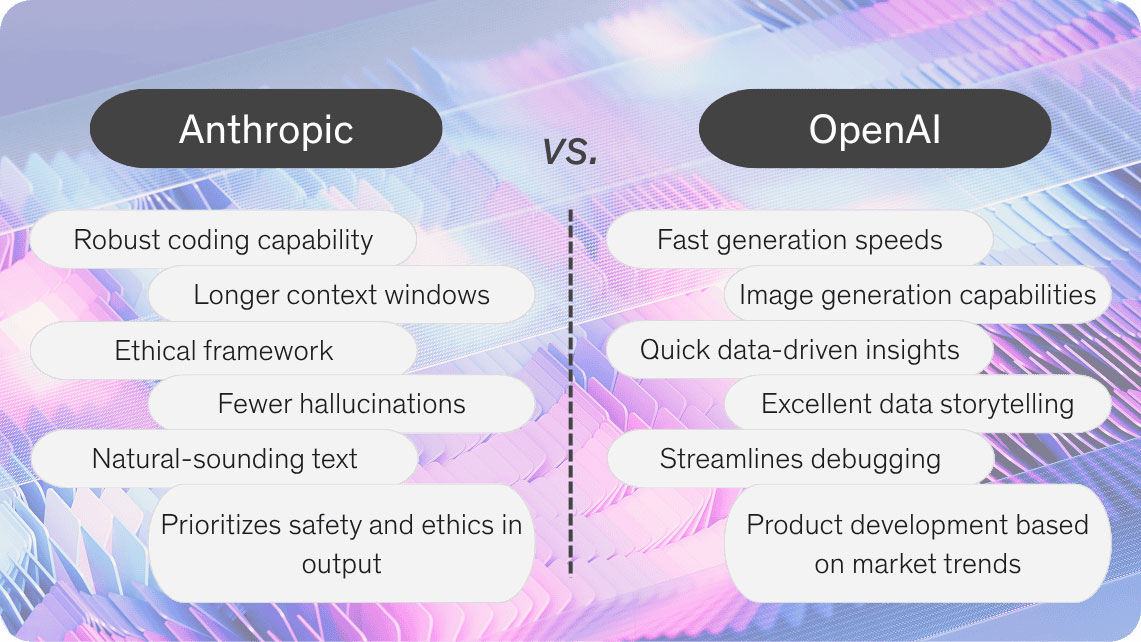
The right ecosystem depends on your usage scenario and preferences. GPT-5 is more widely supported by third-party productivity tools, such as Slack, Notion, and Microsoft Teams. However, platforms such as Zapier offer integration tools for Claude 4. You may also have preferences based on the specific application.
Developers
Claude 4 is great for projects that require strong analysis skills, larger context windows, or higher-accuracy coding for multistep tasks. Choose GPT-5 or GPT-5o for projects requiring speed and cost-efficiency or tasks that need intensive logical reasoning and problem-solving.
Claude 4 Pros:
- Robust coding capability
- Longer context windows (200k tokens)
- Fast generation speeds
- A strong ethical framework that emphasizes safety features
Claude 4 Cons:
- Limited plugin options
- Limited real-time data integration
- Overly cautious due to stricter safety protocols
GPT-5/GPT-5o Pros
- Streamlines debugging and provides feedback to improve code
- Fast generation speeds
- Image generation capabilities
GPT-5/GPT-5o Cons
- Lower context window (128k tokens)
- Sometimes struggles with complex or niche problems
- May use outdated functions due to having a cutoff date for training data
Creatives
Choose GPT-5 or GPT-5o for shorter-form outputs or content that requires imagination and creativity. Use Claude 4 if you need long-form content or when nuance, accuracy, and stylistic alignment are necessary.
Claude 4 Pros:
- Creates natural-sounding text
- Adheres to instructions to maintain brand voice and tone
- Prioritizes safety and ethics in output
- Multilingual Capabilities
Claude 4 Cons:
- Can be overly cautious, restraining content
- Can’t generate and incorporate images
- Requires paid plans for more robust features
GPT-5/GPT-5o Pros:
- Multilingual capabilities
- Consistently generates coherent and grammatically correct content
GPT-5/GPT-5o Cons:
- Content can be somewhat generic without human intervention
- May hallucinate and provide factual inaccuracies
Analysts
When you’re working with larger datasets or need deep contextual understanding for accurate analysis, opt for Claude 4. Choose GPT-5 for coding-intensive technical tasks or those that require complex problem-solving.
Claude 4 Pros:
- Summarizes and interprets larger datasets accurately
- Allows for multimodal analysis, accepting and interpreting visual data
- Fewer hallucinations and unwarranted refusals
Claude 4 Cons:
- Fewer customization options
- Inconsistent performance in extremely niche applications
GPT-5/GPT-5o Pros:
- Excellent data storytelling
- Versatile input options
- Provides quick data-driven insights
GPT-5/GPT-5o Cons:
- Requires caution when handling sensitive or confidential data
- May lack expertise in niche fields
- Can amplify biases present in training data
Business Leaders
Claude 4 works great for deep document analysis, nuanced content generation, and cost-effective processing of large amounts of input data. Choose GPT-5 for real-time interaction, multimodal tasks, or integrating into customer-facing applications.
Claude 4 Pros:
- Emphasis on safety keeps Claude 3 ethical
- Capable of following multistep instructions
Claude 4 Cons:
- Integrates with fewer tools than other models
- Lacks advanced workflow features
- Has stricter rate limits with no fallback model
GPT-5/GPT-5o Pros:
- Automates repetitive tasks to improve operational efficiency
- Can assist in product development based on market trends
- Can be customized and trained with internal documents to suit a company’s specific needs
GPT-5/GPT-5o Cons:
- Can be costly to integrate and operate
- Requires businesses to develop an agile workplace due to rapid advancements in AI technology
- Learning curve can be steep for employees who don’t have much technical training
Learn to Work With OpenAI and Anthropic on Git
Even if you’ve never used an AI model before, Git has resources and courses designed to teach prompting, app integration, ethical AI usage, and LLM design for all skill levels.
Consider courses in categories such as:
- Artificial Intelligence: Learn the basics of AI and how to apply it.
- OpenAI API: Explore how to use OpenAI’s API for specific purposes, such as creating chatbots.
- ChatGPT: Discover how to use ChatGPT for AI-driven projects.
- Claude: Build skills utilizing Claude for specific applications.
- Machine Learning: Learn how to use algorithms that teach AI systems with data.
- Prompt Engineering: Develop skills in prompt engineering to better utilize existing AI models.
Our expert-led courses teach real-world skills, whether you’re a hobbyist or a professional looking for continuing education opportunities, you’ll always find the most up-to-date information on our platform.
Please Log in to leave a comment.