A Framework for Structuring Your Job Search
Author: Mimi Aboubaker

Few people find embarking on a job search exciting. In fact, most of us would probably agree that it’s a daunting and emotionally exhausting process. As a result, job seekers tend to fall into two broad categories: avoiders and gatherers.
Overwhelmed by feelings of fear or confusion, avoiders often shut down entirely: “I don’t know where to start, so I’m going to do nothing.” Gatherers, on the other hand, respond to those same emotions with feverish action: “I have no idea what I want to do, so I’m casting a wide net” or “I hate my current job, so I’ll apply to everything.”
Neither mindset is going to lead you to a successful outcome. In the case of avoiders, idleness does not result in job offers. For gatherers, a lack of clear direction leaves you wandering in many directions.
To land a job you will actually enjoy doing, you need to be intentional about where you apply and why. As part of my own process, I’ve created what I call a career and personal manifesto, a framework to provide structure to any job search. You can use it, too.
Here’s how.
The Career and Personal Manifesto
The manifesto has three steps:
Evaluate
Engage
Execute
Evaluate
A successful job search is simple. All you have to do is find job opportunities that match your needs and goals. The hard part is figuring out what those needs and goals are.
To start, spend time with yourself and evaluate your potential next steps. Consider the following six categories, each of which includes a series of questions to help you discover what is the most and the least important to you in your next role.
As you answer these questions, think about your past and present jobs or internships and which aspects of each role you enjoyed the most (or really disliked).
Environment: What kinds of environments, management styles, and ways of working do you thrive in?
Role: What kind of roles and prospects for growth are you looking for?
Compensation: What’s the minimum compensation you will accept, and what’s your ideal range?
Skills acquisition: What skills and competencies does your résumé currently demonstrate? Are you looking to gain additional skills or further specialize in what you know now?
Career narrative: How does your résumé position you in the hiring market? For example, does it suggest you’re someone who cares about socially driven work? Does it suggest you’re great at building, launching, and leading new initiatives? Have you collected prestigious company logos?
On the horizon: Is there a meaningful and realistic step you can take within the next 18 months in light of your answers? For example, are there opportunities you can take off the table or add to your list?
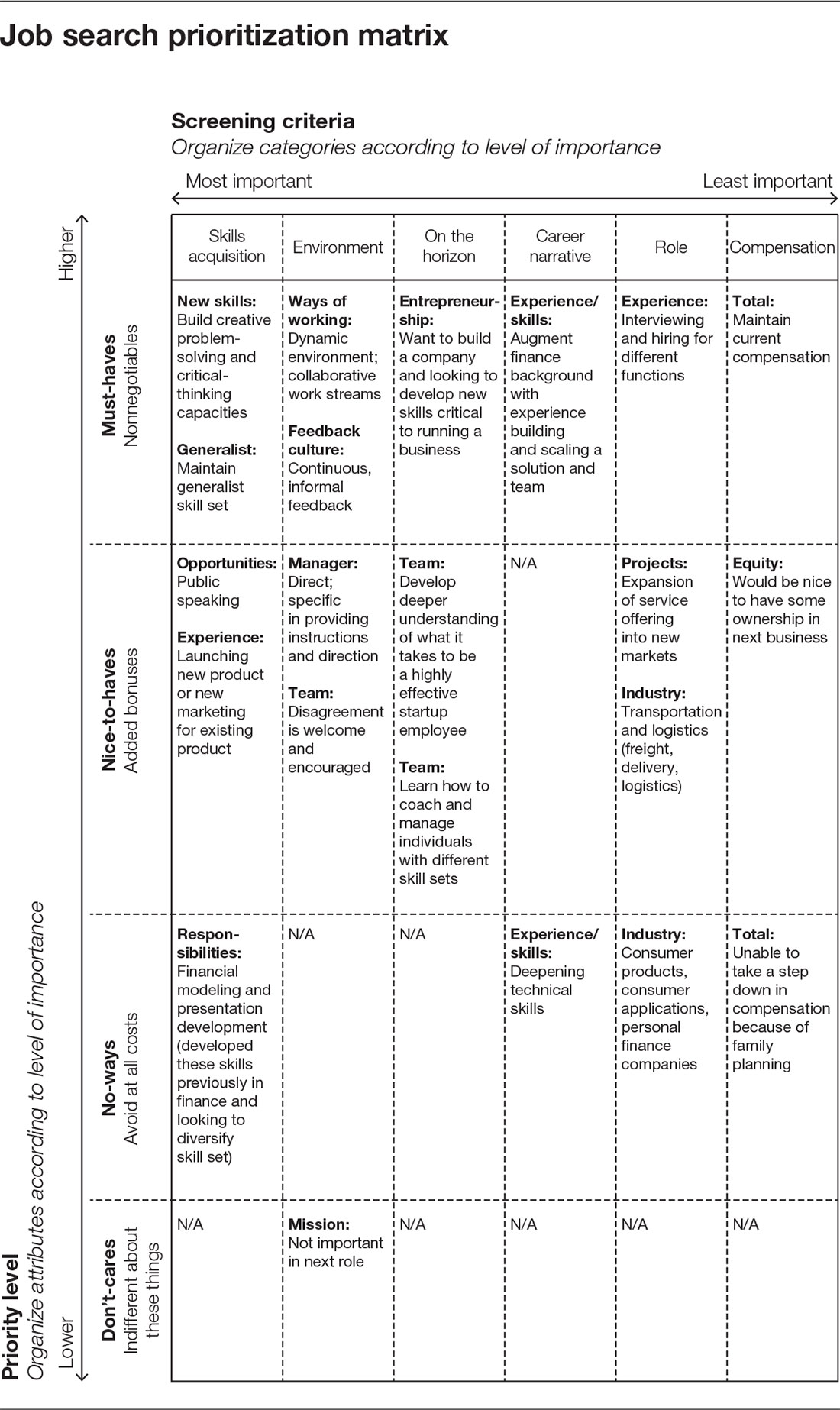
Next, use your answers to these questions to fill out a job search prioritization matrix. Doing so will help you figure out which roles to prioritize as you move forward with your search.
Rank the six evaluation categories in order of importance:
Must-haves: Required—you will not consider any job without these items.
Nice-to-haves: Important—but they won’t make or break an opportunity.
No-ways: Required—you will not consider any job with these items.
Don’t-cares: Important—these things don’t matter or are nonstarters.
For instance, if compensation is the most important factor to you when you are searching for a new role, then compensation should be the furthest to the left on the matrix. Figure 1-1 is an example of a matrix that has been filled out. This matrix is for a junior consultant who is hypothetically interested in getting a job in the tech industry and who most values skills acquisition and the work environment.
FIGURE 1-1
Engage
After working through the questions and filling out the matrix, you should have a better idea of what you are looking to do next. Now, it’s time to take action and start reaching out to people in your network. Discussions are a natural part of the job-hunting process, but you want to segment the people you engage with into two categories:
Thought partners: People who can weigh in on your thinking and path forward (mentors, alumni networks, former managers and colleagues, and so forth)
Opportunity sourcers: People who can help you identify open opportunities
When seeking outside counsel, be wary of what I call advice of convenience, or advice from people who are in your orbit. Advice of convenience is an easy trap to fall into. Instead, try to step out of your comfort zone.
The best people to reach out to for advice are those who (1) you admire, (2) have demonstrated skills and personal attributes you would like to gain, or (3) are doing what you want (or think you want) to be doing. After all, who better to show you the path to where you want to go than the person already there?
Surprisingly, people of all statures are accessible and enjoy offering career advice. There are a variety of channels you can use to reach professionals. The most tried-and-true is LinkedIn, where many professionals have an account. If you use this channel, include a personalized invitation to connect, explaining your objectives to increase the chance of a response.
USING YOUR NETWORK
by Bill Barnett
The best source of potential roles is your network. And the best way to succeed at networking is to reach out broadly. Don’t limit your contacts to those you know well—widespread outreach is the only reliable path to success.
Management consultant Isabel provides a good example of active outreach. She targeted three fields and built a list of people to contact by talking to her consulting colleagues and searching alumni databases at her two universities. She also added relevant contacts from search firms. To stay organized, she used a spreadsheet.
Isabel emphasizes how much she learned from simply talking to people—a lot of them: “I had 40 or 50 conversations. Thirty-five were informational. I was talking to anyone who seemed close to being relevant. What do you do? What do you like? I was willing to explore any option in my target areas, in some cases if only to learn.”
The more she heard, the more she learned. Insights from earlier meetings helped her ask better questions later. She dropped one of her target industries once she realized it didn’t match her objectives. People suggested others to contact. Isabel found two good opportunities in three months.
Active outreach isn’t easy. It requires commitment and organization, but it is absolutely essential. Take these steps:
Broadly define your network. Most people don’t realize how many contacts they have. Consider former classmates, colleagues from earlier employers, business relationships outside your institution, and civic acquaintances. People will be flattered that you’re asking for help, and they’ll likely be happy to assist you.
Create a new network along the way. Ask people whom else to talk to. Consider people you don’t know but who are relevant to your search. Cold-call them, email them, ask a mutual contact for an introduction, or reach out on LinkedIn or Instagram.
View discussions as learning opportunities, not just job inquiries. Ask about more than jobs. Ask about the industry, how to succeed, and how to position yourself. Approaching these meetings as conversations breaks the ice. What you learn may lead you to shift your target, as Isabel did, or change the way you present yourself.
Be systematic with good record keeping. Staying on top of broad outreach is complicated. After each meeting, write down what you learned and what you’ll do as a result. Use a spreadsheet or another system to track your new knowledge and to gauge progress.
Periodically evaluate your progress and whether to change the approach. View this step as conducting a study. Review your notes from different meetings. Look for patterns. Are there better ways to move in the direction you’ve selected? Are there different approaches that could help you more? If you see a more effective or efficient way to do something, try it.
Bill Barnett led the Strategy Practice at McKinsey & Company and has taught career strategy to graduate students at Yale and Rice. He is the author of The Strategic Career: Let Business Principles Guide You.
Adapted from the article “Find a Job with Massive, Structured Networking”.
The basic structure of your message should follow these steps:
Introduce yourself.
Establish legitimacy by sharing some background on yourself.
Clearly explain the purpose of your outreach, including why you want to connect with the recipient (for example, a specific job you have identified at their company, interest in their industry, or interest in learning more about their career path).
Ask to meet by phone, by video call, or in person.
Sticking with the example of the junior consultant who is interested in transitioning into the tech industry, here is a LinkedIn message they might send to a hiring manager at a company they’re interested in:
Hi Ben,
I’m a second-year consultant with casework that includes working with education agencies. I’m looking to transition to edtech startups, and your company piqued my interest.
Would you be open to speaking with me sometime about roles that may match my skill set and interests?
Appreciate any time you can provide, and hope to hear from you soon.
Thanks,
[Your name]
Industries such as technology, media, and fashion also heavily leverage social media platforms such as X/Twitter and Instagram. If the person you are interested in connecting with has a public account, you could send them a public tweet, comment on one of their posts, or send a private direct message, depending on your comfort level. A cold email—similar to the LinkedIn message above—is another option to consider. (Many years ago, I sent an Instagram direct message to the woman leading the U.K. fashion and luxury retail practice of a top technology company, asking to meet while I was in London. We did and we’re still in touch!)
Reaching out to people with whom you have affinity will result in higher response rates. They can be high school or college alumni or individuals who like the same sports team or who share your hometown or home state, culture, gender, or professional society.
Once a meeting time has been confirmed, be sure to send a calendar invite with all the appropriate details to the person you are connecting with. You want to make it as easy as possible for them.
Execute
At this stage, work with the contacts you have made in the preceding step to identify a few opportunities that are a good fit for the next stage of your career. Take another look at your evaluation criteria, and determine how your job prospects stack up against each other.
This is where the opportunities prioritization matrix comes in. Use it to organize the opportunities you find and prioritize which ones you actually want to apply to. This matrix will save you a great deal of time and energy in your search.
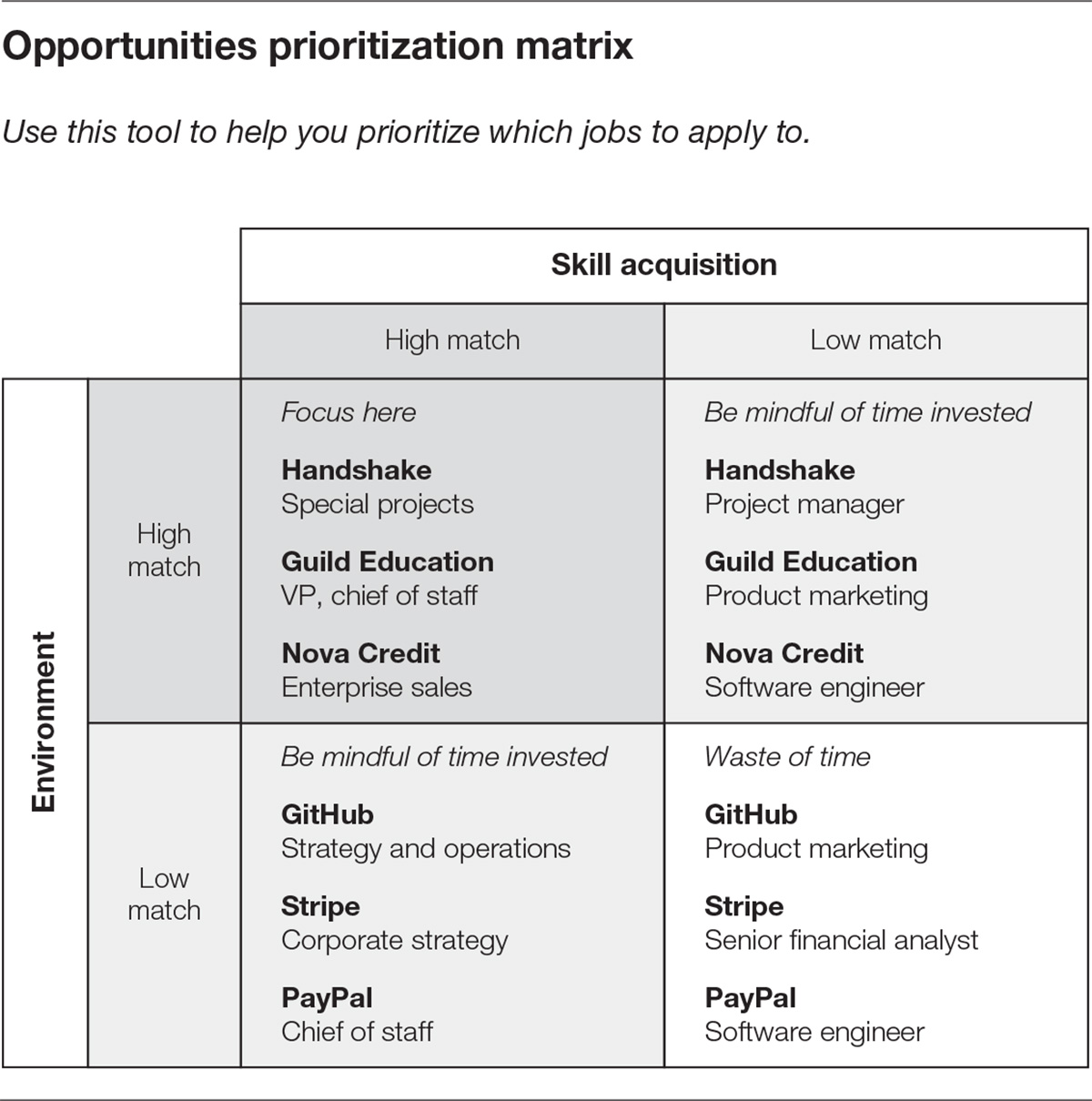
The opportunities prioritization matrix is a loose adaptation of Dwight D. Eisenhower’s prioritization framework. Here’s how to set it up: Look back at the job search prioritization matrix. Which two categories did you rate as the most important to you? Place these on the two axes (see figure 1–2 for an example) and assess your opportunities to see if they rank high or low (meet or do not meet) those priorities.
The matrix has four quadrants showing three levels of priority:
Focus here (one quadrant): Opportunities in this quadrant are your dream jobs. They meet the two most important criteria you have identified, so you should invest the most time pursuing these.
Be mindful of time invested (two quadrants): These roles match one of your most important criteria but not the other. You will want to use discretion in applying to these positions.
Waste of time (one quadrant): Opportunities in this quadrant rank low for both of your most important criteria. They may not even be worth applying to.
If we use our example of a junior consultant interested in moving into the tech industry, we know that this job seeker has an interest in mission-driven companies and has indicated in a job prioritization matrix that maintaining a generalist skill set and working in a dynamic, collaborative environment are the two most important factors for their next job.
Figure 1–2 shows how the junior consultant might fill out the opportunities prioritization matrix if they were considering certain roles at various companies. You can see that job opportunities that offer generalist skills development (for example, strategy, partnerships and sales, operations) and collaborative team environments land in the “Focus here” quadrant. Job opportunities with a specialized skill set (low match for generalist) and less collaborative environment land in the “Waste of time” quadrant. Since social mission is also important to this candidate, mission-driven companies rank high for fit on environment. Similar positions at non-mission-driven companies rank low on fit when it comes to environment.
FIGURE 1–2
All companies and positions have trade-offs, so structuring your matrix in this way allows you to stay laser-focused on the two most important factors as you evaluate opportunities.
For even the most seasoned professionals, the multitude of career paths and job opportunities available can leave you feeling immobilized. By using a structured framework such as this one to focus your efforts, you’ll end up with a more favorable outcome and sidestep becoming an avoider or a gatherer.
Mimi Aboubaker is an entrepreneur and a writer. Most recently, she founded Perfect Strangers, the largest U.S. response initiative to the coronavirus crisis. The organization has delivered 3 million meals across the country in partnership with government agencies such as the City and County of San Francisco, the City of Oakland, and the County of Marin. Prior to Perfect Strangers, she founded an edtech venture and spent time at Goldman Sachs and Morgan Stanley. For more tips on leaning in on career and life, follow her on X/Twitter @Mimi_Aboubaker and check out her website at www.mimiaboubaker.com.
Please Log in to leave a comment.