Build a Circle of Advisers
Author: Mimi Aboubaker

Everyone could benefit from having a circle of advisers—an informal group of people you trust, whose knowledge and perspectives you can call on when working through decisions—to supercharge your professional (and personal) trajectory.
The term mentor is often anchored to this kind of relationship, but I find it limiting. For many, the “shoulds” and “shouldn’ts” attached to mentorship are stressful and can become a deterrent to pursuing much-needed support. Instead, I’d recommend swapping the term for adviser and referring back to your high school days for a more approachable model.
In high school, students are often given the opportunity to develop informal advising or support relationships with a mix of people. You may have had this experience. These relationships typically form organically and can include academic advisers, athletic coaches, family, neighbors or community members, and even peers and near-peers. Together, these people make up a support network.
The professional world is similar. Your circle of advisers includes people with varying specialties. You have different levels of connection with each of them, and your relationships have the potential to strengthen over time. There are, however, a few important distinctions that can make finding advisers in your early career more challenging than it was in your teens:
Your priorities. During your adolescence, classes, college, and fitting in socially were likely top of mind. As a young professional, your priorities have probably shifted to career growth, finding the right job or organization, and fitting in culturally at your firm (for example, interpersonal dynamics, office politics, and so on).
Your level of initiative. For many of us, support networks were built into our high school or college experiences, especially if they included our family members, friends, or instructors. In the professional world, you have to proactively recruit supporters.
Your cadence. Before, you may have had access to members of your support network weekly, or even daily. Once you enter the workforce, you need to be more intentional about when and why you reach out to people.
So how can you find the right advisers for you?
A personal adviser scorecard is a framework I created that you might find useful (see figure 20-1). It outlines the most important factors you should consider when curating your circle of advisers and is meant to improve your understanding of yourself and your needs. Doing so can provide guardrails to the sometimes ambiguous networking process and help you determine which relationships are worth pursuing and deepening.
Personal adviser scorecard
Use the scorecard below to evaluate potential advisers and build a diverse circle of people who will meet your professional and personal needs. You can update each category based on your preferences and goals.
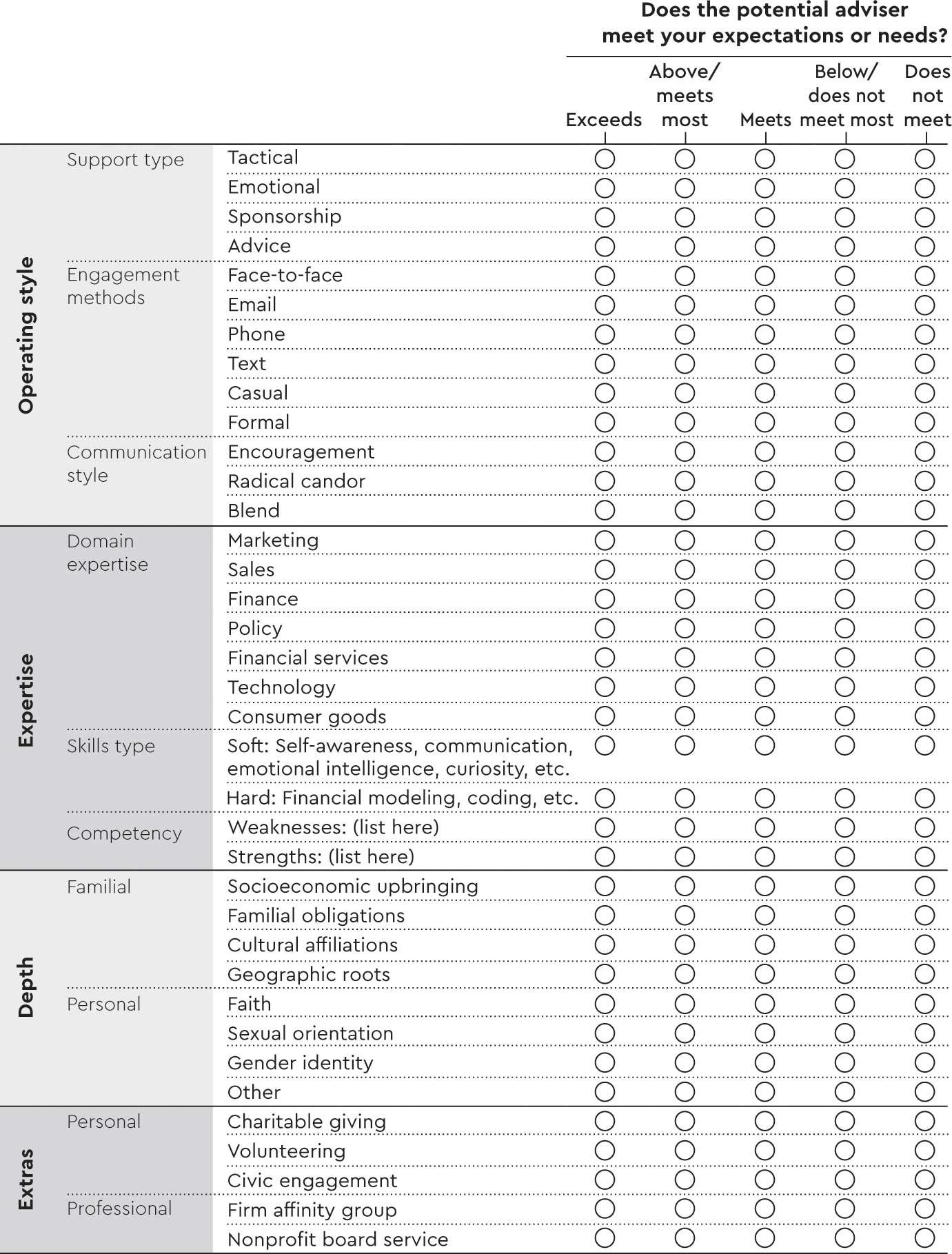
FIGURE 20-1
My scorecard includes four categories, which in my experience capture the most essential attributes you should consider in an adviser. Use the broad categories below as a template when developing your own unique scorecard, and expand or adjust it based on your professional or personal needs:
Operating style: support type, engagement method, and communication style
Expertise: industry, skills, or knowledge
Depth: long-term potential and capacity for deeper conversations
Extras: bonus categories based on your core values, interests, or support needs
Operating Style
Despite our instinct to group people based on jobs or backgrounds, we come in all shapes and sizes. When curating your advisers, it’s important to tune into their differences and how they match up with your preferences and needs, which will likely shift over time.
Operating style is one way to think about this—it can be broken down into three categories:
Support type
This covers the kind of support you need from potential advisers, and how capable they are of giving it to you. Though support comes in many forms, to keep things simple, you can categorize it as “emotional versus tactical” and “advice versus sponsorship.” Our needs usually fall somewhere on the spectrum between the two.
If you’re looking to ease your fears about a job application, for example, you need emotional support. If you’re looking for guidance around how to prepare for a technical job interview, you need tactical support. If you’re looking to be promoted or change industries, you may need a sponsor—someone to advocate for you when you’re not in the room. In all these cases, you need advice (just different kinds). When you’re building out your circle of advisers, consider who would perform best in these different roles to ensure all your bases are covered.
Generally speaking, I’ve found that near-peers are the most willing to offer tactical support, like résumé reviews and mock interview sessions. Midcareer professionals are more qualified to offer specialized advice around their expertise, and senior leaders are best suited to serve as sponsors or provide aid on big-picture career decisions and strategy.
Engagement
This is all about format, formality, and frequency. Does your potential adviser like to chat face-to-face, over email, by phone, or through messaging apps? How soon or far out do they prefer to schedule meetings? Is this person someone you want to share regular updates with, or someone you don’t mind seeing biannually?
It takes time to feel out these preferences, but you don’t need to formally ask people to be your adviser to accelerate the process. These relationships develop much like friendships. Whatever method you use, just be consistent about reaching out and maintaining the relationship. Their responsiveness is an indicator of their commitment.
Communication style
This is about what kind of feedback you find most effective, and whether the preferred communication style of your adviser candidates align with that.
Some people, for example, benefit more from words of encouragement while others prefer tough love. In my experience, it’s best to have a healthy mix of people under this category. When you need a confidence boost, you’ll want to connect with someone who fills you with pride; when you need to hear the unvarnished truth, you’ll want someone who can deliver radical candor. In the case of sponsorship, you’ll want someone who’s willing to guide and be honest about what you need to accomplish in order for them to feel comfortable putting their reputation on the line and advocating for your advancement.
As you shift and grow, bring new people with styles better suited to your current situation into your circle, and negotiate the terms of your existing relationships.
Expertise
Humans are mimetic by nature. We absorb behaviors and knowledge from those we spend time with. That’s why building a circle of advisers who encourage you to stretch yourself is a simple way to accelerate your personal growth and expand your mindset.
Like operating style, expertise is multidimensional and can be broken down into three categories:
Domain expertise
Domain expertise describes someone’s knowledge of a specific or specialized field and typically takes two forms: functional (for example, marketing, sales, finance) or industry (for example, technology, financial services, consumer products).
If you’re still figuring out what career path you want to take, you could benefit from advisers who specialize in your functional area across different industries (for example, financial services, strategic finance at a startup). If you’re looking to grow within a specific industry, a circle of advisers who each specialize in different areas of that industry (or who have different functional expertise within it) may be more beneficial, as you’ll have a wide variety of subject-matter experts to call on as questions or challenges arise.
In either case, taking a holistic approach to building your circle will serve you for years to come.
Skill type
Skills can be bucketed into “hard” and “soft” skills. As an early-career professional, you may be tempted to focus more on advisers who have hard skills that clearly align with your job responsibilities or interests (for example, financial modeling, coding). But underdeveloping your soft skills (for example, self-awareness, communication, emotional intelligence, curiosity) is a risk. As you move further along in your career, and particularly if you’re interested in management, you’ll spend a great portion of your time using those soft skills—which recruiters are finding increasingly desirable.
As you curate your advisers, be on the lookout for people whose talents are more intangible. These softer skills can look like someone who has strong verbal and/or written communication (for example, a good storyteller, analytical writer, structured communicator whose thoughts are easy to follow). These skills could also take the form of strong interpersonal dynamics (for example, facilitating meetings in a way that brings everyone around the table into the conversation, capable of influencing others, magnetic personality).
Competency
Lastly, consider your strengths and development areas and seek out competent people in both categories. Capitalizing on your strengths will benefit you, and people who share them—especially senior colleagues—can teach you how to practice them in useful ways. Communication, for example, is one of my strengths, and being around other people who value clear communication has helped me continue to learn, develop, and take pride in that skill.
In a similar vein, you can address your weaknesses by surrounding yourself with advisers who excel in those areas. A good adviser will teach you how to improve and actively nudge you toward a higher standard. If your company has determined that certain competencies are essential to promotion, developing them is going to be essential to your growth.
Depth
“Bigger is better” is a narrative that most people are conditioned to believe, particularly early in their careers. But when it comes to your advisers, a smaller, highly curated group of people you can develop deep relationships with and who have the capacity to grow alongside you is typically better.
As you advance professionally, your career decisions will become more nuanced and include more personal factors—your partner’s career, family planning, buying a home, your health, and so on. All these things can have a big impact on your choices. When you change industries, careers, or trajectories in general, your network will need to evolve with you. Choosing advisers who are invested in your long-term development will lower their churn rate.
So how do you identify these people? I’d encourage you to consider all the dimensions of your identity and add the elements that are most important to you to your scorecard. The professional world has a tendency to be reductionist when it comes to this topic, throwing people into neat boxes labeled by gender, race, or institutional affiliations. Too often, we overlook the multiplicity of what shapes us and influences how we view the world.
Consider your socioeconomic upbringing, cultural affiliations, faith, sexual orientation, geographic roots, or any other factors that impact your person, and how they fit together to make you unique. Then look for alignments in the people you meet or come across.
It can be helpful to review a potential adviser’s published work, social media posts, or group memberships (on LinkedIn) to get a sense of whether your interests, dispositions, or identities align in meaningful ways. If you see things that resonate, they may be a good fit.
For example, if I were a student interested in technology and engaged with the foster care system, I might reach out to someone like Emi Nietfeld, former Google and Facebook engineer who’s written about her experiences with the foster care system and homelessness, as she could speak more intimately to my experience. Similarly, if I was undocumented, interested in finance, and unsure about navigating the compliance component of hiring, someone like Julissa Arce or Charlis Cueva, who have both navigated those processes with Goldman Sachs, might be people with whom I’d able to form more intimate relationships. (Look these folks up on LinkedIn—you’ll find them.)
The point is to look deeper than surface-level affinities and focus on the things that make people uniquely relatable to you. You can get personal guidance that is tailored to your needs if you make connections with this mindset early on. The more meaningful the relationship, the higher the probability it has of enduring, as emotional resonance is an essential ingredient of strong relationships.
Extras: Bonus Categories
This is a free space to fill as you wish. For example, because living a life of purpose is integral to who I am, my bonus category is purpose (for example, striving for impact beyond building generational wealth or making it the C-suite). Purpose has manifested in different ways in different periods of my life—in middle school, I tutored students at no charge in classes; in the last few years, entrepreneurship has been my chosen vehicle for service, and I have used it to build several mission-driven ventures. I see service as an integrated, lifelong practice and believe that philanthropy is a “give back” accessible at all ages and stages.
Your bonus categories should also be based on your core values, interests, or support needs. Some examples may be managing mental health, neurodivergency, caregiving, or work-life blend. Your values and needs have a strong influence on how you process career and life decisions. Having people in your network who see the world through a similar lens can be a powerful tool when making tough choices and planning ahead.
Finally, Remember …
Just breathe. You’ve been building relationships your whole life. The professional realm isn’t much different from the personal. You’re still making connections—you’re just talking about different topics. Building a cabinet of advisers is worth doing early in your career, as influencing and stakeholder buy-in will become more integral to success as you advance. Scorecards are a good exercise to ensure you are bringing the right people close.
QUICK RECAP
You should build a circle of advisers with varying specialties who can support you throughout your career. There are four key factors to consider when curating your circle.
Operating style. Observe their differences and how they match up with your preferences and needs.
Expertise. They should vary in terms of background, industry, roles, or skill sets to encourage you to stretch, grow, and expand your mindset.
Depth. Your group should be small—full of people you can develop deep relationships with and who have the capacity to grow alongside you.
Extras. Base your bonus categories on your core values, interests, or support needs.
Please Log in to leave a comment.