Dear Manager, You’re Holding Too Many Meetings
Authors: Benjamin Laker, Vijay Pereira, Ashish Malik, and Lebene Soga

Meetings serve different purposes, ranging from informal social gatherings to formal strategy discussions. They often show up on our calendars as recurring events (with no end date in sight). New research shows that about 70% of all meetings keep employees from working and completing all their tasks. While there was a 20% decrease in the average length of meetings during the Covid-19 pandemic, the number of meetings attended by a worker on average rose by 13.5%. Ineffective meetings that waste our time can negatively impact psychological, physical, and mental well-being.
Our recent research found that newly promoted managers may be contributing to the problem. New managers hold almost a third (29%) more meetings than their seasoned counterparts. When we set out to understand the hidden costs of flexible working practices, we discovered that meetings have steadily increased in frequency and duration since companies transitioned to the remote workplace.
There are a couple of reasons this might be the case. Without the ability to connect with their team members in person as often, people newly promoted into management roles may feel extra pressure to build connections digitally. And they may be driven by a desire to be more visible and get buy-in from their teams. It’s also easier than ever to stack our days with back-to-back meetings. When we’re working remotely, we don’t have to travel between private meeting rooms. We can pretty much leave one meeting and log into another a minute later.
What’s the impact? Our research shows that 92% of employees consider meetings costly and unproductive. And countless online interactions can lead to “Zoom fatigue”—a condition neuropsychologists say is a big contributor to “technostress.” In short, more meetings don’t help anyone reach their goals.
To investigate further, and consider the implications for managers, we surveyed 76 companies that reduced the number of meetings over the course of 14 months. We found that although building trust and achieving cohesion rely on the frequency and quality of a team’s interactions, meetings are no longer the best way for managers to accomplish those things. In fact, there are much more effective ways to develop bonds in the absence of face-to-face meetings—including having fewer meetings altogether.
The Benefits of Having Fewer Meetings
Across the 76 companies we surveyed, we found that employee productivity was 71% higher when meetings were reduced by 40%. This is largely because employees felt more empowered and autonomous. Rather than a schedule being the boss, they owned their to-do lists and held themselves accountable, which consequently increased their satisfaction by 52%. (See figure 7-1.)
Impact of fewer meetings
A survey of 76 companies that reduced their meetings over the course of 14 months found that overall employee ratings were positively impacted.
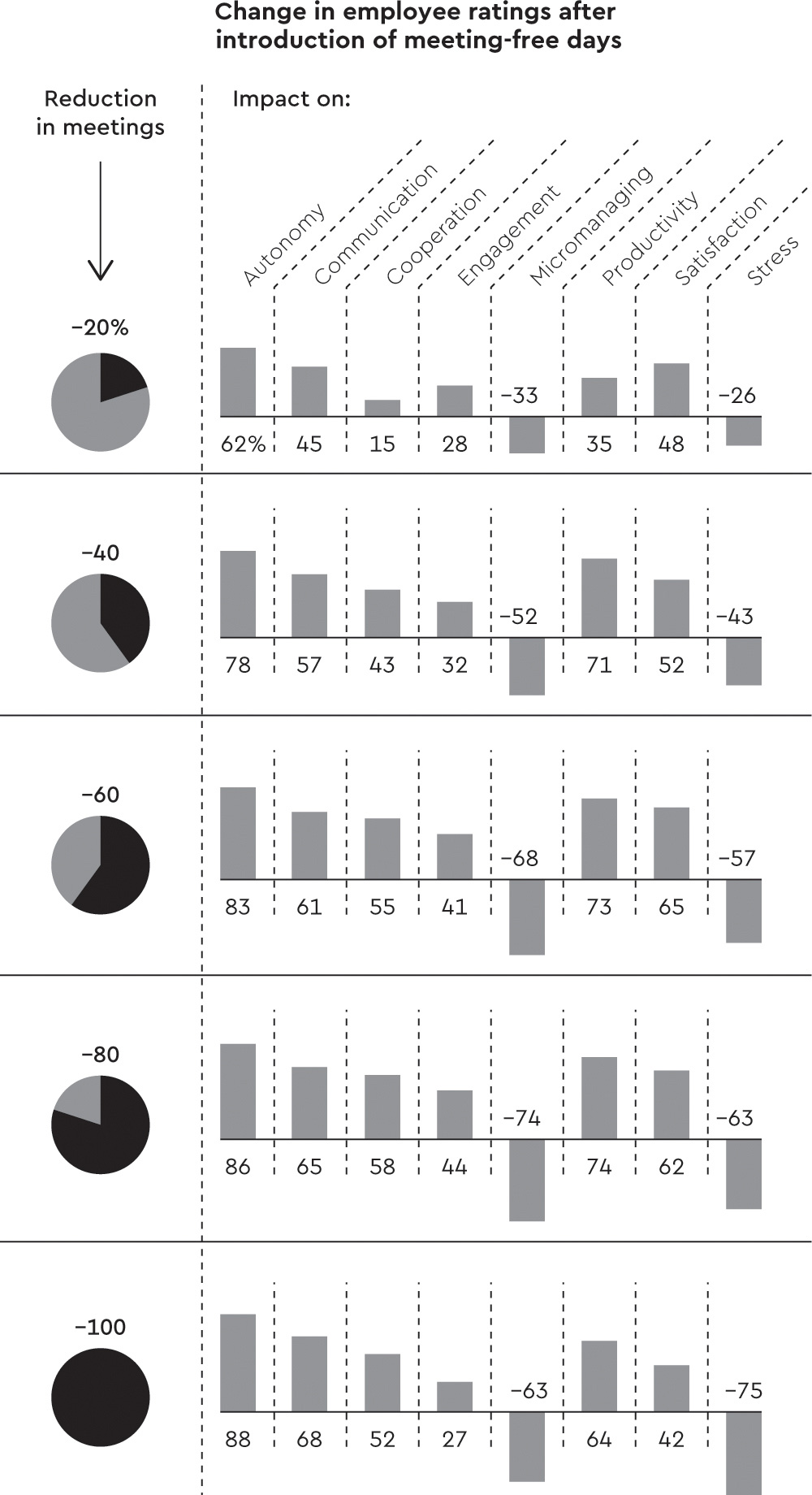
FIGURE 7-1
Removing 60% of meetings increased cooperation by 55%. Workers found better ways to connect one-on-one at a pace suitable for them, often using project management tools, such as Slack or Teams, to aid communications specific to each project. In doing so, the risk of stress decreased by 57%, which improved employees’ overall well-being.
When meetings declined by 80%, we found that employees’ perception that they were being micromanaged lessened by 74%. People felt valued, trusted, and more engaged, subsequently working harder for their company. Communication was 65% clearer and substantially more effective. The reason is that there were far fewer misunderstandings. To review an assignment or request, people would quickly check a previous Slack conversation or a project outline. The often-used phrases “I thought you told me …” or “I was under the impression …” were rarely used.
How to Scale Back Meetings
If you’re a manager trying to establish healthy and impactful team norms, we have some advice to help you rethink your approach. By following our suggestions, nearly half of the companies we investigated reduced meetings by 40% over a three-month period. Thirty-five percent achieved three no-meeting days per week, and 11% achieved four.
Be very selective
Think about the meetings you’ve conducted or participated in recently. Which ones have been the most useful? You’re probably thinking about a new project launch or a brainstorm that required a two-way dialogue in real time. As a general rule of thumb, we recommend holding meetings only when absolutely necessary. That typically includes:
To review work that’s occurred (what worked or didn’t and why)
To clarify and validate something (policies, team goals, and so on)
To distribute work appropriately among your team
Even in those cases, you should carefully edit your invite list. Is everyone really needed? Or can you make the meeting optional for some people? The less important the topic is to their work, the less engaged your team members will be.
Encourage your team to flag or cancel meetings if they aren’t the best use of their time. Make it clear that, as their manager, you encourage it and won’t judge or punish them. Being judicious about which meetings add value and which don’t will help free up people’s calendars. Doing so also forces managers to rethink the informal ad hoc engagements that pepper everybody’s calendars.
Interestingly, we found this strategy garners loyalty toward managers. Granting autonomy allows people to job craft, which previous studies show helps them find meaning in their work.
Transition your daily status meetings to Slack or Teams
Daily huddles are the most frequently held meetings, and often, they are the most difficult to give up. As a new manager, you may feel that it’s important for your team members to be aware of one another’s work in order to reach your goals as a group. These meetings may seem like the best time to do this.
We have another suggestion: Set up a Slack or Teams channel specifically for this purpose. Every weekday, schedule a message to go out at 9:00 a.m.: “@here What’s on your plate today?”
Ask your team members to respond within the hour, explaining what they’re working on, any important project updates, setbacks, and so on. Managers (and your team members) can then scan the responses and follow up privately on updates that may need more context.
Our research found that 83% of employees preferred using these chat touch points over traditional one-to-one meetings because it saved them time. If your team members have a question, they can drop you a message instead of having to find a 30-minute block on your calendar.
Make the Most of Your One-on-One Meetings
by Steven G. Rogelberg
The best managers recognize that one-on-ones, or regular meetings with your direct reports, are not an add-on to their role—they are foundational to it. Those who fully embrace these meetings as the place where leadership happens can make their teams’ day-to-day output better and more efficient, build trust and psychological safety, and improve employees’ experiences, motivation, and engagement.
But how can you prepare for and facilitate effective one-on-ones?
Create an Agenda Before the Meeting
Both direct reports and managers should contribute to the agenda of a one-on-one so that both your priorities, and your employee’s concerns, can be addressed. Collaborating on an agenda can be as simple as having each party create a list of topics to discuss.
Alternatively, some managers create the agenda from broad questions, such as: What would you like to talk about today? How are things going with you and your team? What are your current priorities, and are there any problems or concerns you would like to talk through? Is there anything I can help you with or anywhere I can better support you? What do I need to know about or understand from your perspective?
But don’t focus too much on immediate tactical issues and fires to be put out. Periodically weave in longer-horizon topics such as career planning and developmental opportunities—by either taking five or 10 minutes at every meeting to discuss those areas or dedicating one out of every three or four meetings to addressing them.
Listen More Than You Talk
Once you’ve prepared for a meeting, a fruitful discussion will depend on your ability to create a setting in which your employee feels comfortable. A valuable one-on-one addresses both the practical needs and the personal needs—to feel respected, heard, valued, trusted, and included—of the employee.
Make sure to actively listen as your direct report speaks. Display genuine interest without judgment and acknowledge the employee’s viewpoint even if you disagree with it. Ask questions that clarify and constructively challenge that viewpoint. Encourage your team member to provide thoughts on the matters at hand and potential solutions to problems. Stay vigilant about your body language and reactions to ensure that you’re creating a welcoming and safe space.
Improve Your Meetings Over Time
Ideally, both parties should leave the conversation feeling valued, respected, and well-informed, with clarity about next steps on projects, solutions to problems, and the commitments that each of them has made. However, the most important metric for success is whether your employee found the meeting both valuable tactically and fulfilling personally.
To learn where you stand and to improve these meetings over time, start by asking your team members for feedback and ideas to make future one-on-ones better. Or you can anonymously survey your team with three basic questions: What’s going well with the one-on-ones? What’s not going well? Do you have ideas for improving them?
Excerpted from the article “Make the Most of Your One-on-One Meetings”.
Use digital tools for asynchronous work
The next time you have a brainstorming meeting, ask, Can some of this be done asynchronously? The answer is probably yes.
For example, tools like Mural and Google Forms can be used to get people to submit their ideas in advance. Then you can schedule a follow-up meeting to review them together, likely cutting your meeting time in half. Eighty-three percent of employees in our survey preferred this approach over traditional methods, claiming it helps them contribute on their own time and further refine ideas in person.
Additionally, meeting-dependent activities like checking in on the progress of projects can be tracked asynchronously on a dashboard in a way that is transparent to everyone. This approach, we found, can help prune calendars, leaving more space for valuable “no meeting” time and focused work.
Whereas our data highlights the importance of holding fewer meetings, we want to emphasize that managers need to understand what works for their unique contexts to maximize the full benefits of these strategies. For example, we found that the advantages of no-meeting periods begin to plateau after reducing meetings by 60% and actually wane beyond that. Satisfaction, productivity, engagement, and cooperation all decline when meetings are reduced completely, instead of retaining at least one day for meetings. We posit that when two days per week are retained for meetings, it can prove beneficial.
Even so, with the traditional meetings yielding little return on time investment, the opportunity cost is too high not to act now. Your teams are full of talented and capable people doing what they do best, but they need space to do so. By better understanding how they want to work together, how meetings fit into that, and where meetings do and don’t add value, you’ll minimize the need for useless meetings.
QUICK RECAP
If you’re a manager trying to establish healthy and impactful team norms, start by rethinking your approach to meetings.
Be selective when scheduling meetings. Don’t schedule one unless you need to review work that’s occurred, clarify something significant, or distribute work.
Transition your daily status meetings to Slack or Teams. Use chat touch points instead of traditional one-to-one meetings to save time.
Use digital tools for asynchronous work. Allow team members to contribute to discussions on their own time by using online tools like Mural and Google Forms. Then, further refine ideas in person.
Please Log in to leave a comment.