Do You Tell Your Employees You Appreciate Them?
Authors: Jack Zenger and Joseph Folkman

THE RESEARCH IS CLEAR: Employee recognition—when done well—has huge payoffs. According to the data we collect on leaders across industries, every measure of morale, productivity, performance, customer satisfaction, and employee retention soars when managers regularly provide recognition.
And yet many leaders fail to do it frequently or skillfully. In fact, the most common complaint we hear about managers is that they neglect to convey appreciation. One survey, conducted at a health care company, found that 29% of employees reported not having received any recognition within the past year.
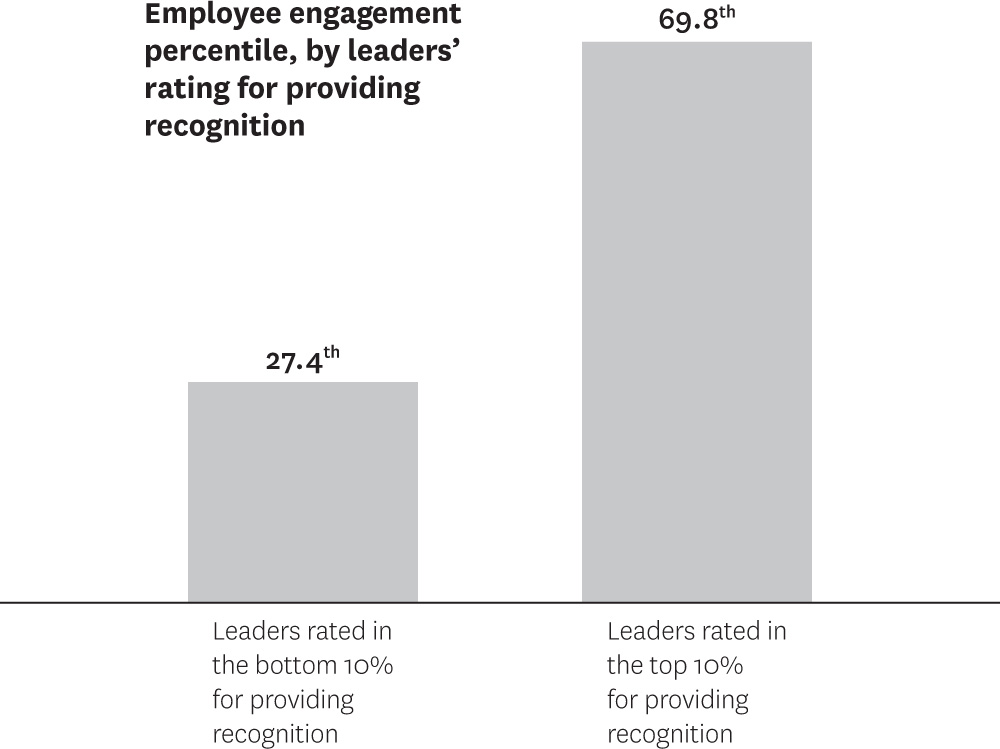
The section (“The connection between recognition and enagement”) is an analysis of a subsection of the tens of thousands of 360-degree assessments we’ve collected. The data shows the impact of giving recognition on levels of employee engagement. Leaders who rated in the bottom 10% for providing recognition had employees at the 27th percentile on engagement. By contrast, those leaders who rated in the top 10% had employee engagement at the 69th percentile.
The connection between recognition and engagement
The better a leader is at giving recognition, the more engaged their employees are.
Source: Zenger Folkman.
The leaders in the top group also had employees who:
Were much more confident that they would be treated fairly
Felt they were kept better informed
Showed significantly higher levels of discretionary effort
Were much less likely to quit
Idea in Brief
- The Problem
Recognizing employees for the good work they do is a critical leadership skill—and has an impact on morale, productivity, performance, retention, and even customer satisfaction. Yet, there are a frightening number of leaders who fail to do it frequently or skillfully.
- The Data
There’s a strong connection between employee recognition and engagement. Managers who are rated in the top 10% for giving recognition are much more likely to have employees who report feeling engaged, confident they’ll be treated fairly, and willing to put in higher levels of discretionary effort.
- The Solution
Getting better at giving recognition requires focusing on two things: The substance of the recognition itself and the manner and context in which you deliver it.
Does Everyone Want to Be Recognized?
When we asked a global sample of more than 12,000 people their preference for giving and receiving recognition, 33% indicated that they dislike receiving recognition. We contend that this is most often a semantic problem. Had we asked, “Do you like to be appreciated for your accomplishments?” we suspect nearly all respondents would have said yes. Almost everyone values “appreciation,” which implies a more quiet, personal expression, without fanfare and hoopla.
For many people, “recognition” means being called out in a meeting and given public praise for something they’ve accomplished. It conjures images of spotlights glaring on them, and they might find all that attention embarrassing. Whether because of their personality or perhaps cultural upbringing, being publicly singled out is uncomfortable for many people. In other words, they resist the way that the recognition is delivered, not the underlying message of appreciation.
What We Know About Leaders Who Are Inclined to Give Recognition
We conducted a different analysis of 658 leaders using the data we had on their preferences for giving and receiving recognition. Of those, 513 managers had a strong desire to give recognition, while 145 resisted giving it. We compared that data to the 360-degree-feedback ratings we had for those leaders from their manager, peers, direct reports, and others and found that those who were more inclined to give recognition were also perceived as being better at:
Collaboration and teamwork
Being open to feedback from others
Building relationships
Inspiring and motivating
Tips for Giving Better Recognition
Getting better at giving recognition requires focusing on both the substance of the recognition itself and the manner and context in which you deliver it.
Improve the substance
Appreciation that is specific is far more powerful than a general “good job” comment. Describe a specific event or action and the impact it had on you, the team, the organization, or your customers. This drives home the importance of what the person has done.
While feedback from peers is appreciated, for most people, recognition from their immediate manager is most meaningful.
Recognizing outcomes is valuable, but it’s also important to recognize the actions that led to the positive outcome. Some outcomes are out of the person’s control, but their tenacity, hard work, and creativity are things they can control. Those deserve recognition as well.
Improve the delivery
Many people feel embarrassed by being singled out publicly. Respect those who prefer their recognition to be in private and more personal.
People appreciate notes and cards, and we’ve heard stories of people saving such mementos for decades.
Timely recognition is important. The sooner you give the recognition after the behavior, the higher the perceived value.
Increasing the frequency of recognition will give you more chances to practice and improve this skill while also making it more comfortable for the receiver, who becomes accustomed to hearing your appreciation.
Set a Goal to Recognize Others More Often
Can a leader give too much recognition? We know it may be possible, but we have not seen it happen. It is often helpful at the end of each day to ask yourself: “Who went above or beyond today? Who did more than was expected? Who made a helpful contribution?” Then, when names come to mind—don’t hesitate to give the recognition in a way that is most meaningful to them.
We all have heard about the importance of recognition, and yet many leaders are not doing it enough. While the data from our research isn’t necessarily groundbreaking, we hope it’s an important reminder to tell people—those who report to you but also your peers, and yes, even your boss—what they need to hear, not just what you want to say.
Please Log in to leave a comment.