Get the Feedback You Need to Grow by Kim Scott
Authors: Kim Scott, Liz Fosslien, and Mollie West Duffy

Knowing how and when to ask for feedback is a learned skill—as is checking your (normal) defensive reaction in the face of helpful criticism. To be able to adapt to changing conditions and ensure that your team continues to feel supported and motivated, you need to understand what you’re doing well—and where you’re falling short. Soliciting clear, actionable feedback allows you to make better, more informed decisions and pivot when necessary.
Asking for feedback also creates a culture of trust and transparency. In an era of uncertainty, already overwhelmed teams are being asked to do more with less. When employees feel like their input matters, they’re more likely to remain loyal, engaged, and productive. They’re also much more willing to surface valuable concerns and suggestions. Based on our books and research, we put our heads together to outline the specific steps you should take to ask for feedback. The first thing to do is to ask for criticism, especially if you’re the boss. This is awkward at best and can be a difficult emotional journey, so here are five tips for how to successfully solicit Radical Candor from your employees.
FIGURE 1
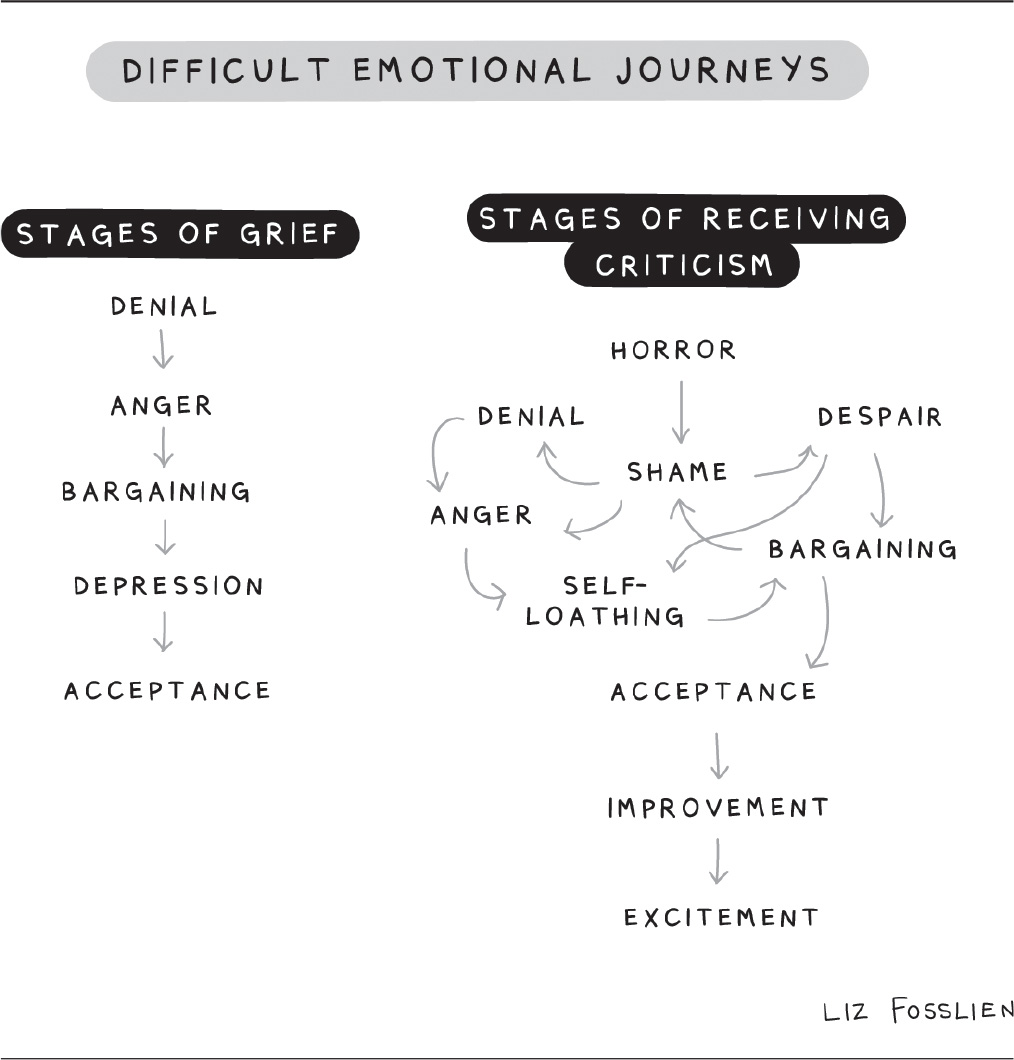
1. Embrace feeling “negative” emotions—often
Hearing what you need to improve rarely feels good. Ask yourself: How many times each week do the people you work with tell you things that make you anxious, upset, or even defensive? How often do they tell you things that make you feel wonderful? If it’s all feel-good praise and no hard-to-hear criticism, beware! You’re not getting the real story. You need to work harder to get them to criticize you.
Remember, when it comes to soliciting Radical Candor, good news is no news, no news is bad news, and bad news is good news. As one of Liz’s former managers told her, “Someone who cares about you tells you that you have food on your face. Everyone else will stay mum because they don’t want to feel uncomfortable.” Even though criticism is hard to hear in the moment, you need it to get better over time—and in time, it will sting less, too.
FIGURE 2

2. Have a go-to question
It can be awkward to ask people point blank about what’s going on. And when things are uncertain, it can feel risky to them to say what they actually think. We recommend that you come up with a go-to question that establishes psychological safety. There are three elements to a good go-to question:
The question cannot be answered with a “yes” or a “no,” or an “Oh, no, everything is fine”—which is exactly the answer you’ll get most of the time if you ask, “Do you have any feedback for me?” Liz and Mollie love, “What one thing can I do to support you?” By asking for “one thing,” you make it much more likely that you’ll get a specific, actionable response.
Your question must sound like you—something you would naturally say. The question Kim likes to use is, “What could I do or stop doing that would make it easier to work with me?” However, if those words don’t fall easily off your tongue, find words that do.
Your question must be adapted for the person you’re talking to. Jason Rosoff, who cofounded Radical Candor with Kim, told her he hates her go-to question, so she needs to ask him a more specific one.
Consider making your go-to question a recurring part of your 1:1 agendas. If your team knows what you’ll be asking ahead of time, they’ll have more time to prepare a useful answer.
3. Embrace the other person’s discomfort
No matter how good your go-to question is, the other person is likely to feel uncomfortable. And you’re likely to feel uncomfortable because they’re uncomfortable. It can be tempting to let the person off the hook at this point. But if you do that, you’ll never get the feedback you need to succeed.
The only way out of this discomfort is through. Try asking your question and then remaining silent. Count to six, slowly, in your head. Very few people can endure six full seconds of silence. They’ll tell you something.
4. Listen to understand, not to respond
When listening to feedback, your motivation matters. You should want to understand what the other person is telling you, rather than listening so that you can deliver a response. It’s the difference between, “I hear what you are saying, thank you” (great) and “I hear what you are saying, but . . .” (not so great).
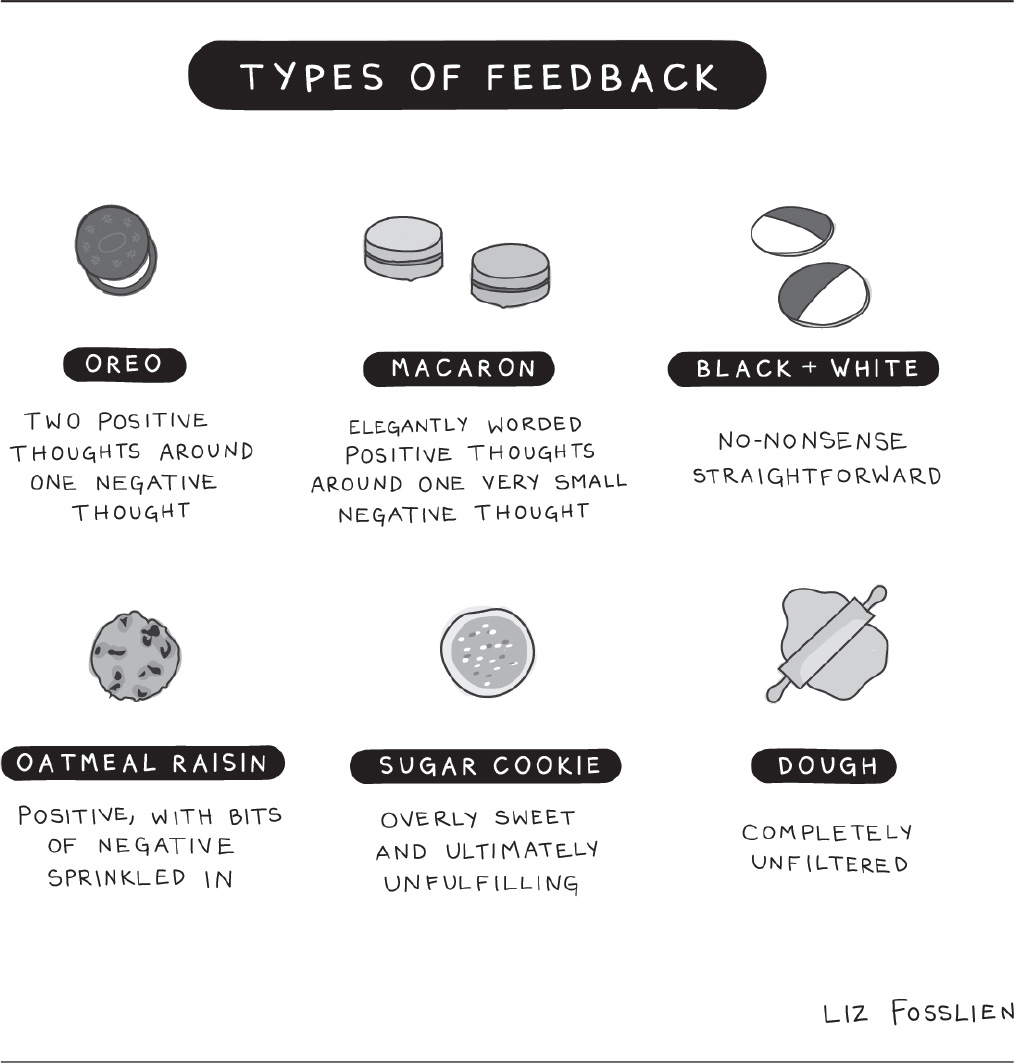
Feedback opens us up to seeing our behaviors from different points of view. If we’re focused on defending ourselves, we lose out on the opportunity to learn and improve. A helpful hint about listening to understand: Look for the criticism. Often people will hide the criticism. Sometimes you’ll get “oreo” feedback: two positive thoughts around a negative one. Make sure you don’t miss the criticism. Other times the feedback will be more like an oatmeal raisin cookie. Don’t miss the raisins!
FIGURE 3
5. Close the loop: make your listening tangible
The best way to ensure you’ll continue receiving feedback is to follow up and share the actions you’ve taken based on what you heard.
When you receive critical comments, it’s useful to immediately outline what you’ll do with the suggestions or concerns that were flagged. Try, “Here’s what I’ll do moving forward.” And remember: You don’t need to promise to make massive changes (you might not be able to deliver on those promises). You can say something like, “My next step will be to talk to other leaders to see what’s possible.”
Take Netflix CEO Reed Hastings, who gets an annual 360-degree written assessment that any employee can contribute to. Hastings closed the loop on his 2019 360 by writing a memo to all Netflix employees. Here’s an excerpt from his book No Rules Rules:
I find the best comments for my growth are unfortunately the most painful. So, in the spirit of 360, thank you for bravely and honestly pointing out to me: “In meetings you can skip over topics or rush through them when you feel impatient or determine a particular topic on the agenda is no longer worth the time . . . On a similar note, watch out for letting your point-of-view overwhelm. You can short-change the debate by signaling alignment when it doesn’t exist.” So true, so sad, and so frustrating that I still do this. I will keep working on it.
Once you’ve taken action, make sure you share the changes you’ve made. Ask if you overcorrected or under-corrected. Helpful hint: If the problem is something you’ve struggled with for some time, it’s usually a good idea to try to overcorrect. If you get feedback that you move too fast, work on slowing down until someone tells you you’re moving too slowly.
And if you weren’t able to do anything differently, communicate why. When an employee told Kim she interrupted him and other employees in meetings, she wore a rubber band to her next staff meeting, told everyone about the feedback, and asked for help in changing this deeply ingrained bad habit that she couldn’t realistically change overnight. She asked people to snap the rubber band on her wrist when they noticed her interrupting. (She knew that the people on her team would actually do that, and with a laugh—you might decide to take a different approach.) The rubber band helped her interrupt less. But more importantly, it made her listening tangible—and demonstrated that although she couldn’t change things overnight, she was working on it.
One of the biggest missteps we see people take is staying silent when, after careful consideration, they realize they’re unable to act on feedback. When employees and colleagues never hear back after giving feedback, they’ll assume that their suggestions were ignored. It’s much, much better to come back to people and say something like, “Unfortunately, due to the executive team’s priorities for the quarter, we won’t be able to do ______, but I’m going to keep it in mind,” than to say nothing at all.
It’s easier to avoid difficult feedback. A culture of ruinous empathy or false harmony is not the path to success! Inviting criticism helps you learn how to grow and change and creates a culture of trust and stability for your team—and success for your organization.
KIM SCOTT is the author of the New York Times and Wall Street Journal bestsellers Radical Candor and Just Work and cofounder of the company Radical Candor. Kim was a CEO coach at Dropbox, Qualtrics, Twitter, and other tech companies. She was a member of the faculty at Apple University and before that led AdSense, YouTube, and DoubleClick teams at Google. Before that Kim managed a pediatric clinic in Kosovo and started a diamond-cutting factory in Moscow. She lives with her family in Silicon Valley. LIZ FOSSLIEN is the coauthor and illustrator of the Wall Street Journal bestseller No Hard Feelings: The Secret Power of Embracing Emotion at Work and Big Feelings: How to Be Okay When Things Are Not Okay. She is on the leadership team of Atlassian’s Team Anywhere, where she helps distributed teams advance how they collaborate. Liz regularly leads workshops for leaders; her clients include Google, Paramount, and the U.S. Air Force. Liz’s writing and work have been featured by TED, The Economist, “Good Morning America,” the New York Times, and NPR. MOLLIE WEST DUFFY is the coauthor of the Wall Street Journal bestseller No Hard Feelings: The Secret Power of Embracing Emotion at Work and Big Feelings: How to Be Okay When Things Are Not Okay. She is the head of learning and development at Lattice and was an organizational design lead at global innovation firm IDEO. She has worked with companies of all sizes on organizational development, leadership development, and workplace culture.
Please Log in to leave a comment.