How Bullying Manifests at Work
Authors: Ludmila N. Praslova, Ron Carucci, and Caroline Stokes

An estimated 48.6 million Americans, or about 30% of the workforce, are bullied at work. In India, that percentage is reported to be as high as 46% or even 55%. In Germany, it’s a lower but nonnegligible 17%. Yet bullying often receives little attention or effective action.
To maximize workplace health and well-being, it’s critical to create workplaces where all employees—regardless of their position—are safe. Systemic, organizational-level approaches can help prevent the harms associated with different types of bullying. Here, we’ll discuss the different types of bullying, the myths that prevent leaders from addressing it, and how organizations can effectively intervene and create a safer workplace.
The Different Types of Bullying
We’ve identified 15 features of bullying, based on standard typologies of aggression, data from the Workplace Bullying Institute, and more than 25 years of research and practice by one of us (Ludmila) focused on addressing workplace aggression, discrimination, and incivility to create healthy organizational cultures. Table 17-1 lists each one along with some sample behaviors and outcomes.
TABLE 17-1
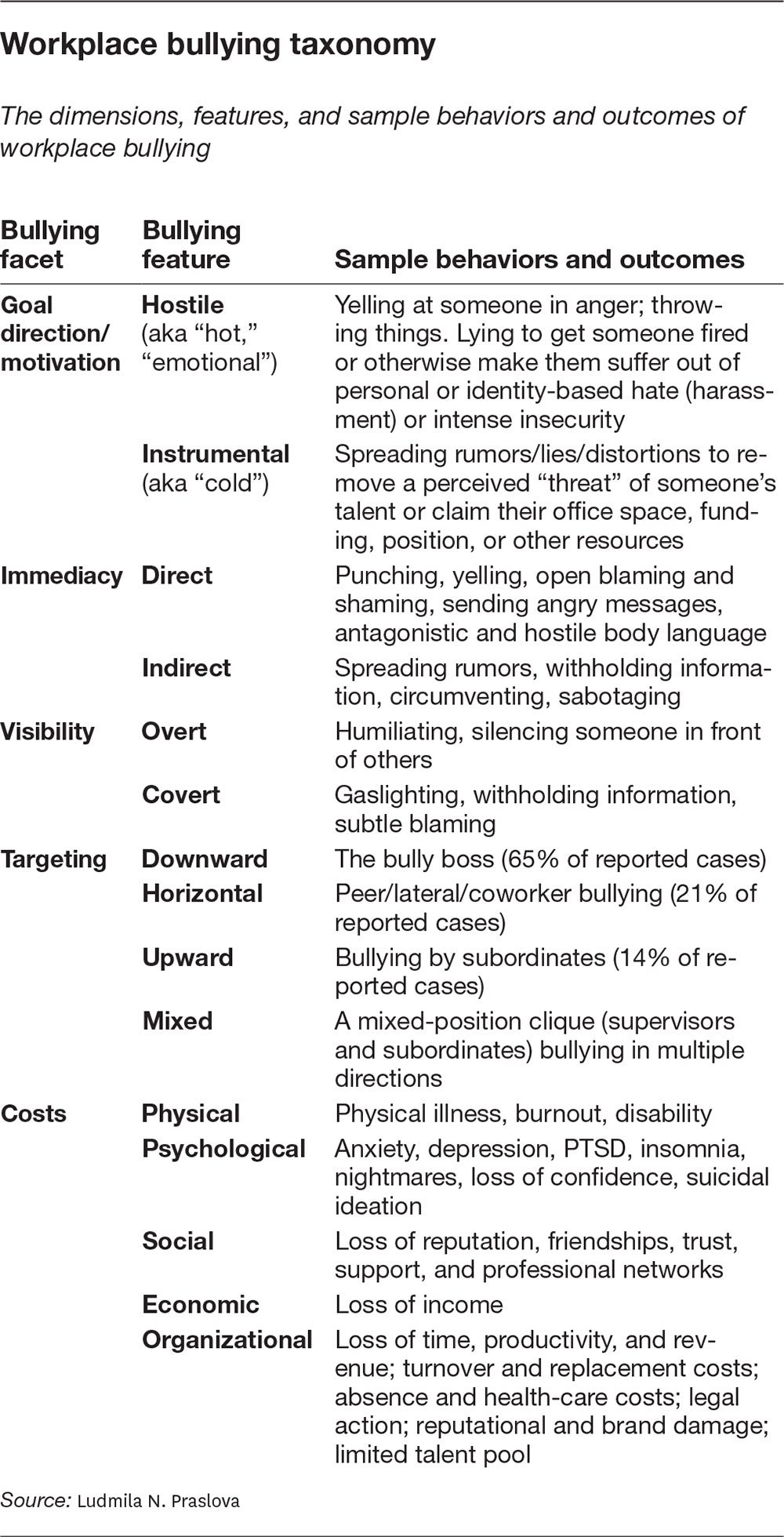
These 15 features can be mapped to some of the common archetypes of bullies. Take the “Screamer,” who is associated with yelling and fist-banging, or the quieter but equally dangerous “Schemer,” who uses Machiavellian plotting, gaslighting, and smear campaigns to strip others of resources or push them out. The Schemer doesn’t necessarily have a position of legitimate power and can present as a smiling and eager-to-help colleague or even an innocent-looking intern. While hostile motivation and overt tactics align with the Screamer archetype, and indirect bullying is typical of the Schemer, a bully can have multiple motives and use multiple tactics—consciously or unconsciously.
Caroline mediated a situation that illustrates both conscious and unconscious dynamics. At the reception to celebrate the national-level achievement award of an employee named Ewa, her coworker Harper spent most of the time talking about her own accomplishments, then took the stage to congratulate herself on mentoring Ewa and letting her take “ownership” of their collective work. But there had been no mentorship or collective work. After overtly and directly putting Ewa down and (perhaps unconsciously) attempting to elevate herself, Harper didn’t stop. She “accidentally” removed Ewa from crucial information distribution lists—an act of indirect, covert sabotage.
Workplace Bullying Myths
The usual myths about bullying—for example, that it’s simply “holding people to high standards” or having a “competitive personality”—suggest that it does not harm and may even spur performance. However, bullying and the myths about it hinder outcomes.
A common assumption is that bullies are often star performers and that high performance justifies bad behavior. However, actual star performers are more likely to be targets of bullying than bullies themselves. Bullies are usually mediocre performers who may appear to be stars but in fact often take credit for the work of others. Moreover, bullies are not motivated by organizational goals. They’re driven by self-interest, often at the expense of organizations. Research indicates that bullies often envy and covertly victimize organization-focused high performers—those who are particularly capable, caring, and conscientious.
The “motivation” myth justifies bullying as helping to “manage” or “motivate” low-performing individuals toward improvement. Indeed, low performers are more likely to experience bullying than mediocre ones—but it does not help them improve. Rather, it can further hinder performance, creativity, collaboration, and delivering on business goals due to employee distress.
Ineffective Interventions
Research has thoroughly documented that bullying is detrimental to individuals’ productivity and organizational outcomes. Unfortunately, even when organizations attempt to address it, the interventions are rarely effective.
Traditional methods of addressing bullying tend to be unsuccessful for several key reasons:
The reactive approach addresses bullying after individual and organizational harm has already occurred. However, the first line of defense against all workplace stressors should be prevention. Preventing harm from occurring in the first place helps avoid both individual and organizational costs of bullying.
Placing the burden of proof and antibullying work on the target ignores the fact that bullying is trauma, and that for most people, documenting their own trauma while it is happening while maintaining productivity is an impossible demand. In Ludmila’s neurodiversity work, some of the most difficult situations are when bullying targets are told to “just fix it/figure it out” with the bully. The process is disproportionately taxing for those who are already disadvantaged and have fewer coping resources (such as autistic employees, who are bullied more often than others; those with extensive history of trauma or depression; as well as those who are economically disadvantaged). Targets are likely to leave because they don’t have the resources to fight through the painful process of documenting and reporting with little hope for a just outcome, while bullies move on to new targets.
Individual-level focus attempts to address bullying via “fixing” personality characteristics of targets and bullies via assertiveness training or self-control training/anger management, respectively. Not only does this ignore the stability of personality characteristics, but it also largely ignores the notoriously hard-to-address characteristics involved in various forms of bullying, such as the sense of egotistic entitlement or fragile ego.
A focus on overt and hostile bullying does nothing to address covert and instrumental bullying.
A Systemic Approach to Creating a Safer Workplace
W. Edwards Deming famously wrote that 94% of issues in the workplace are systemic and only 6% are attributable to individual-level, idiosyncratic factors. Effectively addressing all types and manifestations of bullying requires a systemic and prevention-focused approach.
While bully characteristics matter, bullying is a behavior of opportunity enabled by organizational environments that allow it to occur and continue. Organizations can’t eliminate egotism from human nature, but it is possible to create systems in which egotistical behavior is discouraged rather than reinforced.
Effective organizational systems of bullying prevention do not need to be designed from scratch. The mechanisms that support productivity via asynchronous work and that facilitate inclusive and psychologically healthy organizations do double duty in preventing bullying. Effective antibullying mechanisms are rooted in organizational justice, transparency, a focus on outcomes, and the use of valid instruments in decision-making. They are supported by tools that facilitate inclusive, flexible work; voice; and participation.
Addressing hostile bullying—stopping the Screamer
Some degree of prevention of hostile or emotional bullying can be achieved on the individual level, with selection and training. Organizations legally can and must screen out people based on negative characteristics demonstrably related to poor performance, such as arrogance in leadership.
Training employees in nonviolent communication is another important tool. For example, communication regarding suboptimal work can be violent or bullying: “You call this a report? This garbage is insulting. You don’t know how to write.” The same point phrased nonviolently is: “I am disappointed that I cannot forward or use this draft of the report. I need clarity. Please arrange the numerical data in tables and write four or five clear bullet-point takeaways.”
Systemically, hostility is typically triggered by resource scarcity and overall stress. Reducing the stress of unrealistic deadlines, chronic underresourcing resulting in workplace “hunger games,” management by fear, and moral compromises can help decrease hostile bullying.
Addressing instrumental bullying—stopping the Schemer
To prevent instrumental, indirect, and covert bullying, organizations should ensure transparent, fair, equitable, and legitimate ways to obtain rewards. Promotions, resource allocation, and other crucial decisions should be made based on transparent and accurately measured performance outcomes. “Eyeballing” performance leads to bragging, credit-taking, and possessing external markers of privilege.
Moreover, ensuring justice in organizational decision-making requires a mechanism for correcting high-stakes decisions when necessary (such as if the information they were based on was incomplete or false). For example, an independent group (for example, a committee of ombudspeople) could verify the evidence supporting demotions or progressive discipline. Specific mechanisms differ based on the type of organization (state, private, unionized, and so on) and employment, often taking the form of grievance committees serving a specific type of employee (for example, classified or unclassified, salaried or hourly). In any case, grievance and check-and-balance mechanisms may help disincentivize the reliance on instrumental bullying to get ahead.
Asynchronous work tools like task boards and shared documents may also help prevent instrumental bullying in the form of credit-taking or unfair evaluations. Beyond their purpose as productivity tools, they serve an additional function of documenting performance and contributions.
Valid and well-designed recruitment, selection, and talent-management mechanisms that focus on demonstrated skills, results, and the ability to support others (rather than the ability to talk oneself up) also play a significant role in establishing a positive organizational climate. These can help prevent the hiring and promotion of takers and overconfident but incompetent individuals by identifying early signals of someone’s potential bullying behavior. For example, asking candidates to describe their experiences of failure or of enabling others to succeed will reveal degrees of humility, self-awareness, and orientation toward others.
Preventing downward bullying
To prevent downward bullying, where the bully targets someone more junior to them, HR and upper management must pay close attention to subtle signals. While 360-degree evaluations and climate surveys are helpful and must be read carefully, sometimes the most valuable information is between the lines. Someone who is bullied or threatened may fear that sharing their reality—even on an anonymous survey—may jeopardize their employment or incur repercussions from their superior. Multiple employees providing nonanswers like “I really have no ideas to share here,” “I’m not in a qualified position to respond to this,” “I think I responded to that earlier,” or “I know this person is under a great deal of pressure to get the job done—they have a very hard job to do” is a red flag. Leadership development focused on creating psychological safety might be in order.
Further organizational weak-spot assessment can involve analyzing climate surveys to reveal greater context or underlying issues by team or department. Using both 360-degree evaluations and culture assessments enables Caroline to work closely with clients to identify and design successful leadership interventions or purpose-oriented reinvention strategies to remedy bullying that can derail engagement, retention, and growth.
Preventing upward bullying
To prevent upward bullying, where the bully targets someone more senior to them, organizations need cultures of transparency with clear role and behavioral expectations. At onboarding, employees must understand their responsibility for contributing to positive environments. Training for new managers must include dealing with multiple interpersonal scenarios, including upward bullying. For example, leaders who struggle to confront poor performance or aggressive behavior may inadvertently empower those who upward-bully them. Ensuring that leaders have the confidence and skill to address disrespectful, manipulative, or aggressive behavior head-on helps to curtail it early. Role-playing such scenarios can help develop the necessary confidence, skills, and mental scripts. In addition, grievance and complaints systems must support supervisors as well as nonsupervisory employees.
Preventing horizontal and mixed-direction bullying
To prevent horizontal and mixed-direction bullying, where an individual bullies a peer or a group bullies in multiple directions, organizations should avoid creating environments of unhealthy internal competition. One key way to do that is avoiding rank-and-yank performance evaluation, which encourages cutthroat behavior.
Be sure to distribute resources in fair and transparent ways and balance team-level and individual rewards. Also, ensure that cross-functional partnerships are grounded in shared metrics to incentivize collaboration. In addition, develop mechanisms to constructively air and address the natural tensions that exist at organizational seams. For example, regularly convene—in psychologically safe environments—those who must collaborate to reach shared results. Finally, discourage drama triangles and manipulation by ensuring transparency and setting an example.
All relationships have the potential to go wrong. Even experienced managers may lack an understanding of the cultural or psychological nuance involved in specific situations. Ideally, in organizations aiming to maximize psychological well-being, managers and employees will be supported by professionals trained in developing and maintaining psychological, relational, and workplace health who can serve as neutral parties.
Addressing bullying is not easy, but doing so systemically supports well-being and belonging and may prevent organizational demise. Ignoring or placating bullies results in losing conscientious performers. Over time, those organizations will be poisoned by a critical mass of toxic individuals and a snake-pit culture.
Ludmila N. Praslova, PhD, SHRM-SCP, helps organizations create cultures of well-being. She is a professor of psychology and business and an accreditation liaison officer at Vanguard University of Southern California, and the author of the forthcoming book The Canary Code: A Guide to Neurodiversity and Intersectional Belonging in the Workplace. Ron Carucci is cofounder and managing partner at Navalent, working with CEOs and executives pursuing transformational change. He is the bestselling author of eight books, including To Be Honest and Rising to Power. Connect with him on LinkedIn and download his free “How Honest is My Team?” assessment at www.tobehonest.net. Caroline Stokes specializes in business sustainability, people strategy, and executive leadership development. Connect with her on LinkedIn and use her Workplace EQ tool (visit https://workplaceeq.typeform.com/carolinestokes) to design a sustainable organization to tackle societal, economic, and environmental change. She is the author of Elephants Before Unicorns: Emotionally Intelligent HR Strategies to Save Your Company.
Please Log in to leave a comment.