How Early-Adopter Companies Are Thinking About Apple Vision Pro
Author: Cathy Hackl
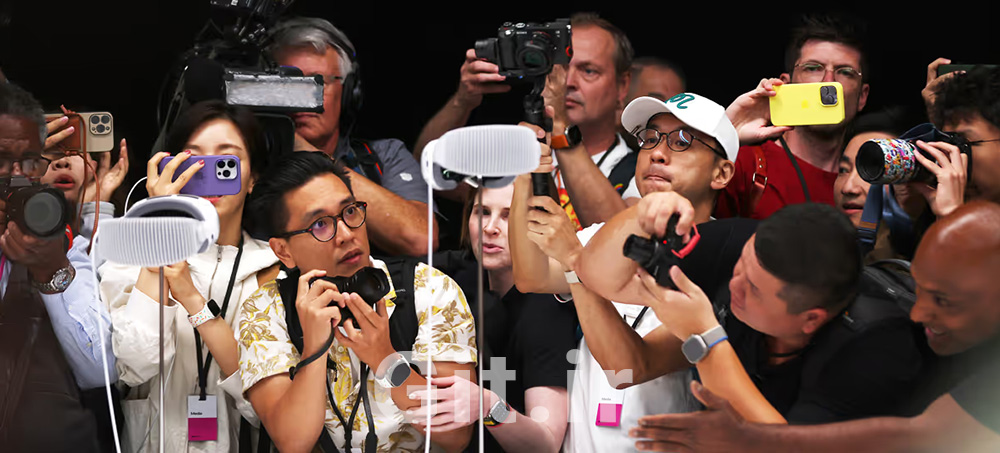
The Apple Vision Pro recently launched in the United States to a mix of both fanfare and skepticism. From skeptics, the arrival of Apple’s new device—priced at $3,500—has been met with questions like “Who is this for?” and “What’s the point of it?”
To understand the hype, it’s important to have context: For many, the headset is the biggest test yet of a new field of technology, called spatial computing, that proponents believe could usher in a new era of computing. Business leaders should take note of the Apple Vision Pro not for the device itself, but for the spatial computing capabilities that come with it and the possibilities that may lay ahead for their businesses and products.
Spatial computing uses AI, computer vision, augmented and virtual reality, and other technologies to blend virtual experiences into a person’s experience of the physical world and create a form of computing that works in three dimensions. Driven by advances in software, hardware, data, and connectivity, it enables people to interact with each other and tech in new ways, and enables machines with new capabilities to navigate our physical world. By adding a virtual layer to a user’s experience of the physical world, it allows images, sounds, and accelerations processed by a device to contribute to real-time perceptions. Our eyes become a mouse, and our gestures are clickers.
From a business perspective, it has the potential to expand computing into everything you can see, touch, and know, promising the kind of change that came with the introduction of the smartphone era.
So what does this mean for businesses? And how are companies trying to engage with this new frontier? Early adopters of Apple’s new product—and other spatial computing devices—can give businesses some hints of its potential, and what may or may not work. Businesses that are building native apps for visionOS, the operating system that powers the Apple Vision Pro, are already learning key lessons.
Who Are the Early Adopters and What Have They Learned?
When the Vision Pro was released, companies from Lowe’s to e.l.f. Cosmetics launched native apps to go with it. Other early-adopter brands, like Hanifa, are already working on creating new customer experiences. These native visionOS apps give us a glimpse into how spatial computing could change how business, customer service, entertainment, and work will evolve.
Lowe’s
Lowe’s launched Lowe’s Style Studio, an app that uses the immersive, spatial computing abilities of the Vision Pro to allow users to create, explore, and bring their kitchen renovation to life. Instead of starting their renovation by looking at 2D screens or flat images, homeowners can step into an immersive 3D kitchen scene. After finalizing their renovation plans, customers can share their style boards with significant others, contractors, or interior designers.
According to the company, its app is built to leverage Apple Vision Pro’s unique capabilities like its true depth camera and gesture tracking.
“Our lives and homes are inherently three-dimensional, yet the tools we’ve had for designing and visualizing these spaces have largely been limited to 2D representations on smartphones or computers. These traditional methods lack the depth and realism needed to understand a space,” said Seemantini Godbole, executive vice president, chief digital and information officer at Lowe’s.
Godbole added that launching Lowe’s Style Studio on Apple Vision Pro was about keeping pace with technological advancements and meeting customers’ evolving expectations by investing in emerging technologies to eliminate the friction in home improvement.
Building an app for the Vision Pro—a technology it hadn’t worked with before—in time for launch day required Lowe’s to embed members of its mobile technology team into its innovation labs team. That “enabled us to complement our lab team’s expertise in 3D visualization, spatial computing, and game design with our mobile tech team’s expertise in iOS UX and UI design and deep day-to-day familiarity with Lowe’s omnichannel business,” said Godbole.
The brand sees a business advantage to being early to spatial computing. It understands home improvement as a unique category within retail—inherently complex, often requiring specialized knowledge, expertise, and a deep understanding of spaces, and potentially deeply personal. Spatial computing, it believes, may help their customers manage the complexity of design and make better home improvement decisions.
e.l.f. Cosmetics
The cosmetics company e.l.f. launched “your best e.l.f.” on the Vision Pro, making it one of the first beauty brands to do so. The company has already explored new opportunities for its brand with experiences in Roblox and an active presence on Twitch and TikTok. It saw the opportunity to launch on the Apple Vision Pro as a way to use spatial computing and chart a new path in consumer engagement. “Testing and learning is in our DNA, and in order for us to create experiences on Vision Pro, we have to test and learn and tailor experiences to the community,” said e.l.f. Beauty’s chief digital officer Ekta Chopra.
When it comes to the business advantage of being early, Chopra indicated that the company sees spatial computing as part of the brand’s journey and vision to disrupt norms, shape culture, and connect communities. “There’s even more opportunity in spatial computing because if your community is living in that device for hours, you go with them on the journey. For beauty brands, it creates an experience that goes so much further than just a product, creating an experience for users to connect with your whole self,” she said.
PGA Tour
The PGA Tour released the PGA Tour Vision app for the Vision Pro. The app includes a 3D spatial map of the par-3 seventh hole at Pebble Beach Golf Links, the site of the AT&T Pebble Beach Pro-Am. The app will update weekly to include additional holes leading up to The Players Championship. Scott Gutterman, PGA Tour senior vice president, digital operations, said in a press release, “PGA Tour Vision for Apple Vision Pro brings golf fans inside the ropes and directly onto the tee boxes and greens of the world’s most iconic courses, no matter where they are.”
The app uses 2D video and 3D-rendered models generated from real-time live-shot data captured during the tournament. This is where spatial computing comes in, rendering 3D models using live data in real time. “We were able to take the learnings from past AR/VR/XR experiences and put them into practice with PGA Tour Vision,” said Eric Hanson, vice president of digital product development.
“The main goal is to grow our fan base, and this platform presents an opportunity to reach fans in a new manner,” said Hanson. “A golf tournament is played across 100 to 200 acres, and we change courses every week. It’s hard for a fan to get a sense of what it is like to play one of these courses because you can only see a little bit of each hole on TV. Spatial computing allows fans to go inside the ropes of the competition and see what it is like to play each hole. In the immersive mode, you’re placed on each tee box so you can see what the players experience when they take their first tee shot.”
Hanifa
Hanifa first became a well-known fashion name during the 2020 pandemic after launching the first virtual fashion show. Walking pantsuits and fashionable outfits walked across the screens of those who watched, becoming a viral sensation across the internet and the fashion world. “As a fashion brand whose ethos is tied to pushing fashion’s boundaries, we want to bring fresh new ideas to life in the Apple Vision Pro,” said Anifa Mvuemba, who founded the luxury brand.
While Hanifa’s spatial computing app is still in development, the company aims to be an early adopter. “Our efforts involve the integration of digital elements into physical spaces, offering new possibilities for immersive experiences and interactions,” said Mvuemba. This includes enhancing customer experiences, creating virtual showrooms, and showcasing products.
These are, of course, experiments, and it’s too early to know what will work and what brands and businesses need to know to make spatial computing work best for consumers. But there are overlaps to how these companies are approaching this task. For one, they’re thinking about how a spatial computer acts as an agent for its wearer. While developers must create apps that support depth, gestures, effects, and immersive scene types, they also must take into account who will be experiencing their app and how they wear the Vision Pro.
Barriers to Entry
At launch, Apple announced that more than 600 apps had been built specifically for the Apple Vision Pro and would be available in the App Store. However, adapting regular iOS apps to the Apple Vision Pro from mobile is no simple task. Apple created an all-new platform to develop on the Vision Pro called visionOS Simulator. Developers have the option to develop in windows, volumes, or spaces. This creates an all-new dimension for developers to consider when creating applications for the Apple Vision Pro.
Developers face challenges from designing for hand gesture input all the way to gaps in team-based knowledge. As far as hardware is concerned, developers will need a MacBook Pro with at least an M2 Apple Silicon chip. Plus, there is the cost of the Vision Pro itself. Companies will need to decide whether they’re ready to embrace native 3D and spatial content, and whether investing in an app for the first Apple Spatial Computing device will be a net benefit for R&D.
Barriers to entry to develop spatial computing apps for the Vision Pro include:
Technological expertise: Finding developers with the knowledge, skills, and expertise in spatial computing, development knowledge of game engines like Unity, or visionOS could pose a challenge or expense for new entrants.
App competition: Early adopters of the Apple Vision Pro are the first to gain market share on the new platform. They have the chance to learn early and adapt to changes in the market. However, businesses that wait and learn from the first iteration of the Vision Pro may make up for a later entry with established best practices, seasoned developers, and a larger user base of Vision Pro owners. The Vision Pro may have launched with 600 apps but there are 1.8 million apps on Apple’s App Store. This might become more relevant when future iPhones support more spatial capabilities or in future iterations of the Apple Vision Pro, or if more platforms like Meta start supporting spatial video and spatial experiences that could be ported.
Discovery and visibility: Apple has projected it could sell as many as 350,000 units of the Vision Pro in its first year. Compare that to the 200 million iPhones Apple typically sells annually. The up-front costs and investment in development teams for the Vision Pro should be considered when choosing to plan, develop, and market an app for the Vision Pro.
Platform lock-in: Developing an app exclusively for visionOS could mean the app is locked into the Apple ecosystem. Other head-mounted displays like the Meta Quest are on track to roll out spatial video, but app support might emerge more slowly. Business professionals should consider where their target audience is and where they will start to migrate to. Over time, key audiences may be on multiple devices or spatial computing experiences may become cross-platform.
As with any new technology, the biggest barrier to technology is figuring out the best way to use it. The Apple Vision Pro offers new features—ones that are 3D, spatial, and immersive. It’s up to the early adopters and their developers and partners to figure out the best practices, implementations, and creativity to make apps that will be a wearer’s first pick.
What Is the Business Value of Being Early?
Being an early adopter of spatial computing benefits businesses in several ways. Those companies that dive in and create spatial computing apps for the Vision Pro today give themselves a competitive advantage and position themselves as leaders in their industries.
They have a chance to influence the development of this new technology field, enact best practices, and shape the early development and monetization of customer experiences. Early adopters of the Vision Pro can build brand loyalty in a new space on a new device. This is a chance for companies that may have struggled with mobile or social media to get a head start on the next computing technology.
Now is the time for business leaders to start building small and nimble teams and exploring their creativity, which could potentially unlock new revenue streams. While there could be some downsides to being an early adopter of a new technology, the rewards for embracing spatial computing could far outweigh them.
Humans have been searching for the most natural way to interact with technology for decades. Spatial computing is just getting started, and business leaders have a chance to experiment and learn while building with an eye toward the development of the next computing platform.
TAKEAWAYSThe Apple Vision Pro marks the biggest experiment yet in the field of “spatial computing,” which proponents believe will be on par with the emergence of mobile computing. There are clear barriers to entry, as well as challenges and rewards for early adopters. But what are companies really doing with Apple’s new hardware, and what do they hope to gain from these investments? This article examines four cases.
✓ Lowe’s believes that its experiments with spatial computing may help its customers manage the complexity of design and make better home improvement decisions.
✓ e.l.f. Cosmetics sees spatial computing as part of the brand’s journey and vision to disrupt norms, shape culture, and connect communities.
✓ The PGA Tour’s immersive “PGA Tour Vision” app has a goal of growing its fanbase and reaching fans in a new manner.
✓ Hanifa’s Vision Pro app is still in development, but it expects the technology to become an essential piece of its ethos of pushing fashion’s boundaries.
Please Log in to leave a comment.