Leveraging New Tech to Bring Supply Chain Closer to Home
Author: Suketu Gandhi
The location of low-cost labor largely shaped today’s global supply chains, but that has changed dramatically over the past five years. Technology is finally ready to replace human labor across a broad range of supply chain activities, which will give companies more opportunities to operate where they choose and reduce their dependence on Asia.
Savvy companies are busily exploring how they can employ a host of new technologies to make their end-to-end supply chain much more resilient yet still competitively cost-efficient. Those that succeed will take an artificial-intelligence-plus-human intelligence (AI + HI) approach. But first, they will revisit what customers really value and bring the supply chains for higher-margin products closer to home.
The Current Challenge
Today’s global supply chains were designed to operate reliably, at the lowest possible cost in a steady-state environment. Lately, however, they have been unreliable (such as with the microchip shortage) and expensive (including higher costs for labor, commodities, and ocean shipping), primarily because conditions have been anything but steady. Geopolitical tensions between the Western democracies and the autocracies of Russia and China have led to calls for companies to become less vulnerable by radically restructuring their distant supply chains.
Companies have long expressed interest in reshoring, near-shoring (switching to suppliers closer to the markets served), and friend-shoring (using suppliers located in countries with shared values)—all of which offer certain logistical, strategic, and brand image advantages. The biggest obstacles have been labor costs, labor availability, and deep manufacturing expertise. The largest and most affordable pool of qualified manufacturing labor is in China and other Asian low-cost countries.
But advances in technology are starting to lower these barriers.
New Technologies
A few developments are beginning to make a difference. For example, it is possible to locate affordable factories closer to home. Companies are also improving their operations and reducing the time it takes to train workers from months to days on tasks such as assembling diverse products—electrical or mechanical—on the same assembly line.
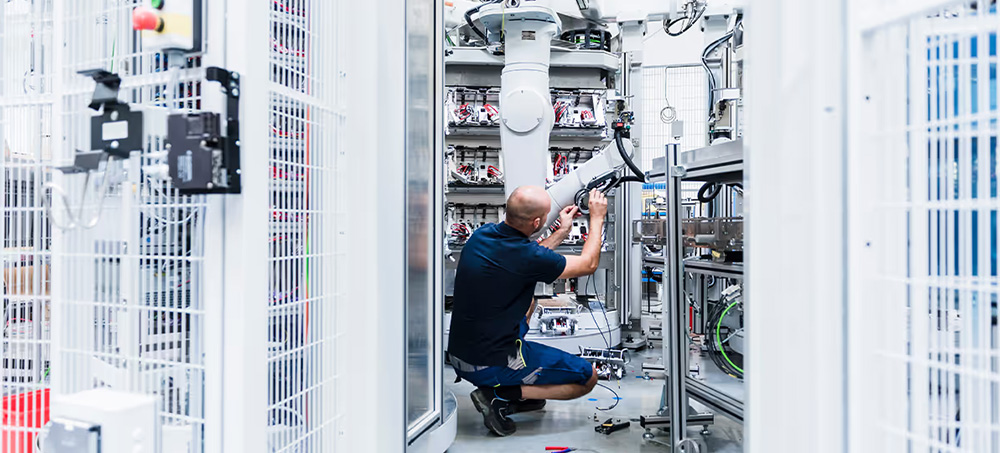
AI + HI. The maturity of AI, particularly humans’ ability to use it, offers new ways out of the cost trap. Major advances in cobots—robots that directly interact with humans in manufacturing facilities—combine AI and HI to lower the labor costs while retaining the value of human oversight.
3D printing. Advances in additive manufacturing (3D printing) are making it possible for companies to affordably produce a broad range of components and products. They also allow them to shorten manufacturing processes in factories closer to home, reducing reliance on numerous and distant suppliers.
Recognition technology. In manual manufacturing processes, such as automobile engine assembly, AI-driven action recognition technology combines live video with analytics to ensure that workers are correctly following complicated steps without making errors. The result is better quality control, higher productivity, and data sets that can be used to improve processes.
Digital manufacturing solutions. These systems track product manufacturing across workstations, enable real-time input of data by workers, provide end-to-end traceability, and ensure that only high-quality parts move downstream.
Three-dimensional simulations. These include metaverse applications such as NVIDIA Omniverse. Simulations allow manufacturers to build digital twins of their processes and simulate factory layouts, workstation designs, and assembly design.
Logistics technology. Investments are pouring into this area, especially in tools for warehouse management, matching freight loads to transportation capacity, and cost-effective routing. The rate of investment from venture capital (VC) firms suggests that VC funding for “supply tech” will overtake that for fintech before the end of this decade.
Three moves can help companies take full advantage of these labor-saving intelligent technologies.
Rethink what customers really value
Start with deep analysis of what customers will want, where they will want it, and when. Many products are complex in places where consumers do not see value but production is labor-intensive—issues that mattered less when supply chains were stable and labor costs low. Recognizing this, some companies are moving toward making products in smaller batches that are keyed to refined customer preferences. Some are finding ways to adapt or redesign products for automated production without sacrificing perceived or effective end-user value.
Consider an industrial tools manufacturer that had seen its products grow more complex with many subcomponents, such as motors, switches, controllers, and wiring, and many raw materials such as resins, plastics, and copper. Before bringing manufacturing from Asia and closer to most of their customers in North America and Europe, the company took a hard look at what its customers really cared about. It found that, above all, users wanted a motor that lasted a long time and a tool that could survive in a harsh operating environment. The company was able to eliminate many of its products’ superfluous elements, making manufacturing easier to automate and less expensive while still delivering the attributes that customers want.
Rebalance machine intelligence with human agency
AI, analytics, and robotics can greatly reduce reliance on human effort to move products through value chains faster, more reliably, and more efficiently. But the goal should not be to remove human beings completely from processes; it should be to free them to do what they do best: make critical judgments based on their experience and expertise. For example, these technologies can allow workers to devote more time to investigating and learning from system failures and figuring out how to make the system more robust.
Consider a medical device manufacturer. In its industry, safety is the number one priority, and getting the product to the customer rapidly is number two. There is tension between these priorities. Reshoring would help get products to customers faster but increase labor costs. So the company adopted machine learning and state-of-the-art cameras to inspect for anomalies in the products and in the manufacturing process. The company’s best human experts then identify the causes.
Bring newer, higher-margin products closer to home first
When companies first began moving manufacturing to low-cost countries, they usually focused first on their high-volume, lower-margin products. Now, as they relocate production closer to home and to customers, they should begin with their higher-margin products for three reasons.
First, because higher-margin products are often more complex (such as medical devices), using new technologies to produce them and to manage their supply chains can generate the most benefits.
Second, in the face of today’s uncertain global supply chains, companies should consider the risks of disruptions for all of their products and make the repatriation of those that deliver the highest return the priority.
Third, thin margins leave no financial room for experimentation, learning, and the initial capital expenditure needed to maneuver in a world of new technology and higher labor costs. As a result, it’s difficult to make the business case for relocation, and companies are incapable of moving forward. But when relocation is considered in terms of the total amount of margin repatriated, instead of total cost savings, the business case becomes compelling. And as a company continually improves its manufacturing proficiency with higher-margin products, it can then turn its attention to relocating the manufacture of lower-margin products.
Admittedly, making all these changes will take time. Companies will not be able to drastically reduce their dependence on suppliers in China and other distant countries overnight. But by understanding the capabilities of these technologies and aggressively investing in them, companies will be able to bolster the resilience of their supply chains in the months and years ahead.
TAKEAWAYS
The location of low-cost labor largely shaped today’s global supply chains, but that has changed dramatically. Technology is ready to replace human labor across a broad range of supply chain activities, which will give companies more opportunities to operate where they choose.
✓ New advancements in technology—including AI + HI, 3D printing, recognition technology, digital manufacturing solutions, and 3D simulations—are making it possible for Western countries to relocate factories closer to home, lowering supply chain risk.
✓ To remove complexity from supply chains, companies should rethink what customers really value and simplify products’ superfluous elements.
✓ Companies should bring higher-margin products closer to home first. Higher-margin products are typically more complex and more exposed to supply chain risk.
Please Log in to leave a comment.