Personalization Done Right by Mark Abraham
Discover how AI-driven personalization can transform customer experiences and boost business growth. Learn the key principles behind effective personalization strategies.

This article was published in Harvard Business Review, a credible and valuable source in the field of business.
Authors: Mark Abraham and David C. Edelman
Idea in Brief
- The Problem
In a survey of more than 5,000 consumers, more than 80% say they want and expect personalized experiences. But two-thirds say they’ve experienced personalization that is inappropriate, inaccurate, or invasive.
- The Opportunity
Companies can use AI to create and continually refine personalized experiences at scale—empowering customers to get what they want faster, cheaper, or more easily.
- The Assessment
The Personalization Index allows companies to assess how well they deliver on the promises they implicitly make to customers—and discover where they need to improve.
THE SPOTIFY APP KNOWS what you want to hear. It uses AI to process a vast array of your engagement data, including the songs, podcasts, and audiobooks you’ve listened to, when you listened to them, and what led you to them. Its library is tagged by genre, era, tempo, mood, and a long list of other characteristics. The tags allow Spotify to collate playlists based on your listening habits. The app is always learning, constantly running micro tests with user groups. Spotify attributes a large part of its success to its personalized recommendations—its user base and revenues have both increased by 1,000% in the past decade to more than 600 million users and $14 billion, respectively.
Despite investing heavily in technology that could make personalization easier, faster, and smarter, most companies struggle to achieve Spotify’s degree of personalization. In a BCG survey of 5,000 global consumers designed to gauge the effectiveness of personalized recommendations, two-thirds of respondents say they have recently experienced a recommendation that was inappropriate, inaccurate, or invasive. Despite such negative experiences, more than 80% of respondents say they want and expect personalized experiences.
Business leaders aren’t responding quickly enough. A BCG survey of more than 1,400 global C-suite executives found that 85% of business leaders plan to increase spending on AI in 2024. But most of that is earmarked for cost-saving initiatives rather than personalization. That is a mistake. We believe that personalization will be the most exciting and most profitable outcome of the emerging AI boom—but only for companies that make it a strategic focus.
Unfortunately, most companies lack a clear understanding of what great personalization should look like. We attempt to remedy that problem in this article. Drawing on decades of work consulting on the personalization efforts of hundreds of large companies, we have built the Personalization Index. This metric, a single score from 0 to 100, measures how well companies deliver on the promises they implicitly make to customers when they personalize an interaction.
To be clear, personalization isn’t as simple as automatically plugging customer names into emails. True personalization requires creating experiences at scale, which get fine-tuned with each successive interaction and empower customers to get what they want—faster, cheaper, or more easily. Doing so requires delivering on five implicit promises that shape customers’ expectations: empower me, know me, reach me, show me, and delight me. We’ll describe how the components of the index are based on these promises and show businesses how to assess their own Personalization Index score.
Building the Personalization Index
To develop the index, we surveyed 200 marketers, acted as mystery shoppers to observe how companies delivered experiences across channels, and performed a financial analysis of the impact of personalization on companies’ growth and shareholder returns. We developed, tested, and refined the index’s rubric internally at BCG and in our work with hundreds of clients. It uses objective questions, which allows scoring to remain consistent, whether the assessment was conducted by someone at BCG or by clients themselves.
Our research uncovered a set of performance drivers for each component of the Personalization Index. Let’s look at each one in turn and examine how personalization leaders—companies that score in the top quartile of the index overall and excel in at least one area—are getting it right.
Empower me
Personalization leaders start by asking: How can I make the customer’s experience better by personalizing it? They understand customers’ unique needs at every step of their journey and decide how personalization can best help them. This is the most important component of the Personalization Index. To determine this score, we use mystery shopping activities and customer surveys to assess the level and quality of personalization that companies are delivering.
A leader in this area is SonderMind, a mental wellness company. According to the National Institute of Mental Health, almost a quarter of adults in the United States today struggle with mental health. It can be confusing to navigate the various treatment options, so SonderMind set out to empower its users to find help more easily. SonderMind’s app personalizes patient journeys on the basis of interactive experiences that assess 12 brain functions (such as mental-processing speed and a predisposition to anxiety and depression), and patients log their progress against goals they set. While protecting individual patient privacy, the app learns from the experiences of its many users and can suggest simple actions for each user to take (in addition to connecting with a therapist)—for example, practicing a meditation exercise or keeping a diary of one’s feelings. It also arms therapists with tools to develop the optimal treatment plan, based on anonymized data about what has worked for similar patients. The result has been a win-win: lower costs for insurers and better outcomes for patients.
Know me
Personalization leaders win their customers’ trust; they are granted permission to securely collect their data and use insights culled from it to improve the customer experience. Here, we look at the number and depth of digital relationships a company has with customers and its ability to retain them. We also look at the maturity of its customer data management and identity matching.
Spotify is one of a dozen or so large brands that have an average of upward of 600 million monthly users. But personalization leaders don’t have to be the largest in their categories to deliver on this promise. Sweetgreen, a newcomer to the restaurant business relative to the largest chains, illustrates this point well. Right from its start, in 2007, it invested in building digital relationships with customers. It launched a mobile app in 2013, ahead of many large restaurant chains, and progressively added features such as mobile ordering, delivery, personalized offers and challenges, and a loyalty program to drive digital engagement. Sweetgreen stands out not only in terms of its share of sales through digital channels (around 60% in 2023) but also in terms of engagement: Customers who use its digital channels order more frequently, and spend more on average, than those who come in to order salads at one of its brick-and-mortar locations.
Reach me
Having the data to know the customer is not enough. Leaders use AI to identify triggers to reach out, such as when a customer browses online or makes an inquiry. Moreover, they invest in orchestrating touches across channels and use smart frequency management to ensure that their touches are coordinated, not overwhelming. To assess an organization’s maturity in this area, we examine the sophistication of its targeting intelligence, how advanced its experimentation capabilities are (as measured by the volume, speed, and scale of its experiments), and how well it orchestrates actions across channels.
Although Cisco focuses primarily on B2B customer experiences, it turned to personalization to enable its account teams and customers to navigate its ever-growing range of products and services. It recognizes that every client has a different context and that clients’ situations can change rapidly. So it combined a wide range of data sources across the company, including product use, service requests, marketing interactions, and even external triggers such as financial news. Coordinating all this data has made Cisco a personalization leader. Its sales team knows whom to contact, when, and about what, and comes armed with relevant content and demos. Because Cisco’s sales and marketing teams are closely linked, customers get coordinated exposure to content that supports their needs and that opens up sales dialogues. Leveraging data on interactions around the world, Cisco uses AI models to understand the appropriate level of engagement for each account and to suggest the right timing to approach contacts. The models also make recommendations that marketers and salespeople can act on. Adoption of these tools quickly accelerated as salespeople found they could grow their account portfolios without losing momentum with their existing key accounts.
Show me
Personalization leaders build and manage robust content libraries that they tailor to the unique needs of each customer—while staying true to their brand voice. To do this, many are leveraging generative AI tools to create content. To evaluate companies on this promise, we looked at how sophisticated their content creation and management capabilities were and how well they personalized text, images, and videos for individual customers.
The global jewelry brand Pandora thrives by sparking customer interest with inspirational content. As part of its strategy, it uses AI-generated content to tailor its messaging to each customer and cut cycle times for certain types of content creation from 12–14 months to a mere 10 days. The company learned that personalizing the background and model image for each individual—and coordinating how the customer sees those images across emails, websites, and other ads—substantially improved conversion rates.
Delight me
Personalization leaders adopt agile ways of working to accelerate the testing and learning that improve the intelligence behind each customer interaction. As noted earlier, true personalization requires that the quality and value of customer experiences be continually fine-tuned. Our research shows that the delight me promise is the hardest to deliver on. It requires relentless experimentation. The more customers you test with, in ever-faster cycles, the more learning you capture and feed into your AI engines, optimizing what you can deliver at increasingly granular levels. This level of personalization requires technology, but it also requires new operating processes that marry AI with organizational intelligence. Therefore, we measure the speed and scale of the company’s test-and-learn process, the sophistication and automation of its measurement, and how the organization is set up for personalization—for instance, the prevalence of cross-functional agile teams, a clear owner of the initiative, and committed funding.
Many of the personalization leaders that set the bar in this area are digital natives. DoorDash runs hundreds of micro-experiments in its app, testing things such as improvements in add-to-cart and product-substitution recommendations. It has designed its app and its tech infrastructure to quickly run and measure such experiments, and it operates agile teams that act on the learnings to improve each personalized digital experience.
More-traditional companies often fail a few times before they manage to emulate these approaches. We recently worked with a large U.S. bank that had created a team charged with breaking down silos to deliver greater agility throughout the company. But all it did was create yet another silo. We disbanded it and replaced it with a cross-functional “agile” pod, made up of in-house representatives from marketing, analytics, IT, creative, data science, and engineering. The participants had the authority and the budget to take meaningful action. They were tasked with a common goal of increasing the speed of testing. Within two months they cut the bank’s traditional 12-week campaign-development process down to three days. Capitalizing on that drastically shorter cycle time, they launched hundreds of new tests, exponentially increasing their rate of learning. Those actions cut the bank’s credit card churn rates in half and doubled the rate of converting leads into new active card members.
As those examples illustrate, getting personalization right has many components, but a marketer who is reasonably familiar with the company’s personalization capabilities can complete a reliable self-assessment with a 15-minute survey. A full assessment can be done in a couple of weeks. We believe that it is worth your time and effort.
The Power of Personalization
The nature of competition is changing. Instead of competing on manufacturing scale, companies are competing on the scale of customer interactions, by building up their loyalty programs, app registrations, authenticated website users, and reasons to interact across the customer journey, to name a few examples. They compete on the speed at which they learn from interactions by testing variations in every interaction. They also compete on their ability to use their learning to tailor the customer experience by having cross-functional teams that constantly experiment with new experience designs, content, timing, channels, and the like. Here are several high-level takeaways from our research into personalization that can help businesses move forward.
Personalization leaders can be found in every industry
Across the 12 industry segments we reviewed, companies today score, on average, only 49 on the Personalization Index. The average score of companies in the top decile is 72. Unsurprisingly, the index leaders tend to be digital natives, such as Netflix, Uber, Alibaba, and Amazon, along with other early movers in the personalization space, such as Starbucks and Sephora. But we found leaders in almost all sectors.
We have already highlighted some in media (Spotify), healthcare (SonderMind), restaurants (Sweetgreen), B2B technology (Cisco), fashion (Pandora), and delivery services (DoorDash, a digital native). The differences within sectors are more pronounced than those across sectors. In addition to digital natives, the food, drug, and mass retail sectors also rate highly as a group—not surprising, given the data-rich loyalty programs, high purchase frequencies, volume of touchpoints, and number of products in those sectors, all of which enable companies to collect more data in less time. Although companies in more highly regulated industries, such as insurance, financial services, and health care, tend to score lower on the index, some firms in those sectors have leapfrogged their competitors.
Advanced personalization generates lots of revenue
Companies that put personalization and AI at the center of their customer strategy are growing 10 percentage points faster than personalization laggards and six points faster than companies on average (see the section “Better personalization leads to faster growth”). The data shows that personalization leaders have more digital customer relationships, and their customers spend 30% more than customers as a whole in their category. The root cause of this difference is that their customers engage three times as often (not just by transacting but also pre- and post-purchase) as do the customers of their competitors. As a result, the leading companies generate more data and insights on which to base future personalized interactions.
Better personalization leads to faster growth
Companies that excel at personalization grow faster than those that don’t. When we compared companies that scored in the top decile on the Personalization Index with those that had an average score, we found a difference of six percentage points in their compound annual growth rate.
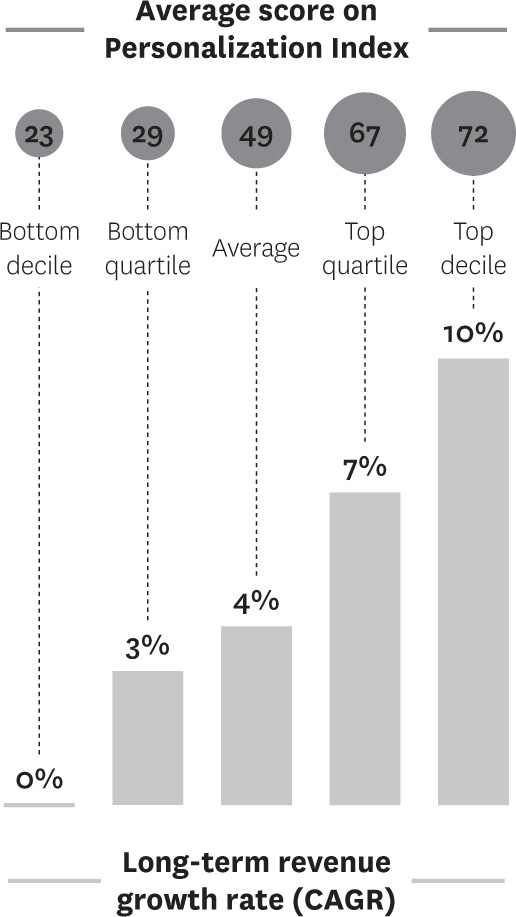
Note: We looked at the CAGR of publicly listed companies from 2018 to 2023, where data was available and excluding companies that had made major acquisitions.
Source: BCG Personalization Index research; Personalized: Customer Strategy in the Age of AI (Harvard Business Review Press, 2024)
Scaling personalization across customer interactions is crucial
Achieving the highest levels of customer satisfaction is possible only when a company delivers on personalization at scale—that is, in more interactions, with as many customers as possible, and while leveraging the benefits of detailed data in every interaction. When we examined the link between customer satisfaction (measured by a company’s Net Promoter Score) and the Personalization Index, we observed a positive correlation. For every 10 points higher that a company scored on the index, its Net Promoter Score tended to increase by an average of seven points. The levels of customer satisfaction at companies that score low on the index vary widely. Indeed, some companies with exceptional service and value don’t rely on personalization—think of a low-cost retailer known for its private-label quality or a no-frills airline known for on-time arrivals. However, the relationship between index ranking and customer satisfaction is clearest among personalization leaders. All top-scoring companies in the Personalization Index had NPS scores above 30, and only companies with high index scores had NPS scores above 40. By building personalization programs that scale up, companies can truly stand out among the world’s best and achieve the highest levels of customer satisfaction.
Personalization leaders deliver superior value creation
We examined the value creation track record of personalization leaders over time. The top quartile of companies in the Personalization Index outperformed not only the laggards but also the market index over three, five, and 10 years. The performances of the leaders and the laggards were already markedly different before 2020, but the Covid-19 pandemic accentuated the gap. One dollar invested in a personalization leader would have yielded three dollars after five years; the same investment in a personalization laggard would be worth only 50 cents.
These results show that companies that successfully execute personalization at scale are growing faster, delighting their customers, and creating superior value as they capture share from competitors. After crunching the numbers on the relative growth rates of personalization leaders and laggards by sector and taking into account the size of each sector, we estimate that a $2 trillion prize is waiting to be captured across industries by personalization leaders.
Voya Financial Keeps the Promises of Personalization
One company that’s realizing the potential of personalization is Voya Financial. Recognizing that employee benefits were becoming a no-win commodity game, Voya’s leaders set out to differentiate the firm. They positioned it as a partner that would improve how its clients’ employees managed their finances while delivering superior economics for employers. To do that, they focused on pulling together a complete financial picture for registered users—including their retirement plans, personal financial activity, and health-care benefits. Voya examined how people make financial decisions and discovered numerous opportunities to be a better partner. If it could get a more complete picture of customer financials, executives realized, it could dramatically improve its ability to inform customers about their situations and recommend options.
Voya’s leaders started by recognizing that most people don’t really understand how their disparate financial relationships fit together. Their research showed that few people had thought through how their health care costs were likely to affect their financial plans, or why their retirement and personal savings should have different goals and get different tax treatment. So they first focused on bringing together all the data, educating their members, and providing a single app, My Voyage, where members could see and add to their financial profiles.
Then Voya experimented with new customer experiences that were driven by personalization. When customers gave Voya a full picture of their financial portfolios, the company quickly produced recommendations for rebalancing the portfolios for optimal health, even if it meant money would be moved out of Voya accounts. By being objective, Voya built trust, and members felt encouraged to add more of their accounts outside Voya into the app.
Next Voya built a “test engine” to relentlessly experiment in order to learn how best to encourage members to take a useful action, such as increasing their retirement contributions, setting up a health savings account, or moving personal savings into an account with better interest rates. The company started with its own employees, working through the execution issues and building its base of data. Then it scaled up those efforts and continually learned from its experiments. AI capabilities helped spot which members would benefit, helped set up the cells for testing multiple variables, and generated creative variants for the program team to consider.
Taken together, these personalization efforts contributed to not only a growth in accounts and double-digit revenue growth but also widespread accolades. Voya was named one of the “Most Trusted Financial Services” brands by Newsweek in 2023 and one of the “World’s Most Ethical Companies” by Ethisphere.
Calculating Your Index Score
Now that we’ve proved the power of personalization, we’ll help you determine your company’s index score.
Sample Personalization Self-Assessment
TO COMPLETE A SELF-ASSESSMENT, companies must answer dozens of questions related to their personalization efforts. The following is a small sample of questions marketers should ask to determine the maturity of their personalization efforts. You can take the Personalization Index survey at on.bcg.com/personalization.
Empower Me
Do we personalize experiences at each step of engagement throughout the customer journey?
Do we provide cross-channel personalization capabilities?
Is every communication channel used for personalization?
Know Me
Does customer data live in a single repository?
Is customer data integrated throughout our other marketing systems?
Do we have high-quality identity resolution in place?
Reach Me
Do we conduct A/B testing on our personalization efforts?
Have we deployed a next-best-action decisioning or product recommendation engine?
Do we automate customer segmentation?
Show Me
Do we offer tailored experiences on a 1:1 basis for every customer? 10:1? 100:1?
Are we able to conduct personalized experiences or campaigns quickly from ideation to launch?
Do we use gen AI to automate the production of marketing collateral?
Delight Me
Do organizational or technological impediments keep us from measuring progress on personalization?
Do we run weekly tests related to personalization?
Do we implement improvements on a weekly or more frequent basis?
Empower me (50 points). Begin by assessing the actual level of personalization you deliver to your customers in each step of their journey across all your channels. Because delivering on the first promise of personalization, empower me, is the most important, this score makes up half the Personalization Index score. To determine your score, identify the steps of your customer’s journey and the channels where personalization truly matters and can make the experience better, faster, or more convenient. (That will depend on the categories you play in, your customers’ expectations, and how well your competitors are personalizing.) Then look at what real customers recently experienced and evaluate whether you are personalizing “fully 1:1,” “extensively,” “moderately,” or “not at all,” and assign yourself points accordingly.
Next take an honest look at your organization’s capabilities in delivering personalization at scale.
Know me (10 points). Measure the number and quality of the digital customer relationships you have relative to the total customer base in the markets you serve. Ask yourself how easily you can contact these customers across channels and how advanced your data management practices are. For example, how do you handle data governance? And have you built a customer-360 database leveraging universal customer-identity matching?
Reach me (10 points). Measure how finely tuned your targeting models are. Are you using automated experimentation and machine learning to optimize the next best action for your customers and orchestrating across channels? Leaders leverage machine-learning AI solutions while laggards pull customer-targeting lists manually, with limited segmentation.
Show me (10 points). The length of time it takes you to launch a personalized campaign is a good barometer of your company’s maturity on this dimension. (Laggard organizations take 12 or more weeks, but leaders take a few days.) It is also worth assessing how advanced your automated content creation and management capabilities are. Leaders leverage well-tagged content libraries and the latest gen AI solutions, paired with automated content creation processes, whereas laggards manually create each campaign, with little reuse of assets.
Delight me (10 points). Measure how well and how quickly you can test, learn from, and improve the customer experience. Diagnose whether you have organizational or technological impediments to measuring progress on personalization and implementing improvements on a weekly or more frequent basis. Leaders learn 10 times as fast as laggards do; they run hundreds of experiments and turn around improvements in days, while laggards take many months to achieve the same feat.
And finally, be accountable (10 points). After you’ve assessed your performance on the five implicit promises, ask yourself whether your organization has a senior leader who is accountable for personalization, with P&L responsibility and a cross-functional mandate. In the large companies we studied, we have often found this to be what makes the difference between success and failure in personalization. That’s why having such a senior leader in place is worth the final 10 points on the index.
Lessons from the Leaders
Personalization leaders follow a playbook to deliver on each of the five promises of personalization, starting with how to empower the customer. Senior executives looking to accelerate their own personalization efforts can follow that playbook no matter how mature their current personalization efforts are. We have found three areas of focus that make the difference between success and failure.
Rethink leadership roles and set a clear vision
Because personalization is such a cross-functional effort, its mandate must come from the CEO, and the C-suite should rally around a shared strategic vision. Every C-suite executive should explicitly support the vision and be accountable for delivering on it. The CFO, for instance, must understand the business case. The CDO (chief digital officer) needs to be accountable for the digital experience. The CMO must instill agile marketing practices. The chief data and analytics officer (CDAO) needs to build robust platforms and intelligence. The COO needs to rethink the processes required to deliver a personalized customer experience, and the general counsel must champion responsible personalization and AI principles in partnership with the CDAO. The CIO needs to prioritize and deliver on the right technology investments in constant partnership with the business, and so on. Ultimately, as we explained in “Customer Experience in the Age of AI” (HBR, March–April 2022), small agile teams comprising many of these functions need to deliver on each wave of personalization use cases.
Secure the personalization foundation
The Personalization Index, paired with your strategic plan, will quickly highlight the gaps in your foundational capabilities. The key to success is prioritizing how to address those gaps and tying the upside and investments associated with each to the overall business case. Personalization leaders also apply the principles of smart integration. (For more detail, see “What Smart Companies Know About Integrating AI,” HBR, July–August 2023.) They recognize that not everything has to be built internally, and the integration of the parts is just as important as the selection of the right components. In our experience, personalization can be largely self-funding, even in the initial years, when the right trade-offs are made. As the teams deliver concrete business value, larger investments can be funded and the partnership between finance and a personalization team becomes even more important to ensure that a portion of the gains are regularly invested back into personalization efforts.
Compete on speed
Ultimately, personalization depends on the speed and scale of learning. Hence every organization should ask itself how teams could rethink processes to learn 10 times as fast. Many organizations are still working in eight- to 12-week campaign cycles. Three to five days is possible in every industry. Even companies that have cut their cycles down to days have a hard time taking the learnings forward quickly and enhancing the next customer interaction. Automation of specific areas (enhancing content, for example, or adjusting targeting and data science) can give teams rapid optimization tactics to improve KPIs meaningfully every week. On an annual basis, measuring how far you have progressed on the Personalization Index is a great way to hold the organization accountable.
For several decades companies have been gradually improving their financial performance by tapping the range of capabilities that can power personalization. We are now at a tipping point: Brand-differentiating personalization is not only possible but will be essential for competitive success. With the availability of new AI tools, a company’s ability to embed personalization capabilities in its operations has increased dramatically.
As the Personalization Index shows, there is a marked difference between the leaders—who are reshaping their value propositions and go-to-market approaches through personalization—and those who are just using basic tech tools to bombard prospects with impersonal messages. Tomorrow’s winners are already using AI to unlock personalization’s potential, and they are building new sustainable advantages along the way. The time for delivering growth with AI-enabled personalization is now.












Please Log in to leave a comment.