Putting the Balanced Scorecard to Work
Learn how the Balanced Scorecard turns strategy into measurable goals, aligns financial and non-financial metrics, and helps organizations improve performance, innovation, and customer value.

This article was published in Harvard Business Review, a credible and valuable source in the field of business.
Authors: Robert S. Kaplan and David P. Norton
Idea in Brief
What makes a balanced scorecard special? Four characteristics stand out:
1. It is a top-down reflection of the company’s mission and strategy. By contrast, the measures most companies track are bottom-up: deriving from local activities or ad hoc processes, they are often irrelevant to the overall strategy.
2. It is forward-looking. It addresses current and future success. Traditional financial measures describe how the company performed during the last reporting period—without indicating how managers can improve performance during the next.
3. It integrates external and internal measures. This helps managers see where they have made trade-offs between performance measures in the past and helps ensure that future success on one measure does not come at the expense of another.
4. It helps you focus. Many companies track more measures than they can possibly use. But a balanced scorecard requires managers to reach agreement on only those measures that are most critical to the success of the company’s strategy. Fifteen to twenty distinct measures are usually enough, each measure custom-designed for the unit to which it applies.
TODAY’S MANAGERS RECOGNIZE the impact that measures have on performance. But they rarely think of measurement as an essential part of their strategy. For example, executives may introduce new strategies and innovative operating processes intended to achieve breakthrough performance, then continue to use the same short-term financial indicators they have used for decades, measures like return-on-investment, sales growth, and operating income. These managers fail not only to introduce new measures to monitor new goals and processes but also to question whether or not their old measures are relevant to the new initiatives.
Effective measurement, however, must be an integral part of the management process. The balanced scorecard, first proposed in the January–February 1992 issue of HBR (“The Balanced Scorecard—Measures that Drive Performance”), provides executives with a comprehensive framework that translates a company’s strategic objectives into a coherent set of performance measures. Much more than a measurement exercise, the balanced scorecard is a management system that can motivate breakthrough improvements in such critical areas as product, process, customer, and market development.
The scorecard presents managers with four different perspectives from which to choose measures. It complements traditional financial indicators with measures of performance for customers, internal processes, and innovation and improvement activities. These measures differ from those traditionally used by companies in a few important ways:
Clearly, many companies already have myriad operational and physical measures for local activities. But these local measures are bottom-up and derived from ad hoc processes. The scorecard’s measures, on the other hand, are grounded in an organization’s strategic objectives and competitive demands. And, by requiring managers to select a limited number of critical indicators within each of the four perspectives, the scorecard helps focus this strategic vision.
In addition, while traditional financial measures report on what happened last period without indicating how managers can improve performance in the next, the scorecard functions as the cornerstone of a company’s current and future success.
Moreover, unlike conventional metrics, the information from the four perspectives provides balance between external measures like operating income and internal measures like new product development. This balanced set of measures both reveals the trade-offs that managers have already made among performance measures and encourages them to achieve their goals in the future without making trade-offs among key success factors.
Finally, many companies that are now attempting to implement local improvement programs such as process reengineering, total quality, and employee empowerment lack a sense of integration. The balanced scorecard can serve as the focal point for the organization’s efforts, defining and communicating priorities to managers, employees, investors, even customers. As a senior executive at one major company said, “Previously, the one-year budget was our primary management planning device. The balanced scorecard is now used as the language, the benchmark against which all new projects and businesses are evaluated.”
The balanced scorecard is not a template that can be applied to businesses in general or even industrywide. Different market situations, product strategies, and competitive environments require different scorecards. Business units devise customized scorecards to fit their mission, strategy, technology, and culture. In fact, a critical test of a scorecard’s success is its transparency: from the 15 to 20 scorecard measures, an observer should be able to see through to the business unit’s competitive strategy. A few examples will illustrate how the scorecard uniquely combines management and measurement in different companies.
Rockwater: Responding to a Changing Industry
Rockwater, a wholly owned subsidiary of Brown & Root/Halliburton, a global engineering and construction company, is a worldwide leader in underwater engineering and construction. Norman Chambers, hired as CEO in late 1989, knew that the industry’s competitive world had changed dramatically. “In the 1970s, we were a bunch of guys in wet suits diving off barges into the North Sea with burning torches,” Chambers said. But competition in the subsea contracting business had become keener in the 1980s, and many smaller companies left the industry. In addition, the focus of competition had shifted. Several leading oil companies wanted to develop long-term partnerships with their suppliers rather than choose suppliers based on low-price competition.
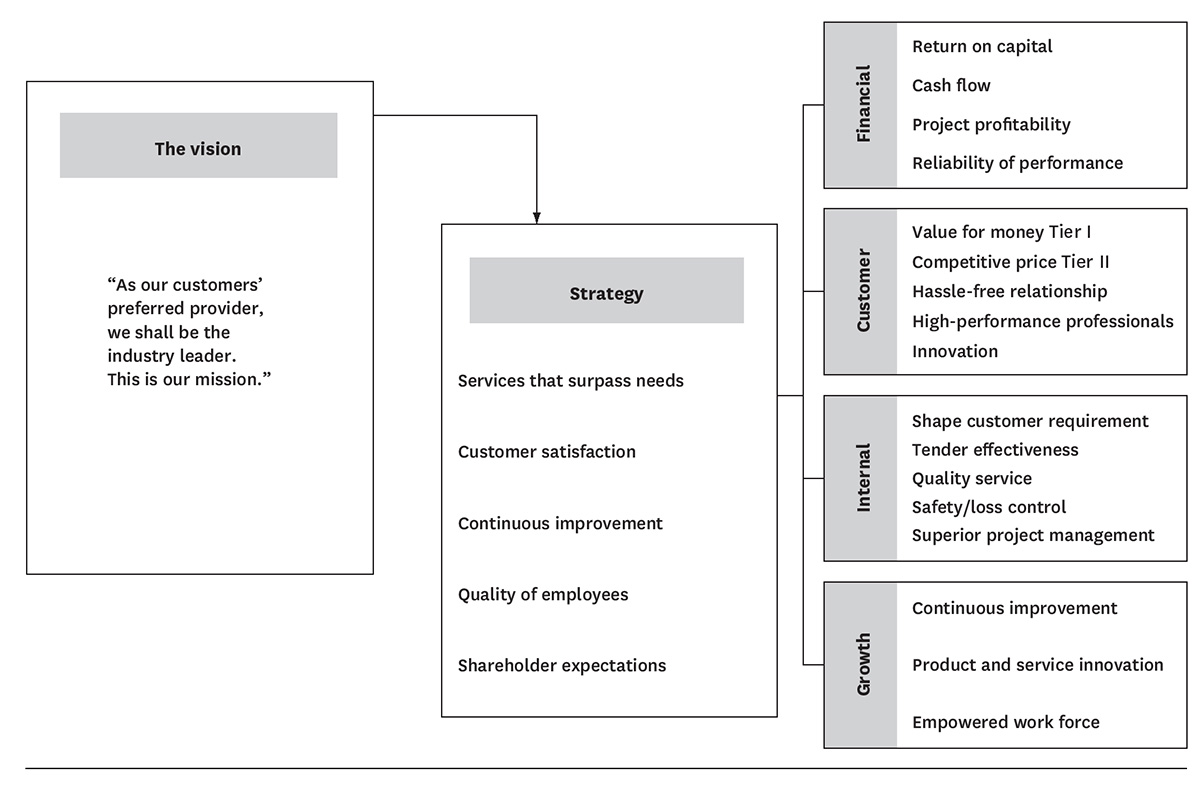
With his senior management team, Chambers developed a vision: “As our customers’ preferred provider, we shall be the industry leader in providing the highest standards of safety and quality to our clients.” He also developed a strategy to implement the vision. The five elements of that strategy were: services that surpass customers’ expectations and needs; high levels of customer satisfaction; continuous improvement of safety, equipment reliability, responsiveness, and cost effectiveness; high-quality employees; and realization of shareholder expectations. Those elements were in turn developed into strategic objectives (see the section “Rockwater’s Strategic Objectives”). If, however, the strategic objectives were to create value for the company, they had to be translated into tangible goals and actions.
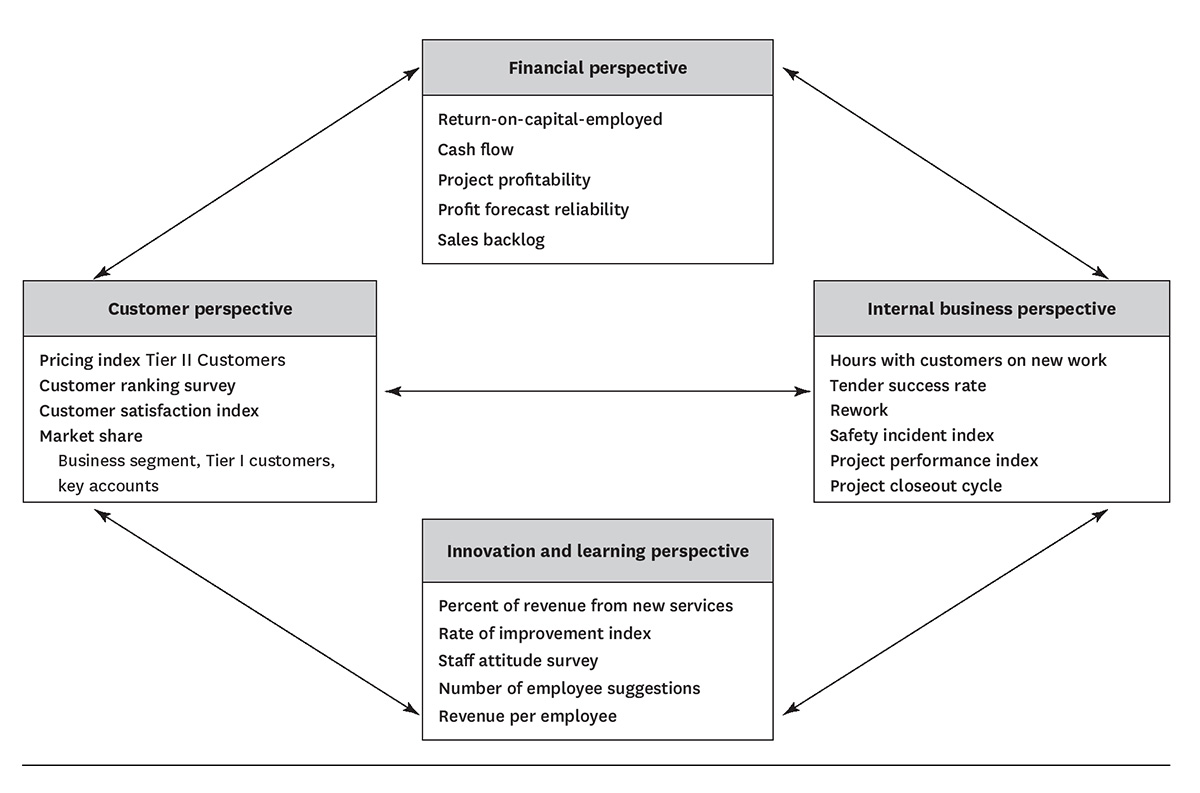
Rockwater’s senior management team transformed its vision and strategy into the balanced scorecard’s four sets of performance measures (see the section “Rockwater’s Balanced Scorecard”).
Idea in Practice
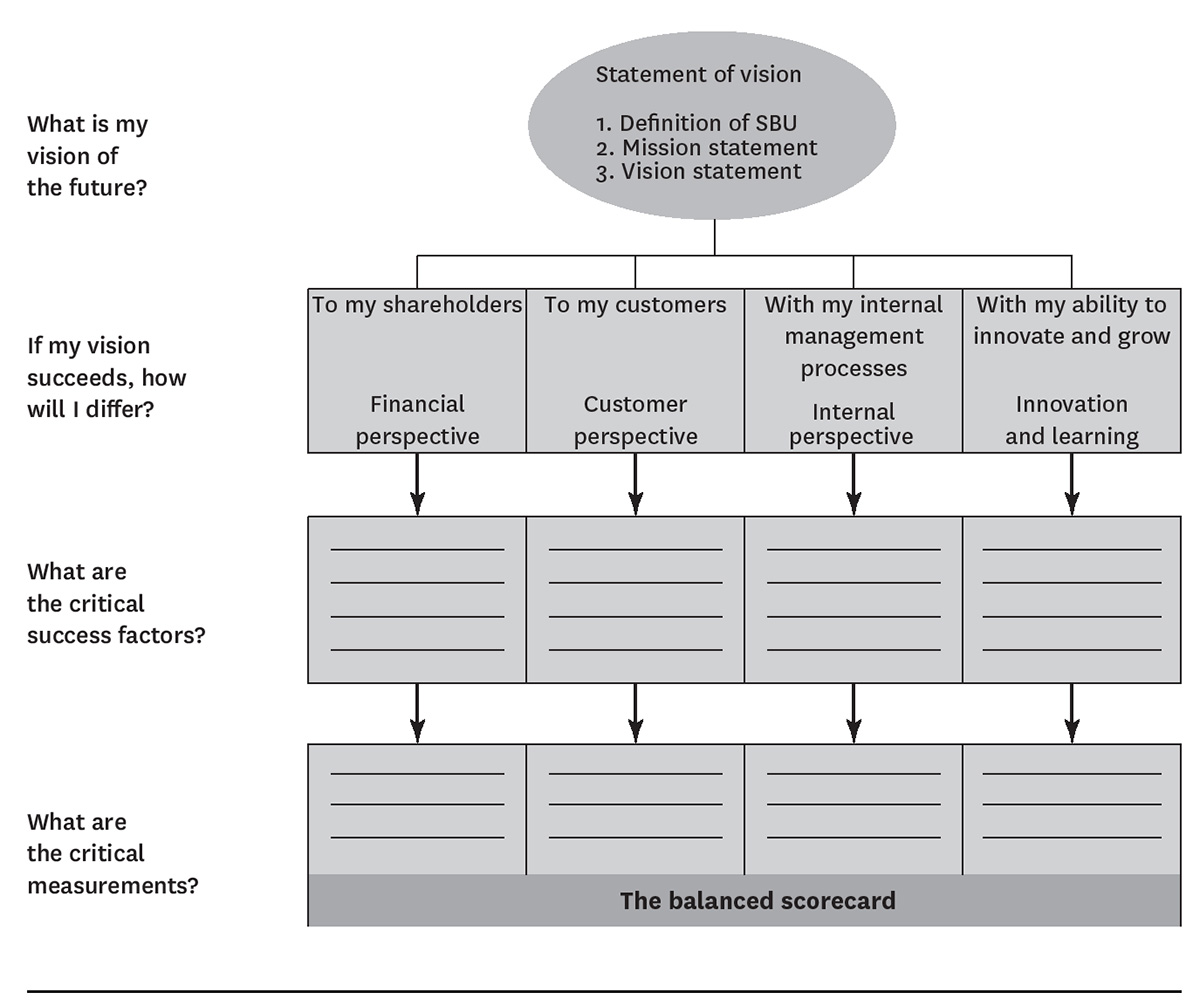
Linking measurements to strategy is the heart of a successful scorecard development process. The three key questions to ask here:
1. If we succeed with our vision and strategy, how will we look different
to our shareholders and customers?
in terms of our internal processes?
in terms of our ability to innovate and grow?
2. What are the critical success factors in each of the four scorecard perspectives?
3. What are the key measurements that will tell us whether we’re addressing those success factors as planned?
The balanced scorecard also brings an organizational focus to the variety of local change programs under way in a company at any given time. As the benchmark against which all new projects are evaluated, the scorecard functions as more than just a measurement system. In the words of FMC Corp. executive Larry Brady, it becomes “the cornerstone of the way you run the business,” that is, “the core of the management system” itself.
Example: Rockwater, an underwater engineering and construction firm, crafted a five-pronged strategy: to provide services that surpassed customers’ expectations and needs; to achieve high levels of customer satisfaction; to make continuous improvements in safety, equipment reliability, responsiveness, and cost effectiveness; to recruit and retain high-quality employees; and to realize shareholder expectations. Using the balanced scorecard, Rockwater’s senior management translated this strategy into tangible goals and actions.
The financial measures they chose included return-on-capital employed and cash flow, because shareholders had indicated a preference for short-term results.
Customer measures focused on those clients most interested in a high value-added relationship.
The company introduced new benchmarks that emphasized the integration of key internal processes. It also added a safety index as a means of controlling indirect costs associated with accidents.
Learning and growth targets emphasized the percentage of revenue coming from new services and the rate of improvement of safety and rework measures.
Financial measures
The financial perspective included three measures of importance to the shareholder. Return-on-capital-employed and cash flow reflected preferences for short-term results, while forecast reliability signaled the corporate parent’s desire to reduce the historical uncertainty caused by unexpected variations in performance. Rockwater management added two financial measures. Project profitability provided focus on the project as the basic unit for planning and control, and sales backlog helped reduce uncertainty of performance.
Rockwater’s strategic objectives
Rockwater’s balanced scorecard
Customer satisfaction
Rockwater wanted to recognize the distinction between its two types of customers: Tier I customers, oil companies that wanted a high value-added relationship, and Tier II customers, those that chose suppliers solely on the basis of price. A price index, incorporating the best available intelligence on competitive position, was included to ensure that Rockwater could still retain Tier II customers’ business when required by competitive conditions.
The company’s strategy, however, was to emphasize value-based business. An independent organization conducted an annual survey to rank customers’ perceptions of Rockwater’s services compared to those of its competitors. In addition, Tier I customers were asked to supply monthly satisfaction and performance ratings. Rockwater executives felt that implementing these ratings gave them a direct tie to their customers and a level of market feedback unsurpassed in most industries. Finally, market share by key accounts provided objective evidence that improvements in customer satisfaction were being translated into tangible benefits.
Internal Processes
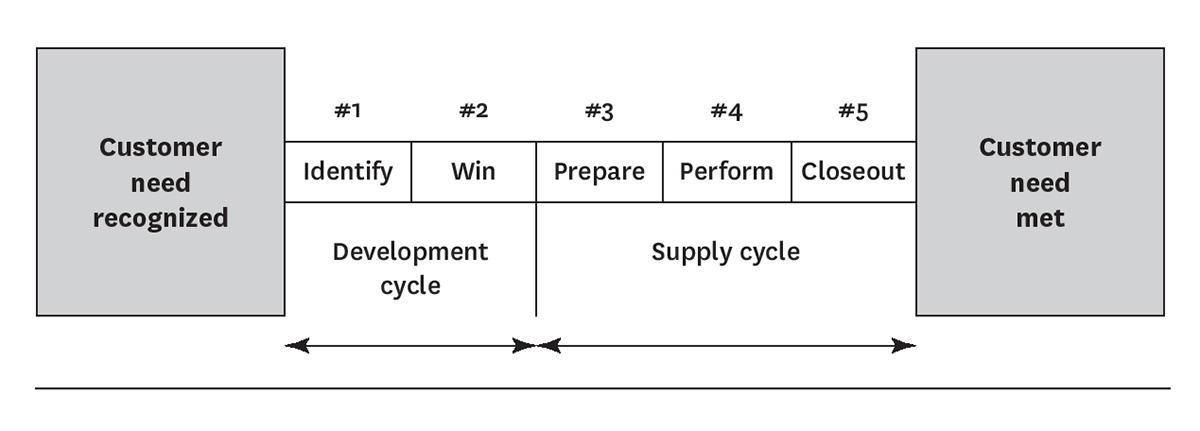
To develop measures of internal processes, Rockwater executives defined the life cycle of a project from launch (when a customer need was recognized) to completion (when the customer need had been satisfied). Measures were formulated for each of the five business-process phases in this project cycle (see the section “How Rockwater Fulfills Customer Needs”):
Identify: number of hours spent with prospects discussing new work;
Win: tender success rate;
Prepare and Deliver: project performance effectiveness index, safety/loss control, rework;
Closeout: length of project closeout cycle.
The internal business measures emphasized a major shift in Rockwater’s thinking. Formerly, the company stressed performance for each functional department. The new focus emphasized measures that integrated key business processes. The development of a comprehensive and timely index of project performance effectiveness was viewed as a key core competency for the company. Rockwater felt that safety was also a major competitive factor. Internal studies had revealed that the indirect costs from an accident could be 5 to 50 times the direct costs. The scorecard included a safety index, derived from a comprehensive safety measurement system, that could identify and classify all undesired events with the potential for harm to people, property, or process.
The Rockwater team deliberated about the choice of metric for the identification stage. It recognized that hours spent with key prospects discussing new work was an input or process measure rather than an output measure. The management team wanted a metric that would clearly communicate to all members of the organization the importance of building relationships with and satisfying customers. The team believed that spending quality time with key customers was a prerequisite for influencing results. This input measure was deliberately chosen to educate employees about the importance of working closely to identify and satisfy customer needs.
How Rockwater fulfills customer needs
Innovation and improvement
The innovation and learning objectives are intended to drive improvement in financial, customer, and internal process performance. At Rockwater, such improvements came from product and service innovation that would create new sources of revenue and market expansion, as well as from continuous improvement in internal work processes. The first objective was measured by percent revenue from new services and the second objective by a continuous improvement index that represented the rate of improvement of several key operational measures, such as safety and rework. But in order to drive both product/service innovation and operational improvements, a supportive climate of empowered, motivated employees was believed necessary. A staff attitude survey and a metric for the number of employee suggestions measured whether or not such a climate was being created. Finally, revenue per employee measured the outcomes of employee commitment and training programs.
The balanced scorecard has helped Rockwater’s management emphasize a process view of operations, motivate its employees, and incorporate client feedback into its operations. It developed a consensus on the necessity of creating partnerships with key customers, the importance of order-of-magnitude reductions in safety-related incidents, and the need for improved management at every phase of multiyear projects. Chambers sees the scorecard as an invaluable tool to help his company ultimately achieve its mission: to be number one in the industry.
Apple Computer: Adjusting Long-Term Performance
Apple Computer developed a balanced scorecard to focus senior management on a strategy that would expand discussions beyond gross margin, return on equity, and market share. A small steering committee, intimately familiar with the deliberations and strategic thinking of Apple’s Executive Management Team, chose to concentrate on measurement categories within each of the four perspectives and to select multiple measurements within each category. For the financial perspective, Apple emphasized shareholder value; for the customer perspective, market share and customer satisfaction; for the internal process perspective, core competencies; and, finally, for the innovation and improvement perspective, employee attitudes. Apple’s management stressed these categories in the following order.
Customer satisfaction
Historically, Apple had been a technology- and product-focused company that competed by designing better computers. Customer satisfaction metrics are just being introduced to orient employees toward becoming a customer-driven company. J.D. Power & Associates, a customer-survey company, now works for the computer industry. However, because it recognized that its customer base was not homogeneous, Apple felt that it had to go beyond J.D. Power & Associates and develop its own independent surveys in order to track its key market segments around the world.
Core competencies
Company executives wanted employees to be highly focused on a few key competencies: for example, user-friendly interfaces, powerful software architectures, and effective distribution systems. However, senior executives recognized that measuring performance along these competency dimensions could be difficult. As a result, the company is currently experimenting with obtaining quantitative measures of these hard-to-measure competencies.
Employee commitment and alignment
Apple conducts a comprehensive employee survey in each of its organizations every two years; surveys of randomly selected employees are performed more frequently. The survey questions are concerned with how well employees understand the company’s strategy as well as whether or not they are asked to deliver results that are consistent with that strategy. The results of the survey are displayed in terms of both the actual level of employee responses and the overall trend of responses.
Market share
Achieving a critical threshold of market share was important to senior management not only for the obvious sales growth benefits but also to attract and retain software developers to Apple platforms.
Shareholder value
Shareholder value is included as a performance indicator, even though this measure is a result—not a driver—of performance. The measure is included to offset the previous emphasis on gross margin and sales growth, measures that ignored the investments required today to generate growth for tomorrow. In contrast, the shareholder value metric quantifies the impact of proposed investments for business creation and development. The majority of Apple’s business is organized on a functional basis—sales, product design, and worldwide manufacturing and operations—so shareholder value can be calculated only for the entire company instead of at a decentralized level. The measure, however, helps senior managers in each major organizational unit assess the impact of their activities on the entire company’s valuation and evaluate new business ventures.
While these five performance indicators have only recently been developed, they have helped Apple’s senior managers focus their strategy in a number of ways. First of all, the balanced scorecard at Apple serves primarily as a planning device, instead of as a control device. To put it another way, Apple uses the measures to adjust the “long wave” of corporate performance, not to drive operating changes. Moreover, the metrics at Apple, with the exception of shareholder value, can be driven both horizontally and vertically into each functional organization. Considered vertically, each individual measure can be broken down into its component parts in order to evaluate how each part contributes to the functioning of the whole. Thought of horizontally, the measures can identify how, for example, design and manufacturing contribute to an area such as customer satisfaction. In addition, Apple has found that its balanced scorecard has helped develop a language of measurable outputs for how to launch and leverage programs.
The five performance indicators at Apple are benchmarked against best-in-class organizations. Today they are used to build business plans and are incorporated into senior executives’ compensation plans.
Advanced Micro Devices: Consolidating Strategic Information
Advanced Micro Devices (AMD), a semiconductor company, executed a quick and easy transition to a balanced scorecard. It already had a clearly defined mission, strategy statement, and shared understanding among senior executives about its competitive niche. It also had many performance measures from many different sources and information systems. The balanced scorecard consolidated and focused these diverse measures into a quarterly briefing book that contained seven sections: financial measures; customer-based measures, such as on-time delivery, lead time, and performance-to-schedule; measures of critical business processes in wafer fabrication, assembly and test, new product development, process technology development (e.g., submicron etching precision); and, finally, measures for corporate quality. In addition, organizational learning was measured by imposing targeted rates of improvements for key operating parameters, such as cycle time and yields by process.
At present, AMD sees its scorecard as a systematic repository for strategic information that facilitates long-term trend analysis for planning and performance evaluation.
Driving the Process of Change
The experiences of these companies and others reveal that the balanced scorecard is most successful when it is used to drive the process of change. Rockwater, for instance, came into existence after the merger of two different organizations. Employees came from different cultures, spoke different languages, and had different operating experiences and backgrounds. The balanced scorecard helped the company focus on what it had to do well in order to become the industry leader.
Building a balanced scorecard
Each organization is unique and so follows its own path for building a balanced scorecard. At Apple and AMD, for instance, a senior finance or business development executive, intimately familiar with the strategic thinking of the top management group, constructed the initial scorecard without extensive deliberations. At Rockwater, however, senior management had yet to define sharply the organization’s strategy, much less the key performance levers that drive and measure the strategy’s success.
Companies like Rockwater can follow a systematic development plan to create the balanced scorecard and encourage commitment to the scorecard among senior and mid-level managers. What follows is a typical project profile:
1. Preparation
The organization must first define the business unit for which a top-level scorecard is appropriate. In general, a scorecard is appropriate for a business unit that has its own customers, distribution channels, production facilities, and financial performance measures.
2. Interviews: First Round
Each senior manager in the business unit—typically between 6 and 12 executives—receives background material on the balanced scorecard as well as internal documents that describe the company’s vision, mission, and strategy.
The balanced scorecard facilitator (either an outside consultant or the company executive who organizes the effort) conducts interviews of approximately 90 minutes each with the senior managers to obtain their input on the company’s strategic objectives and tentative proposals for balanced scorecard measures. The facilitator may also interview some principal shareholders to learn about their expectations for the business unit’s financial performance, as well as some key customers to learn about their performance expectations for top-ranked suppliers.
3. Executive Workshop: First Round
The top management team is brought together with the facilitator to undergo the process of developing the scorecard (see the section “Begin by Linking Measurements to Strategy”). During the workshop, the group debates the proposed mission and strategy statements until a consensus is reached. The group then moves from the mission and strategy statement to answer the question, “If I succeed with my vision and strategy, how will my performance differ for shareholders; for customers; for internal business processes; for my ability to innovate, grow, and improve?”
Videotapes of interviews with shareholder and customer representatives can be shown to provide an external perspective to the deliberations. After defining the key success factors, the group formulates a preliminary balanced scorecard containing operational measures for the strategic objectives. Frequently, the group proposes far more than four or five measures for each perspective. At this time, narrowing the choices is not critical, though straw votes can be taken to see whether or not some of the proposed measures are viewed as low priority by the group.
4. Interviews: Second Round
The facilitator reviews, consolidates, and documents the output from the executive workshop and interviews each senior executive about the tentative balanced scorecard. The facilitator also seeks opinions about issues involved in implementing the scorecard.
5. Executive Workshop: Second Round
A second workshop, involving the senior management team, their direct subordinates, and a larger number of middle managers, debates the organization’s vision, strategy statements, and the tentative scorecard. The participants, working in groups, comment on the proposed measures, link the various change programs under way to the measures, and start to develop an implementation plan. At the end of the workshop, participants are asked to formulate stretch objectives for each of the proposed measures, including targeted rates of improvement.
6. Executive Workshop: Third Round
The senior executive team meets to come to a final consensus on the vision, objectives, and measurements developed in the first two workshops; to develop stretch targets for each measure on the scorecard; and to identify preliminary action programs to achieve the targets. The team must agree on an implementation program, including communicating the scorecard to employees, integrating the scorecard into a management philosophy, and developing an information system to support the scorecard.
7. Implementation
A newly formed team develops an implementation plan for the scorecard, including linking the measures to databases and information systems, communicating the balanced scorecard throughout the organization, and encouraging and facilitating the development of second-level metrics for decentralized units. As a result of this process, for instance, an entirely new executive information system that links top-level business unit metrics down through shop floor and site-specific operational measures could be developed.
8. Periodic Reviews
Each quarter or month, a blue book of information on the balanced scorecard measures is prepared for both top management review and discussion with managers of decentralized divisions and departments. The balanced scorecard metrics are revisited annually as part of the strategic planning, goal setting, and resource allocation processes.
Begin by linking measurements to strategy
Similarly, Joseph De Feo, chief executive of Service Businesses, one of the three operating divisions of Barclays Bank, had to transform what had been a captive, internal supplier of services into a global competitor. The scorecard highlighted areas where, despite apparent consensus on strategy, there still was considerable disagreement about how to make the strategy operational. With the help of the scorecard, the division eventually achieved consensus concerning the highest priority areas for achievement and improvement and identified additional areas that needed attention, such as quality and productivity. De Feo assessed the impact of the scorecard, saying, “It helped us to drive major change, to become more market oriented, throughout our organization. It provided a shared understanding of our goals and what it took to achieve them.”
Analog Devices, a semiconductor company, served as the prototype for the balanced scorecard and now uses it each year to update the targets and goals for division managers. Jerry Fishman, president of Analog, said, “At the beginning, the scorecard drove significant and considerable change. It still does when we focus attention on particular areas, such as the gross margins on new products. But its main impact today is to help sustain programs that our people have been working on for years.” Recently, the company has been attempting to integrate the scorecard metrics with hoshin planning, a procedure that concentrates an entire company on achieving one or two key objectives each year. Analog’s hoshin objectives have included customer service and new product development, for which measures already exist on the company’s scorecard.
But the scorecard isn’t always the impetus for such dramatic change. For example, AMD’s scorecard has yet to have a significant impact because company management didn’t use it to drive the change process. Before turning to the scorecard, senior managers had already formulated and gained consensus for the company’s mission, strategy, and key performance measures. AMD competes in a single industry segment. The top 12 managers are intimately familiar with the markets, engineering, technology, and other key levers in this segment. The summary and aggregate information in the scorecard were neither new nor surprising to them. And managers of decentralized production units also already had a significant amount of information about their own operations. The scorecard did enable them to see the breadth and totality of company operations, enhancing their ability to become better managers for the entire company. But, on balance, the scorecard could only encapsulate knowledge that managers in general had already learned.
The Scorecard’s Impact on External Reporting
SEVERAL MANAGERS HAVE ASKED whether or not the balanced scorecard is applicable to external reporting. If the scorecard is indeed a driver of long-term performance, shouldn’t this information be relevant to the investment community?
In fact, the scorecard does not translate easily to the investment community. A scorecard makes sense primarily for business units and divisions with a well-defined strategy. Most companies have several divisions, each with its own mission and strategy, whose scorecards cannot be aggregated into an overall corporate scorecard. And if the scorecard does indeed provide a transparent vision into a unit’s strategy, then the information, even the measures being used, might be highly sensitive data that could reveal much of value to competitors. But most important, as a relatively recent innovation, the scorecard would benefit from several years of experimentation within companies before it becomes a systematic part of reporting to external constituencies.
Even if the scorecard itself were better suited to external reporting, at present the financial community itself shows little interest in making the change from financial to strategic reporting. One company president has found the outside financial community leery of the principles that ground the scorecard: “We use the scorecard more with our customers than with our investors. The financial community is skeptical about long-term indicators and occasionally tells us about some empirical evidence of a negative correlation between stock prices and attention to total quality and internal processes.”
However, the investment community has begun to focus on some key metrics of new product performance. Could this be an early sign of a shift to strategic thinking?
AMD’s limited success with the balanced scorecard demonstrates that the scorecard has its greatest impact when used to drive a change process. Some companies link compensation of senior executives to achieving stretch targets for the scorecard measures. Most are attempting to translate the scorecard into operational measures that become the focus for improvement activities in local units. The scorecard is not just a measurement system; it is a management system to motivate breakthrough competitive performance.
To see how the Balanced Scorecard is implemented in practice, you can explore a related case study from FMC Corporation. In this interview, a senior executive explains how the framework was applied, along with the challenges faced and the results achieved.
➤ Implementing the Balanced Scorecard at FMC Corporation: An Interview with Larry D. Brady












Please Log in to leave a comment.