Strategic Choices Need to Be Made Simultaneously, Not Sequentially
Author: Roger L. Martin

The CEO of a large Australian company called me to relay a particular strategy-development problem his firm was facing and ask for my advice. The company was an eager user of my “cascading choices” framework for strategy, which I have used for decades and written about extensively, most prominently in Playing to Win, the 2013 book I wrote with friend and colleague A.G. Lafley.
My Australian friend explained that each of his five business-unit presidents was using the Strategy Choice Cascade and that all of them had gotten stuck in the same place. They had chosen a Winning Aspiration and had settled on a Where to Play choice. But all of them were stuck at the How to Win box.
“It’s no surprise,” I told my friend, “that they have gotten stuck. It’s because they considered Where to Play without reference to How to Win.”
I’ve heard variants of this over and over. Although I have always emphasized that these five choices have to link together and reinforce one another (hence the arrows flowing back and forth between the boxes), it has become clear to me that I haven’t done a good enough job of making this point, especially as it relates to the choices of Where to Play and How to Win.
The strategy choice cascade
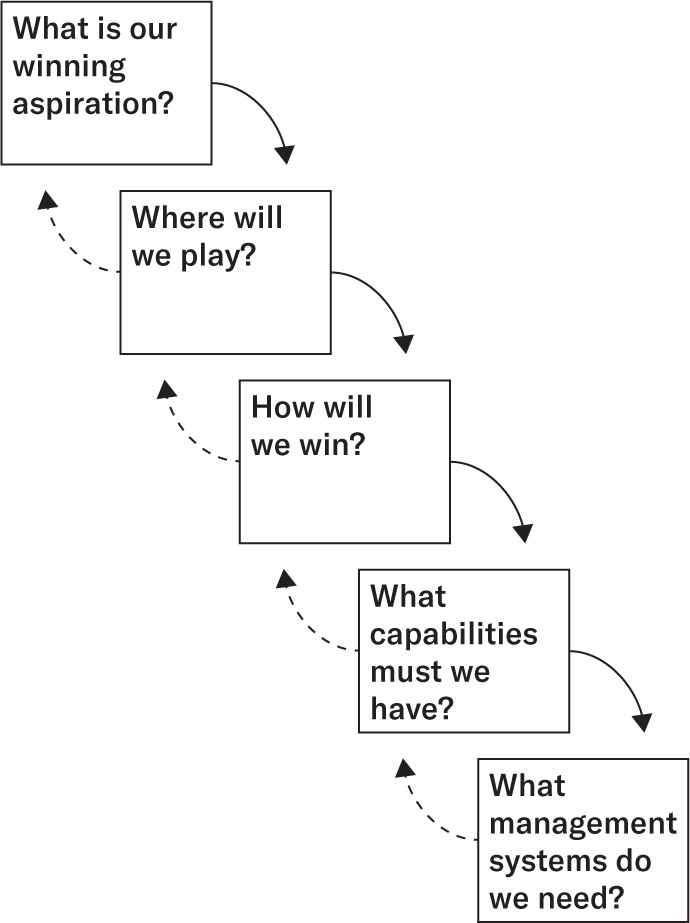
Source: Playing to Win: How Strategy Really Works, by A.G. Lafley and Roger L. Martin (Boston: Harvard Business Review Press, 2013).
The challenge here is that they are linked, and together they are the heart of strategy; without a great Where to Play and How to Win combination, you can’t possibly have a worthwhile strategy. Of course, Where to Play and How to Win have to link with and reinforce an inspiring Winning Aspiration. And Capabilities and Management Systems act as reality checks on the Where to Play and How to Win choices. If you can’t identify sets of Capabilities and Management Systems that you currently have, or can reasonably build, to make the Where to Play and How to Win choices come to fruition, then what you have is a fantasy, not a strategy.
Idea in Brief
- The Challenge
Many organizations struggle with strategic planning because they make key decisions in isolation. This approach often leads to misaligned strategies that fail to deliver optimal results.
- The Solution
Executives must make choices about Where to Play and How to Win simultaneously, since their strategic elements need to reinforce one another to create a cohesive and powerful approach. By doing so, leaders can develop matched sets of decisions that align with the organization’s overall goals and competitive context.
- The Payoff
Organizations that implement this integrated strategy-making process are better positioned to navigate complex environments, respond to market changes, and execute their strategies with greater precision and impact.
Many people ask me why Capabilities and Management Systems are part of strategy when they are really elements of execution. That is yet another manifestation of the widespread, artificial, and unhelpful attempt to distinguish between choices that are “strategic” and ones that are “executional” or “tactical.” Remember that, regardless of the name you give them, these choices are critical parts of the integrated set of five choices necessary to successfully guide the actions of an organization.
I had to tell my Australian friend that locking and loading on Where to Play choices, rather than setting the table for a great discussion of How to Win, actually makes it virtually impossible to have a productive consideration of How to Win. That is because no meaningful Where to Play choice exists outside the context of a particular How to Win plan. An infinite number of Where to Play choices are possible and equally meritorious—before considering each one’s How to Win. In other words, there aren’t inherently strong and weak Where to Play choices. They are only strong or weak in the context of a particular How to Win choice. Therefore, making lists of Where to Play options before considering How to Win options has zero value in strategy.
For example, Uber made a Where to Play choice that included China because it’s a huge and important market. But being huge and important didn’t make that choice inherently meritorious. It would have been worthy only if there had been a clear How to Win as well—which it appears there never was. Microsoft made a Where to Play choice to get into smartphone hardware (with its acquisition of Nokia’s handset business) because it was a huge and growing market, seemingly adjacent to Microsoft’s own. But it had no useful conception of how that would be twinned with a How to Win choice—and it lost spectacularly. Procter & Gamble made a Where to Play choice to get into the huge, profitable, and growing pharmaceutical business with the acquisition of Norwich Eaton, in 1982. While it performed decently, P&G divested the business in 2009 because, in those nearly two decades, it came to realize that it could play but never win in that still-exciting Where to Play.
Moreover, no meaningful How to Win plan exists outside the context of a particular Where to Play choice. Despite what many think, there are not generically great ways to win—for example, being a first mover or a fast follower or a branded player or a cost leader. All How to Win options are useful, or not, depending on the Where to Play with which they are paired. A How to Win choice based on superior scale is not going to be useful if the Where to Play choice is to concentrate on a narrow niche—because that would undermine an attempted scale advantage.
Undoubtedly, Uber thought its How to Win plan—having an easy-to-use ride-hailing app for users twinned with a vehicle for making extra money for drivers—would work well in any Where to Play. But it didn’t work in the Where to Play of China. It turned out that Uber’s How to Win had a lot to do with building a first-mover advantage in markets like the United States; when Uber was a late entrant, the Where to Play wasn’t a simple extension, and it exited after losing convincingly to first mover DiDi. Perhaps Microsoft felt that its How to Win of having strong corporate relationships and a huge installed base of software users would extend nicely into smartphones, but it most assuredly didn’t. As a Canadian, I can’t help but recall the many Canadian retailers with powerful How to Wins here (Tim Hortons, Canadian Tire, Jean Coutu) that simply didn’t translate to a Where to Play in the United States. Perhaps there is some solace, however, in retailer Target’s disastrous attempt to extend its U.S. How to Win into the Canadian Where to Play—turnabout is, I guess, fair play.
The only productive, intelligent way to generate possibilities for strategy is to consider matched pairs of Where to Play and How to Win options. Generate a variety of pairs and then ask about each set:
Can it be linked to an inspiring, attractive Winning Aspiration?
Do we currently have, or can we reasonably build, the Capabilities that would be necessary to win where we would play?
Can we create the Management Systems that would need to be in place to support the building and maintenance of the necessary Capabilities?
Those Where to Play and How to Win possibilities for which these questions can plausibly be answered in the affirmative should be taken forward for more consideration and exploration. For the great success stories of our time, the tight match of Where to Play and How to Win is immediately obvious. USAA sells insurance only to military personnel, veterans, and their families and tailors its offerings brilliantly and tightly to the needs of those in that sphere—so much so that its customer satisfaction scores are off the charts. Vanguard sells index mutual funds/exchange-traded funds to customers who don’t believe that active management is helpful to the performance of their investments. With that tight Where to Play, it can win by working to achieve the lowest cost position in the business. Google wins by organizing the world’s information, but to do that it has to play across the broadest swath of search.
It doesn’t matter whether the strategic question is to aim broadly or narrowly, or to pursue low costs or differentiation. What does matter is that the answers are a perfectly matched pair.
Please Log in to leave a comment.