The Two Traits of the Best Problem-Solving Teams
Authors: Alison Reynolds and David Lewis
Imagine you are a fly on the wall in a corporate training center where a management team of 12 is participating in a session on executing strategy. The team is midway through attempting to solve a new, uncertain, and complex problem. The facilitators look on as at first the exercise follows its usual path. But then activity grinds to a halt—people have no idea what to do. Suddenly, a more junior member of the team raises her hand and exclaims, “I think I know what we should do!” Relieved, the team follows her instructions enthusiastically. There is no doubt she has the answer—but as she directs her colleagues, she makes one mistake, and the activity breaks down.
Not a word is spoken but the entire group exudes disappointment. Her confidence evaporates. Even though she has clearly learned something important, she does not contribute again. The group gives up.
What happened?
In our previous research, we discovered that teams with high levels of cognitive diversity performed better than those with low levels on these kinds of challenges. In these groups, we observed a blend of different problem-solving behaviors, like collaboration, identifying problems, applying information, maintaining discipline, breaking rules, and inventing new approaches. These techniques made these groups more effective than groups where there were too many rule-breakers or too many discipline-maintainers, for example.
But in the case of the 12 managers in the example we described, they did show a cognitively diverse approach. So what happened? We returned to our data to find out. In this team, as well as other underperforming teams, we observed a smaller percentage of the group contributing, longer intervals between testing ideas, and greater repetition of the same mistakes.
The groups that performed well treated mistakes with curiosity and shared responsibility for the outcomes. As a result, people could express themselves, their thoughts, and ideas without fear of social retribution. The environment they created through their interaction was one of psychological safety.
Psychological safety is the belief that one will not be punished or humiliated for speaking up with ideas, questions, concerns, or mistakes. It is a dynamic, emergent property of interaction and can be destroyed in an instant with an ill-timed sigh. Without behaviors that create and maintain a level of psychological safety in a group, people do not fully contribute—and when they don’t, the power of cognitive diversity is left unrealized. Furthermore, anxiety rises and defensive behavior prevails.
So the question is, how do you establish and maintain psychological safety with a cognitively diverse group?
The generative organization
Over the last 12 months we asked 150 senior executives from different organizations across the world to rate their organizations in terms of cognitive diversity, psychological safety, and the extent to which they consider their organization able to anticipate and respond to challenges and opportunities, that is, their adaptability. Not surprisingly, adaptability correlated very highly with high levels of both cognitive diversity and psychological safety. We called these organizations “generative,” and labeled the worst-performing organizations oppositional (high diversity, low safety), uniform (low diversity, high safety), and defensive (low in both).
We also asked the same 150 executives to choose five words (from a list of more than 60) that best described the dominant behaviors and emotions in their organization. To identify which behaviors correlated with the best- and worst-performing groups, we matched the chosen words with the levels of reported psychological safety and cognitive diversity. Figure 1 shows the most common behaviors selected by each group.
In the Generative quadrant, we find behaviors associated with learning, experimenting, and confidence. Together they facilitate high-quality interaction. Interestingly, “forceful” appears here, too, which at a first glance might seem surprising. Exploring this further, participants were identifying the assertive expression and vigorous analysis of ideas. “Forceful” therefore relates to having the confidence to persist in expressing what you think is important. Psychologically safe environments enable this kind of candor without it being perceived as aggressive. Note that we also see more positive emotions in the generative and uniform quadrants.
FIGURE 1
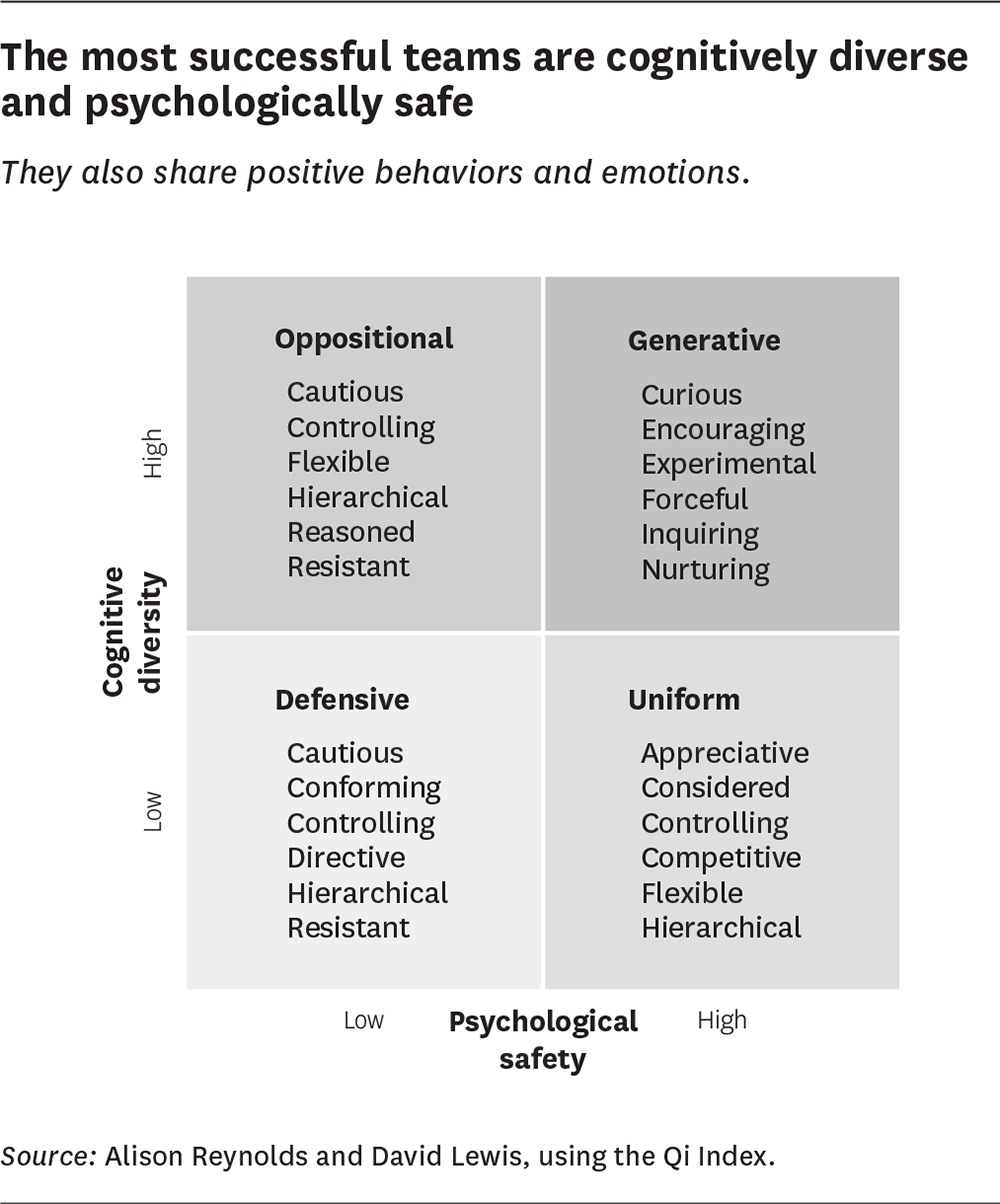
By contrast, in the other quadrants, we find words associated with control and constraint. These behaviors are conspicuously absent from the Generative quadrant. We see more negative emotions as well.
The behaviors that count
We choose our behavior. We need to be more curious, inquiring, experimental, and nurturing. We need to stop being hierarchical, directive, controlling, and conforming. It is not just the presence of the positive behaviors in the Generative quadrant that count; it is the corresponding absence of the negative behaviors.
For example, hierarchical behavior is cited as one of the top five dominant behaviors 40% of the time in the non-generative quadrants. It is only cited 15% of the time as a top behavior in the Generative quadrant. This is not because the organizations in the Generative quadrant have a flatter structure—hierarchy is a fact of organizational life—but because hierarchy does not define their interactions. We see controlling cited 33% of the time as a top behavior in the non-generative quadrants compared with only 10% in the generative quadrant. We see directive cited 24% of the time as top behavior in the non-generative quadrants compared to only 5% in the Generative quadrant.
When we fail to foster a high-quality interaction, we lose out on the benefit of discourse between people who see things differently. The result is a lack of deep understanding, fewer creative options, diminished commitment to act, increased anxiety and resistance, and reduced morale and well-being.
A psychologically safe environment ignites cognitive diversity and puts different minds to work on the bumpy and difficult journey of strategy execution.
How people choose to behave determines the quality of interaction and the emergent culture. Leaders need to consider not only how they will act but, as importantly, how they will not act. They need to disturb and disrupt unhelpful patterns of behavior and commit to establishing new routines. To lay the ground for successful execution everyone needs to strengthen and sustain psychological safety through continuous gestures and responses. People cannot express their cognitive difference if it is unsafe to do so. If leaders focus on enhancing the quality of interaction in their teams, business performance and well-being will follow.
ALISON REYNOLDS is a member of faculty at the U.K.’s Ashridge Business School, where she works with executive groups in the field of leadership development, strategy execution, and organization development. She has previously worked in the public sector and management consulting and is an adviser to a number of small businesses and charities. DAVID LEWIS is Director of London Business School’s Senior Executive Programme and teaches on strategy execution and leading in uncertainty. He is a consultant and works with global corporations, advising and coaching board teams. He is a cofounder of a research company focusing on developing tools to enhance individual, team, and organizational performance through better interaction.
Please Log in to leave a comment.