What 570 Experts Predict the Future of Work Will Look Like
Authors: Nicky Dries, Joost Luyckx, and Philip Rogiers

“Technology has given us the moon landing, the personal computer, and the smartphone—not to mention indoor plumbing and washing machines,” an optimist might say. “Why would we ever want to stop progress? We should be accelerating, not halting and regulating. AI and robotics are going to bring us into the post-scarcity age, making us all richer and doing our dirty work for us.”
“Let’s not get ahead of ourselves,” a skeptic replies. “Newspapers have claimed that robots are coming to take over our jobs for 50 years now—it hasn’t happened before, and it won’t now. New technologies like AI will, however, increase productivity and efficiency, which leads to economic growth and to new and better jobs for people.”
A pessimist retorts: “Not so fast. This time it really is different. Let’s not forget that previous industrial revolutions indeed brought technological progress, but also had dramatic effects on the working and living conditions of workers of that time, which lasted for decades on end. There is no reason to believe that big business won’t see automation as an opportunity to reduce labor costs, thanks to a workforce of robots and algorithms that can work day and night without ever needing a break, complaining, or getting sick. What we need is not more economic growth, but degrowth.”
Who’s right here: the optimist, the skeptic, or the pessimist? And which scenario do you personally believe in more?
Sorting Out Beliefs About the Future of Work
These two questions were the focus of our recent study. To answer them, we first identified a set of 485 Belgian newspaper articles from the last five years, in which global experts made predictions about the future of work. Based on this newspaper analysis, we found that three specific groups clearly dominate the debate around the future of work in the media: tech entrepreneurs (like Elon Musk), economics professors (like David Autor from MIT), and bestselling authors and leading journalists (like David Frayne and his book The Refusal of Work). We found high agreement between experts from the same group about how they believed the future of work will play out and low agreement between the groups. (To our surprise, policymakers, politicians, union representatives, and HR managers were largely absent in these articles.)
We then identified 570 experts from tech, economics, and writing/journalism, from both our personal networks and from larger mailing lists for Belgian CEOs and journalists. Our team wrote scenarios about the future of work (similar to the ones in our introduction but with more detail) based on the competing predictions made in the media and asked them to rate the likelihood of different predictions. All experts who completed the survey consistently believed that the scenarios pushed by “their” group in the media were more likely.
Next, we asked them to indicate, for each separate prediction, by what year they expected it to happen and with what degree of certainty. As expected, we found that optimists mostly expected positive breakthroughs in the near future; pessimists believed in negative outcomes and saw them as imminent; and skeptics were more likely to indicate for many predictions that they would never happen or only in the very distant future. Assuming that each of these groups of experts held a piece of the puzzle, we averaged out their predictions and mapped them onto one timeline to produce a rather haunting “consensus” view of what the future of work might look like.
A timeline of future-of-work predictions
When asked to rank the likelihood of predictions made by tech entrepreneurs, economists, and journalists in 485 newspaper articles, 570 experts from these fields landed on the following course of events as most likely to occur.
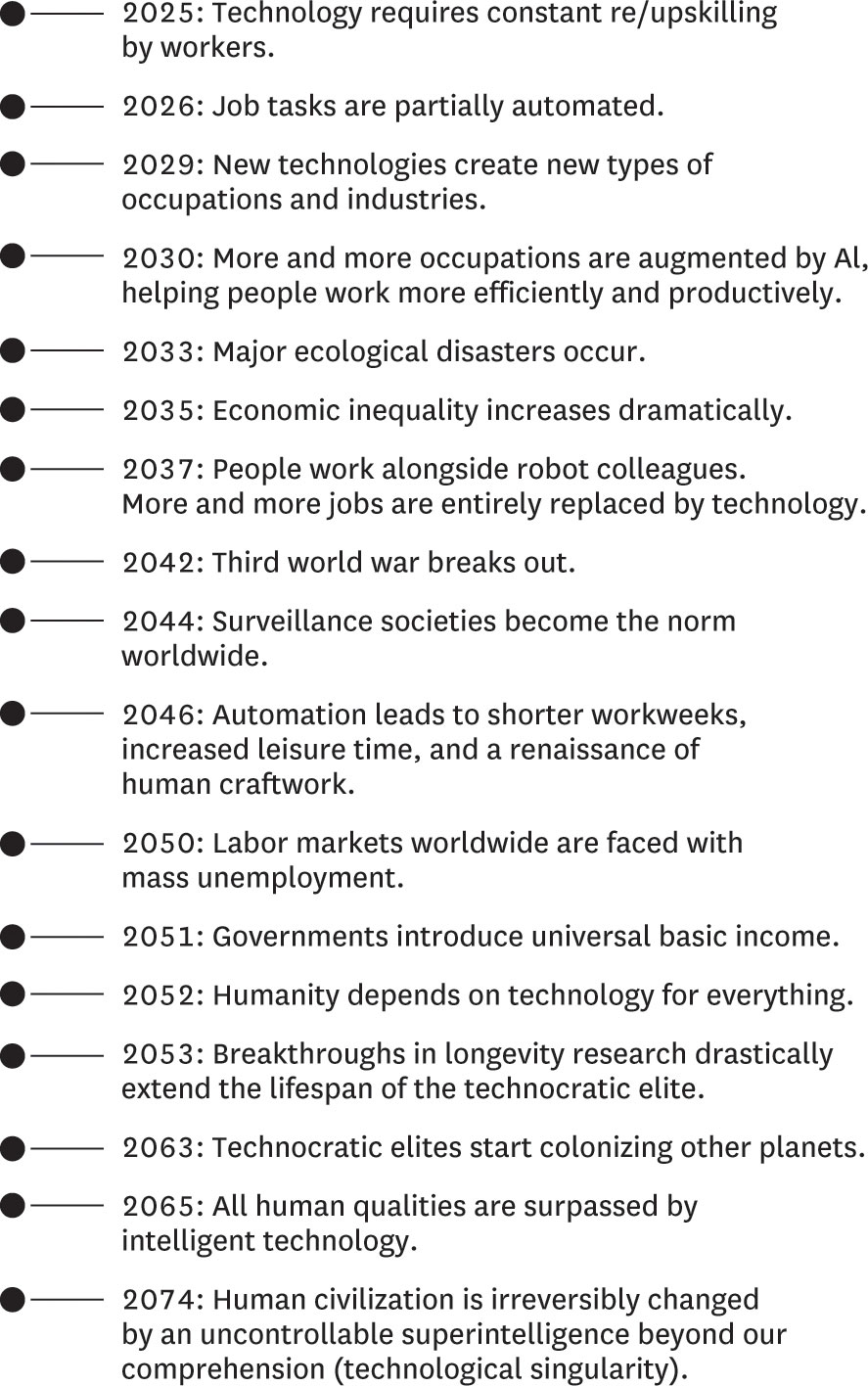
Source: Nicky Dries, Joost Luycks, and Philip Rogiers, “Imagining the (Distant) Future of Work,” Academy of Management Discoveries, 2024.
Finally, we had the three groups of experts take a personality test, which included questions about their childhood and about their current values and beliefs. We found that the tech entrepreneurs were radical optimists, the economists believed in rationality above all, and the authors and journalists held attitudes indicative of misanthropy and a belief that much in society is decided by those in power behind closed doors. We found that not only did these different groups of experts have very distinct personality types, their personalities also translated into competing beliefs about the future of work.
Thus, the tech entrepreneurs were the optimists, the economists the skeptics, and the authors and journalists the pessimists in our data.
To complicate matters further, based on our newspaper analysis, we concluded that all three groups of experts were truly convinced that their predictions about the future of work were right and that the others were wrong—and even preposterous. Economists, for instance, tended to refer to bestselling authors as “doomers” and tech entrepreneurs as “hypers.” They particularly loathed the idea of degrowth, which they likened to institutionalized poverty. Authors and journalists, from their side, could not understand why the other groups of experts did not see that there are (or should be) limits to economic growth, especially in light of climate change and global inequality. Tech entrepreneurs considered themselves the only group qualified to make statements about advanced technologies that no one but them really understands, especially politicians; in their eyes, these people were “dinosaurs.”
Why There Are Differences in Beliefs About the Future of Work
In general, members of each expert group found it hard to understand how it was possible for the others to have such different beliefs about the future of work. After all, their predictions were based on objective numbers, figures, historical trends, and scientific research—how could anyone argue with that? The answer, of course, is that each of these experts were trained in a specific field, with its own set of rules and assumptions about how the world works. Further, they are also taught what counts as evidence within their discipline—consider how different that will look in computer science, economics, and political science, for instance. These experts interact mostly with people from the same or similar disciplines, attend workshops, and read reports that reinforce the so-called “field frames” they have been socialized into. This leads to homogeneity within disciplines and heterogeneity between disciplines. It also explains why these competing groups of experts find it so hard to understand each other’s point of view.
In summarizing the findings of this study to others, we typically quip that “we can’t predict the future of work, but we can predict your prediction.” When we do keynotes about the study, the audience often starts laughing when they recognize the script from their own discipline almost verbatim. Sometimes, executives remark that “they are typical economists” or “they are on team degrowth.” While this may seem like it separates people into distinct categories, we also find that it gets them to listen and talk to each other with a more open mind. We believe that this is crucially important, as many of the challenges humankind will likely face in the future of work—such as the potential emergence of hyperintelligent AI or robots with fine sensorimotor skills—will require interdisciplinary task forces and cooperation. As our study shows, experts from different disciplines typically have different views on future risks and opportunities—and we know from research that embracing uncertainty and competing scenarios is in fact essential to long-term strategic planning.
The Future Is What We Make It
The implications of our study are potentially controversial in the current “post-truth” climate—are we saying that there are no objective facts in life, that everything is subjective, and that expertise is a myth? We wouldn’t go that far. Rather, what we believe our study shows is that as the future is not yet set in stone, it is impossible to determine who is right about the future of work. Instead, the future will be whatever we make it. In our view, the scenarios pushed by optimists, skeptics, and pessimists are all theoretically possible. Questions like “Will AI destroy a lot of jobs?” are thus misguided—whether AI destroys a lot of jobs or not will depend on the decisions made by people in the coming years. The question is thus not, “What will the future of work be like?” but rather, “What do we want the future to be like?” This reframes the future-of-work question as an arena for values, politics, ideology, and imagination, instead of a set of trends that can objectively be predicted. It also makes clear that the debate around the future of work is likely to get even more polarized in the years to come. One person’s utopia is another’s dystopia.
So, what can you start doing today? First, from now on, whenever you hear or read something about the future of work, don’t just look at what is predicted (and by when), but also who is saying it and why. What vested interests do they have? What society do they want, and how does it benefit them? Second, what is your utopia for the future, and what is your dystopia? What should we do—or stop doing—in the short-, mid-, and long-term to move toward your desirable scenarios and to reduce the risk of undesirable ones? What can we do to avoid points of no return for the distant future, for instance, when we are thinking about the climate or superintelligent AI? And third, what do you have most control over from your position of power and influence in society? What forms of power and influence do you not have? Can you partner with others who have sources of influence complementary to yours and who share the same vision of utopia?
Based on our research, we would like to invite every citizen, every policymaker, and every manager and CEO to enter the public debate around the future of work to ensure that it unfolds within a social and democratic dialogue. The future is what we make it.
TAKEAWAYS
The future of work remains uncertain, shaped by differing perspectives from experts in technology, economics, and journalism. A study analyzing predictions from 570 experts in three groups—entrepreneurs, economists, and journalists—revealed that each group sees the future through the lens of their own discipline, leading to contrasting views that are difficult to parse.
Diverging perspectives. Tech entrepreneurs are optimistic, economists are skeptical, and journalists lean pessimistic about automation and AI’s impact.
Expert bias. Each group believes their own predictions are most likely, shaped by their field’s assumptions and evidence.
Uncertain future. The study suggests the future is not predetermined but depends on societal choices and values.
A call to action. Individuals and policymakers should actively shape the future by engaging in democratic discourse and strategic decision-making.
Please Log in to leave a comment.