How to Turn Your Goals Into Reality?

Have you ever wondered why some people seem to effortlessly achieve everything they want, while others, despite their hard efforts, fail to reach their dreams? Perhaps the main difference lies in the approach and method they use to turn dreams into reality. Many of us have big goals in mind; from starting a new business and improving financial status to learning a new skill or achieving fitness. But without a clear roadmap and the necessary tools, these goals can remain mere wishes.
In the psychology of success, this difference is called the «Intention-Action Gap»; that is, the gap between what we want to do and what we actually do. Stanford University research has shown that successful people fill this gap not with more willpower, but with «more effective mental and behavioral structures.»
This article is a comprehensive and practical guide for you to learn how to move your goals from thought to action. We will help you, using proven methods, not only to define your goals correctly, but also to create an operational plan for realizing them and stay steadfast on the path to success. If you're ready to discover your hidden potential and build the life you've always dreamed of, this article is for you.
Table of Contents
- 1. Setting SMART Goals: The Foundation of Success
- 2. Detailed Planning: From Dream to Reality
- 3. Action and Continuous Follow-up: Moving Toward the Destination
- 4. Personal Development and Skills: Tools for Achieving Goals
- Conclusion
1. Setting SMART Goals: The Foundation of Success
Before taking any action, it's essential to clearly know exactly what you're looking for. Setting goals correctly is the first and perhaps most important step in achieving them. A vague goal leads to confusion; but a specific goal lights the way.
What are SMART Goals and Why Do They Matter?
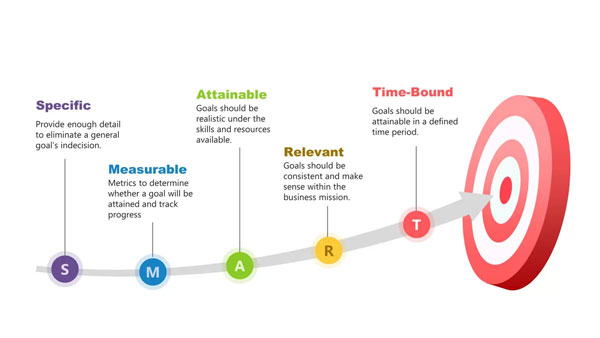
The SMART model is a powerful framework for defining goals that helps you have clear and achievable goals. The word SMART is an acronym for five key characteristics:
- Specific: The goal should be clear and precise. Instead of "I want to succeed," say "I want to increase my monthly income by 20% by the end of the year."
- Measurable: You should be able to measure your progress. "20% increase" is a measurable criterion.
- Achievable: The goal should be challenging but realistic. A goal that seems impossible will gradually reduce your motivation.
- Relevant: The goal should align with your values and other life goals. Is this goal really important to you and does it lead you toward the life you desire?
- Time-bound: Set a deadline for your goal. This creates a sense of urgency and prevents procrastination.
By following these principles, your goals turn from a vague wish into an actionable plan.
How to Set Measurable and Achievable Goals?
Setting measurable goals allows you to see your progress and experience a sense of success. For example, if your goal is "fitness," turn it into "running 30 minutes three times a week" or "losing 5 kg in three months." Achievable goals also mean that you have or can acquire the necessary resources (time, skills, energy) to reach them. If your goal is "becoming a billionaire entrepreneur in one year," you may need to break it down into smaller, more realistic goals.
Setting Relevant and Time-bound Goals to Increase Effectiveness
The connection of the goal to your life is very important. A goal that has no meaning for you is easily abandoned. Ask yourself why this goal is vital for you and what impact it will have on your life. Also, precise timing is a strong driving force. Without a specific deadline, your goals may remain on your to-do list and never reach the execution stage.
Breaking Down Big Goals into Smaller, Manageable Ones
Sometimes, the size and magnitude of a big goal can scare us and cause procrastination. The solution is to break your big goal into smaller, more manageable pieces. For example, if your goal is writing a book, smaller goals could include "writing 1000 words a day," "researching the first chapter," or "outlining the entire book." Each small step brings you closer to the final goal, and the sense of success at each stage increases your motivation.
2. Detailed Planning: From Dream to Reality
A goal without a plan remains just a wish. Planning is the stage that gives your goals structure and direction. This stage draws a precise map from point A to point B and helps you identify the necessary resources and actions.
Developing a Step-by-Step Action Plan for Each Goal
After setting the goal, it's time to specify the details of achieving it. Your action plan should include all the necessary steps, in order of occurrence, to reach the goal. For each step, specify who is responsible for doing it (if it's teamwork), what resources you need, and when it should be done. This roadmap turns vague steps into specific actions.
Identifying Required Resources (Time, Skills, Financial)
To achieve any goal, you need resources. These resources can include enough time to work on the project, specific skills you need to learn or develop, and the financial resources necessary for investment or covering costs. Before starting, make a list of all the required resources. If a resource is not available, plan to acquire or provide it.
Anticipating Potential Obstacles and Solutions to Overcome Them
No path is without challenges. Successful people are not those who never face problems, but those who are prepared for potential obstacles. In the planning stage, take time to think about what challenges might arise in your path. Could you face time shortages, lack of motivation, financial problems, or external barriers? For each potential obstacle, pre-determine one or more practical solutions. This proactive approach helps you be less surprised when facing problems and react faster.

The Importance of Creating a Timeline and Deadlines
Timeline and deadlines are the backbone of an action plan. Setting specific dates for each stage of the plan helps you stay committed and prevents procrastination. These deadlines also allow for measuring progress and show you whether you're on the right track or need to adjust your pace. Breaking big goals into smaller ones with short-term deadlines makes reaching the final goal more manageable.
3. Action and Continuous Follow-up: Moving Toward the Destination
Planning is great, but without action, it's useless. This section focuses on the importance of starting, maintaining momentum, and persisting on the path to achieving goals. Many people stop at the planning stage and never reach execution.
Overcoming Procrastination and Getting Started
Procrastination is one of the biggest obstacles on the path to goals. Often, procrastination happens due to fear of failure, perfectionism, or feeling overwhelmed by the magnitude of the task. To overcome it, start with the smallest step. It doesn't have to be perfect. Just start. Techniques like the "5-minute rule" (if you start a task for 5 minutes, you're likely to continue it) or the "2-minute rule" (if a task takes less than 2 minutes, do it immediately) can be very helpful.
Methods to Maintain Motivation and Energy Throughout the Journey
Maintaining motivation over a long journey is challenging. To keep your motivation and energy, remember that:
- Celebrate small progress: Every small success, even if minor, deserves recognition. This gives you energy to move forward.
- Surround yourself with supportive people: Connecting with people who give you positive energy and believe in your goals is very effective.
- Take regular breaks: Excessive fatigue can reduce your productivity and motivation.
- Keep the ultimate goal in mind: Always remember why you started and where your final destination is.
The Importance of Regular Review and Adjustment of the Plan
A plan is a living document that must be regularly reviewed and adjusted if necessary. Life is unpredictable, and you may face new challenges or opportunities. Weekly or monthly, review your progress. Are you still on the right path? Do you need changes in strategies or deadlines? Flexibility in the plan is a sign of intelligence, not weakness.
How to Deal with Failures and Disappointments?
Failure is an inevitable part of every successful path. Successful people are not those who never fail, but those who learn from their failures. See failure as an opportunity for learning. Ask yourself what went wrong? What could I have done differently? Then, apply the lessons learned to your next attempts. Disappointment is natural, but don't let it stop you from continuing the path.
4. Personal Development and Skills: Tools for Achieving Goals
To achieve big goals, we often need personal growth and development. This section focuses on the importance of upgrading skills and knowledge to turn you into a more capable person on the path to realizing your goals.
Identifying the Necessary Skills for Achieving Your Goals
Every goal requires a set of skills. For example, if your goal is starting a business, you may need skills in marketing, financial management, or sales. Make a list of the key skills you need to reach your goal. Then, honestly assess which of these skills you are strong in and which need improvement.
Ways to Learn and Develop New Skills
After identifying skill gaps, it's time to take action to learn and develop them. There are many resources for this purpose:
- Online and in-person training courses: For effective and up-to-date learning, you can use Git website training courses. These courses help you navigate the path to achieving your goals faster and more purposefully.
- Books and specialized articles: Regular reading in the relevant field deepens your knowledge.
- Mentorship: Finding a mentor with sufficient experience in your field can dramatically increase your progress speed.
- Practice and repetition: There is no substitute for practical practice. Knowledge that is not applied is quickly forgotten.
For deeper learning and further mastery of these concepts, we recommend exploring the courses below:
- How to Set Goals When Everything Feels Like a Priority
- OKR Goal Setting 101 - Achieve more goals than ever! Faster!
- The 7-Step Surefire System for Goal Setting and Achievement
- Complete Goal Setting Course - Become Your Own Life Coach
- Goal Setting & Goal Achievement Workshop
The Importance of Self-Knowledge and Strengths and Weaknesses
Self-knowledge is the cornerstone of personal development. By precisely knowing your strengths and weaknesses, you can make the best use of your strengths and plan to improve your weaknesses. This knowledge helps you choose goals that align with your real abilities or plan to acquire new ones. Tools like personality tests or getting feedback from others can be useful in this path.
The Role of Positive Mindset and Resilience in Success
A positive mindset is not just a motivational phrase, but a powerful tool. Believing in your abilities, expecting success, and seeing challenges as opportunities can have a significant impact on the final result. Resilience also means the ability to return to the initial state after facing hardships and failures. People with high resilience are less likely to give up and more inclined to continue the path, even when things get tough. Cultivating these two traits will assist you on the ups and downs of realizing goals.
Conclusion
Turning goals into reality is a journey, not a destination. This journey requires precise planning, continuous action, flexibility, and self-belief. From setting SMART goals to facing challenges and personal development, each step brings you closer to your ultimate dream. Remember that success doesn't come overnight, but is the result of small, continuous efforts that accumulate over time.
Today, take a small step. No matter how big or small it is, the important thing is to start. Your future awaits your decisions and actions today. So pick up your pen and paper, think about your biggest dream, and take the first step toward realizing it. Your potential is limitless; it's time to showcase it.
Please Log in to leave a comment.