How to Write an Elevator Pitch – With Examples

Let’s be real: no one’s got time for a boring introduction. In a world where attention spans are shorter than a TikTok video, nailing your first impression isn’t optional, it’s everything. Whether you’re hustling for your dream job, pitching investors, closing sales, or chasing down your next big partnership, you need to know how to write an elevator pitch that captures attention and sparks action.
This no-fluff guide serves up a proven 5-part formula, loaded with killer elevator pitch examples and smart tips to tailor your pitch like a pro. You’ll learn what makes a good elevator pitch, how long it should be, and how to make yours stick in someone’s brain like a catchy jingle (but way more profitable).
What Is an Elevator Pitch? (And Why You Only Get 30 Seconds)
An elevator pitch is a short, persuasive summary of who you are, what you do, and why it matters—all delivered in the time it takes to ride an elevator (around 30 to 60 seconds).
It’s commonly used in networking events, job interviews, investor meetings, or any high-speed professional setting.
Think of it as your go-to answer for questions like:
- “What do you do?”
- “Tell me about your company.”
- “Why should I care?”
The goal of an elevator pitch is to “sell” yourself and your abilities, or to communicate the unique value of your product or service. With a killer elevator pitch you want to spark interest fast and open the door to a longer conversation.
Pro Tip: A strong elevator pitch is usually about 75 words and takes under 30 seconds to deliver.
Weak vs. Strong Elevator Pitch Example
Weak or Bad Elevator Pitch
“Hi, I’m Sarah and I run a tech startup that builds productivity tools for businesses. We have a platform that helps with task management and communication. We’re looking for funding to grow.”
Why it doesn’t work:
- It’s too vague: What kind of businesses? What’s the actual value?
- It’s too generic: “Productivity tools” and “task management” are overused terms.
- Has no hook, no data, no CTA: Doesn’t spark curiosity or drive action.
Better Elevator Pitch:
“Hi, I’m Sarah, founder of FlowSync – we help remote teams cut meeting time in half by automating daily standups and status updates with AI. Our early users have saved over 10 hours per employee per month, and one team even saw a 20% boost in project delivery speed. I’d love to show you a 3-minute demo later this week—would that work for you?”
Why it works:
- It has a strong hook: “Cut meeting time in half” immediately grabs attention.
- It shows a clear problem and offers a unique solution: Solves the pain of long meetings using AI.
- It communicates specific, measurable value: 10 hours saved per employee and improved delivery speed.
- It has a direct, low-friction CTA: “3-minute demo later this week.”
The 5 Essential Components of a Perfect Elevator Pitch
Crafting a good elevator pitch isn’t just about speed; it’s about strategic construction. A well-designed pitch moves your audience through a logical flow, building interest and trust with every word.
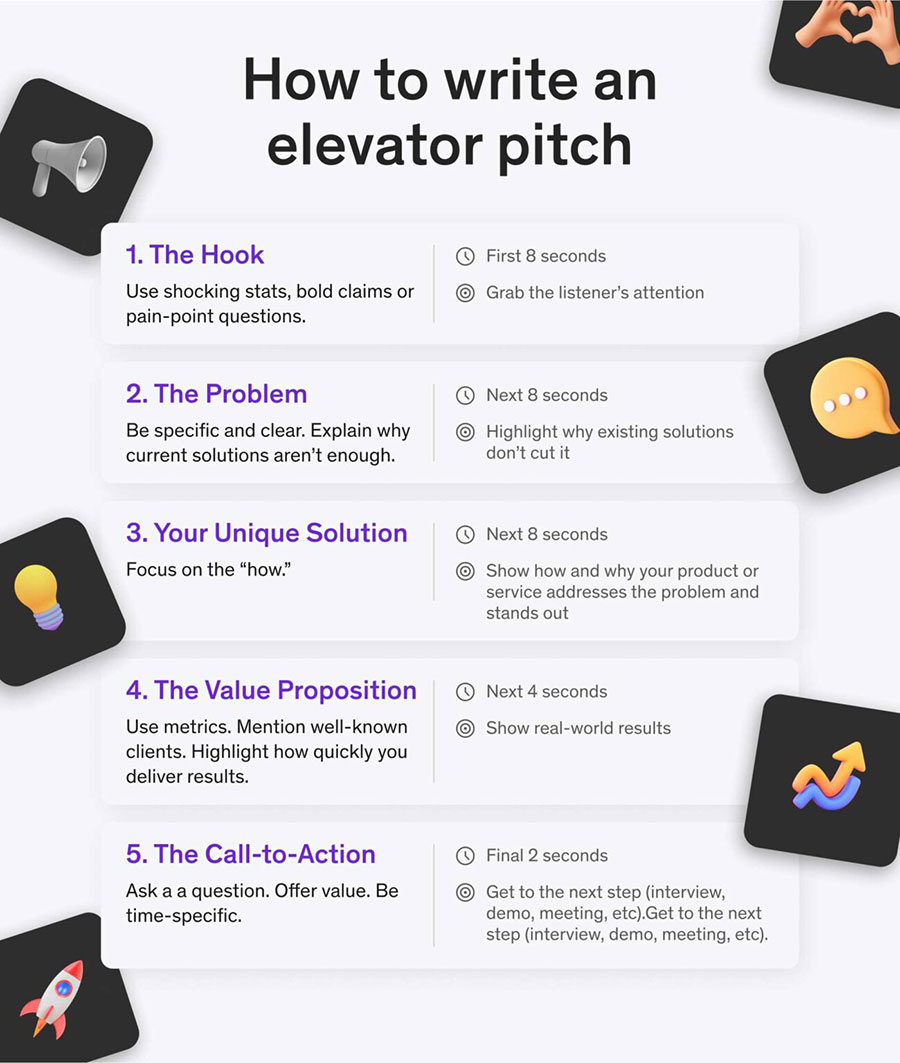
Want to know how to write an elevator pitch that actually works? Here’s the five-part formula used by top professionals, founders, and job seekers alike.
1. The Hook (First 8 Seconds)
The first few seconds are critical for grabbing attention instantly and preventing your audience from tuning out. A strong hook sets the stage, creating immediate curiosity and relevance.
Generic intros are momentum killers because they fail to capture attention, create curiosity or communicate value, three things every listener needs within seconds to stay engaged.
Need some help to craft your hook? Take a look at the types of hooks you can use:
- Shocking stat: Use surprising numbers to frame a problem.
- Bold claim: Say something unexpected or thought-provoking.
- Pain-point question: Ask a question that highlights a common struggle.
When crafting your hook, make sure to tailor it for your specific audience or niche. For instance, a hook for an investor has to be different from one for a potential employer or a peer at a networking event. Think about what truly matters to them!
Elevator Pitch Examples: Hooks
- For entrepreneurs/startup founders: “Did you know 73% of SaaS companies lose $2M annually due to churn?”
- For sales professionals: “Every minute, $1.2M worth of products are abandoned in online shopping carts.”
- For business development professionals: “Most new hires quit within 90 days—often because they don’t get the support they need.”
2. The Problem (Next 8 Seconds)
Once you’ve got their attention, clearly define the problem your idea, product, or service solves.
This isn’t just about stating a general issue; it’s about making the pain feel personal and urgent for your listener without sounding alarmist. The problem should highlight why existing or outdated solutions are failing.
How to define the problem:
- Be specific and clear: avoid buzzwords. Focus on the direct impact of the problem.
- Briefly explain why current solutions fail.
- Make it relatable and urgent. Connect the problem to quantifiable losses or missed opportunities.
Elevator Pitch Examples: Stating The Problem
- For entrepreneurs/startup founders: “… because most companies only find out why customers leave after they cancel.”
- For sales professionals: “…because current tools send generic emails that feel spammy. Those cold emails only recover less than 5% of abandoned carts.”
- For job seekers: “Entry-level hires are often left unsupported, hurting long-term retention and growth.”
3. Your Unique Solution (Next 8 Seconds)
Now explain what you offer, how you solve the problem and why your solution stands out. Explain it in a way that feels inevitable and logical, directly addressing the problem you just presented.
Tips for a strong solution:
- Focus on the “how”: Instead of listing features, explain your unique process or methodology.
- Give your approach a unique name or structure to make it distinctive.
- Show how your solution is the natural or obvious answer to the pain point.
Elevator Pitch Examples: The Solutions
- For entrepreneurs/startup founders: “Our AI predicts churn 30 days before it happens, so companies can win back customers before they leave.”
- For sales professionals: “I create data-driven marketing strategies that boost conversions without wasting a dollar.”
- For job seekers: “With my UX and agile methodologies, I bridge the gap between users and dev teams to improve product-market fit.”
4. The Value Proposition (Next 4 Seconds)
Show the real-world results of your solution, ideally with numbers or social proof. The value proposition should use specific numbers (percentages, dollar figures, or timeframes) to show clear Return on Investment (ROI).
How to communicate value:
- Use metrics (percentages, revenue, time saved) to show tangible results of your solution.
- Mention well-known clients, industries, or categories you’ve worked with.
- Highlight how quickly or effectively your solution delivers results.
Elevator Pitch Examples: Showing The Value
- For entrepreneurs/startup founders: “Our clients reduce churn by 45% and boost MRR by $500K.”
- For sales professionals: “I’ve helped eCommerce brands increase sales by 150% in 90 days.”
- For business development professionals: “We help SMBs recover 35% more abandoned carts, adding $50K+ in monthly revenue.”
5. The Call to Action (Final 2 Seconds)
Your elevator pitch isn’t complete without a clear next step. Your call to action (CTA) should be low-friction and specific, rather than a vague invitation.
Signal value in your ask, whether it’s an offer for a demo, a case study, or an audit, and create a subtle sense of urgency without being pushy.
How to craft your CTA:
- Ask a question: “Can I show you a quick demo?”
- Offer value: “Would a free audit help?”
- Be time-specific: “Are you available this week?”
Elevator Pitch Examples: The CTA
- For entrepreneurs/startup founders: “I’d love to show you a 5-minute demo. Are you free later this week?”
- For job seekers: “I’m looking for cybersecurity internships. Could you share more about the programs your company provides?”
- For sales professionals: “I’m offering free audits to 5 businesses this month. Are you interested in seeing your conversion opportunities?”
Why This 5-Part Elevator Pitch Formula Works
This approach to crafting a good elevator pitch isn’t arbitrary; it’s rooted in maximizing impact and memorability, crucial for effective communication in any context.
Also, this elevator pitch formula works because:
1. It Aligns with How People Process Information
The human brain loves following story structure:
- Curiosity (Hook): The initial intrigue sparked by your opening.
- Relevance (Problem): The immediate connection to a challenge they understand or face.
- Clarity (Solution): A clear understanding of what you offer and how it works.
- Proof (Value Proposition): Tangible evidence that reinforces your credibility and the benefits of your solution.
- Action (CTA): A natural next step that leverages the built-up momentum.
This mirrors a natural emotional flow: from initial attention, through tension created by the problem, relief offered by the solution, confidence from the value, and finally, momentum towards engagement.
The elevator pitch structure is effective in both spoken and written formats, making it incredibly versatile.
2. It Respects the 30-Second Attention Rule
You don’t have time to ramble. The 30-60 second timeframe of an elevator pitch forces you to be disciplined and precise, ensuring your message is short enough to hold attention but long enough to make an impact.
This shortness makes the pitch ideal for “high-speed scenarios” where you have limited time to make an impression, such as: emails, pitch events, LinkedIn bios and live intros.
3. It’s Versatile Across Roles and Industries
This method is versatile. Whether you’re delivering an entrepreneur elevator pitch, interviewing for a job, or pitching a product, you can tailor this formula to fit.
- For Job Interviews: Adapt it to answer “Tell me about yourself” or “What do you do?” by focusing on your skills and what you’re seeking.
- For Investor Decks: Use it as the foundational summary for your business idea, clearly outlining the problem and your solution’s market potential.
- For LinkedIn Bios: Condense it into a compelling summary that defines “your personal brand”.
- For Product Launches: Use it to introduce your product’s unique value to potential customers or partners.
With minor tweaks to tone and specific details, the same core pitch can be reused across different platforms, ensuring consistent messaging.
Pro Tips for Writing and Delivering Your Elevator Pitch
- Rehearse Until It Sounds Natural, Not Scripted
While the elevator pitch formula provides structure, your goal is for it to flow naturally, conveying energy and commitment.
For that reason:
- Practice out loud, don’t memorize it word for word. You want to sound natural and fluid, not robotic!
- Vary your tone, pacing, and energy to keep your listener engaged.
- Record yourself to spot areas for improvement. Use AI tools to help you practice your speech, such as Yoodli, Orai, and Poised. These tools can analyze your tone, pace, body language and even your use of crutch words!
- Customize for Different Audiences
One size rarely fits all. While your core message might remain consistent, a truly effective elevator pitch is tailored to the specific listener and context.
- Research your audience: Understand their background, needs, and what motivates them. For example, non-scientific audiences might prefer analogies or statistics closer to their daily lives.
- Adjust your hook and problem depending on who you’re talking to: The opening and the problem you highlight should directly resonate with your listener’s world, whether they’re B2B vs. B2C, tech vs. nonprofit, or a potential investor vs. a hiring manager.
- Use industry-relevant stats and examples.
- Adjust your CTA based on your goal (meeting, interview, follow-up). A demo might be perfect for an investor, while an introductory email might be better for a new networking contact.
- Keep Evolving Your Pitch Over Time
Think of your elevator pitch as a living asset, not a one-time task. It should adapt and improve as you gain experience and receive feedback.
- Update metrics, results, and proof points regularly. As your business or career progresses, ensure your pitch reflects your latest achievements and most impressive results.
- Refine based on real-world feedback. Pay attention to how people respond. What questions do they ask? What aspects seem to click, and what falls flat? Use this feedback to iterate and improve.
- Adjust your CTA. As your goals evolve, so will your desired next step.
Turn Your Elevator Pitch into Real Opportunities
Here’s a hard truth: if you don’t know how to write an elevator pitch, you’re leaving opportunities on the table. Whether you’re selling a big idea, hyping your personal brand, or just trying not to flop at your next networking event, a punchy pitch is your secret weapon.
Remember to:
- Keep it short (30–60 seconds max).
- Make it crystal clear (ditch the jargon).
- Show the value (why should they care?).
- Always end with a mic-drop CTA (what’s next?).
So go ahead, build your pitch using this 5-part formula, and be ready to own the room (or the Zoom, or the elevator, or the inbox…). Your next big break might just be one bold intro away.
Please Log in to leave a comment.