Sales Techniques That Close (With Examples You Can Use)

The art of selling has changed dramatically. Buyers no longer respond to pushy pitches or old-school tactics like the infamous “Always Be Closing” approach. With access to more information than ever, modern customers expect authentic conversations, not pressure-filled scripts. That’s where modern sales techniques come in.
The most successful sales professionals today win by listening, building trust, and guiding potential clients toward the right solution at the right time. Instead of chasing quick wins, they focus on connection, clarity, and long-term value.
Whether you’re refining your approach or learning how to improve your sales techniques, keep reading to find proven research-based methods that will help you create trust, handle objections, sell smarter and build lasting relationships.
The Psychology of a Modern Buyer
Understanding the modern buyers is the first step of any effective sales technique. Nowadays they’re smarter, more self-sufficient, and better informed. Did you know that 96% of buyers research solutions before ever speaking with a salesperson?
Modern buyers value autonomy, control, and authentic interactions, and if they feel any kind of pressure, their defense mechanisms are immediately triggered.
However, buyers respond positively when they sense alignment, not just a hidden agenda. That means good sales techniques aren’t about talking over them, but about helping them.
Customers want to feel like the hero of their story, while the salesperson acts as a trusted guide who helps them overcome challenges and achieve results.
Sales Techniques That Build Trust and Close Naturally
Ready to build genuine connections and close more deals? Here are some of the best sales techniques rooted in psychology and research:
1. Situational Questioning Over Generic Personas
Traditional sales often relied on pre-defined buyer personas, but research shows that people buy based on their current situation, not just their demographics or job titles. To be truly effective, sales techniques must adapt to the buyer’s unique context, challenges and goals.
So, skip generic buyer personas and focus on real-time, context-driven questions.
You can use the SPIN selling method, which emphasizes asking specific questions (Situation, Problem, Implication, Need-Payoff) to help potential clients become aware of their problems and see the value of a solution.
Asking open-ended questions is crucial, as they encourage deeper, more meaningful dialogue than simple “yes/no” questions.
For instance, instead of asking, “Do you use automation?”, ask, “How does your team currently handle automation?” This prompts critical thinking and provides concrete details you can respond to with specific solutions.
By mastering this, you can frame your solution as perfectly suited to their needs, allowing the buyer to truly believe that your product or service is what they need.
2. The “Unconsidered Needs” Technique
Many salespeople focus only on the problems buyers already recognize. The result? Their pitch sounds just like every competitor’s, giving potential customers no real reason to make a change and often ending in no decision at all.
To break this cycle and create urgency, introduce Unconsidered Needs, meaning: new risks, overlooked challenges or missed opportunities they may not have considered. This will differentiate you from your competitors! Research shows that a provocative message starting with an Unconsidered Need can enhance the persuasive impact by 10%.
Example:
You’re selling cybersecurity software and a prospect tells you their main pain point is “preventing phishing attacks.” If you only focus on that need, your message may sound like every other competitor promising to “reduce phishing risk.”
Instead, highlight an unconsidered need:
“Most companies focus on phishing prevention, but the bigger, often overlooked risk is credential reuse. Even if your team avoids phishing emails, hackers can still buy stolen employee passwords on the dark web and access your systems. Our solution automatically scans for compromised credentials and prevents unauthorized logins before they cause damage.”
By introducing this overlooked challenge, you shift the buyer’s perspective. Suddenly, their current situation feels risky, urgency increases, and your solution stands out as what they need to address a problem they hadn’t considered before.
3. Make the Buyer the Hero
Stories are powerful in sales, but who is the hero of your story? Research suggests that positioning yourself or your company as the hero can be less effective than making the buyer the central character.
A typical hero’s journey involves the hero struggling with a problem, meeting a wise mentor (you!), receiving new insight and a plan, and then overcoming the problem to reach their goal.
Frame your pitch so the potential client is the central character. Use “you” language instead of “we” language to reinforce their ownership of the solution and make change feel empowering and urgent.
Example
You’re selling project management software. Instead of saying “We help companies streamline their workflow and eliminate inefficiencies with our powerful platform”, reframe it to make the buyer the hero:
“You’ve built a strong team, but managing multiple projects in different tools is slowing you down. With our platform, you’ll be able to bring everything into one place, eliminate duplicate work, and give your team the clarity they need to deliver projects on time. You’ll be the one who transforms how your company gets work done.”
Notice the difference? By shifting from “we” to “you,” the buyer feels ownership of the solution. They’re not just purchasing software, they’re the hero who solved a major business challenge and improved their team’s performance.
4. Social Proof Integration
While you make your buyer the hero, bolstering their confidence with external validation is key. Strategic use of social proof, such as customer success stories, case studies, and testimonials, at optimal conversation moments, can significantly build confidence in your solution.
Backing your claims with industry research or customer references makes your product’s value concrete and demonstrates why it will work for their specific use case.
Example
Imagine you’re speaking with a prospect in the retail industry who’s worried about the cost of implementing your customer analytics platform. Instead of just saying, “Our solution delivers great ROI,” integrate social proof at the right moment:
“I completely understand your concern. One of our clients, a mid-sized fashion retailer, felt the same way. After adopting our analytics platform, they increased repeat purchases by 28% within six months because they were finally able to personalize promotions. Here’s their case study if you’d like to see the details.”
By sharing a specific, relatable success story, you’re not just claiming your solution works—you’re proving it with real-world results from a peer in their industry. This reinforces confidence and helps the buyer visualize achieving the same success.
5. Strategic Conversation Disruption
Sales presentations often suffer from the “hammock effect,” where buyer attention peaks at the beginning and end, but wanes significantly in the middle. To combat this and maintain engagement, employ “grabbers” or engaging hooks throughout your conversations, like presenting surprising numbers or stories tied directly to the buyer’s world.
You can use a technique named Number Play.
Example
You’re pitching HR software to a prospect, and midway through the conversation, you sense their attention drifting. Instead of continuing with slides, disrupt the flow with a data-driven hook:
“Let me pause and share three numbers with you: 42, 18, and 2. Any guesses what they mean?”
The buyer leans in. Then, explain:
- 42% of HR leaders report spending more time on manual admin than on strategic initiatives.
- 18 hours a week is the average time managers lose chasing approvals.
- 2 out of 3 employees say slow HR processes hurt their engagement.
“Your team is probably experiencing some of these challenges too, right?”
This technique snaps the buyer back into focus, makes the problem feel urgent, and positions your solution as the key to changing those numbers.
6. Gentle Status Quo Challenging
Buyers naturally prefer sticking with what they know and what they’re already doing. As an outsider, your job is to disrupt this status quo and drive the need for change without being confrontational or pushy.
You can achieve this by showing them the risks of inaction and contrasting it with the benefits of change. This contrast storytelling creates urgency for action.
Example
If you’re meeting with a prospect who currently manages customer support through shared email inboxes and they insist that “is not perfect, but it works for now”, instead of pushing back, gently challenge the status quo with contrast storytelling:
“I completely understand, shared inboxes do get the job done. But here’s what we often see: before switching, most teams were missing up to 30% of customer inquiries because emails got buried or duplicated. That led to frustrated customers and churn they didn’t even realize was happening. After moving to a support platform, those same teams reduced missed inquiries to almost zero and improved customer satisfaction scores by 40% within months. Imagine what that shift could mean for your retention and revenue growth.”
Research shows that executives are 70% more likely to take a risky option when sticking with the status quo feels like a loss, rather than when change is framed as a possible gain.
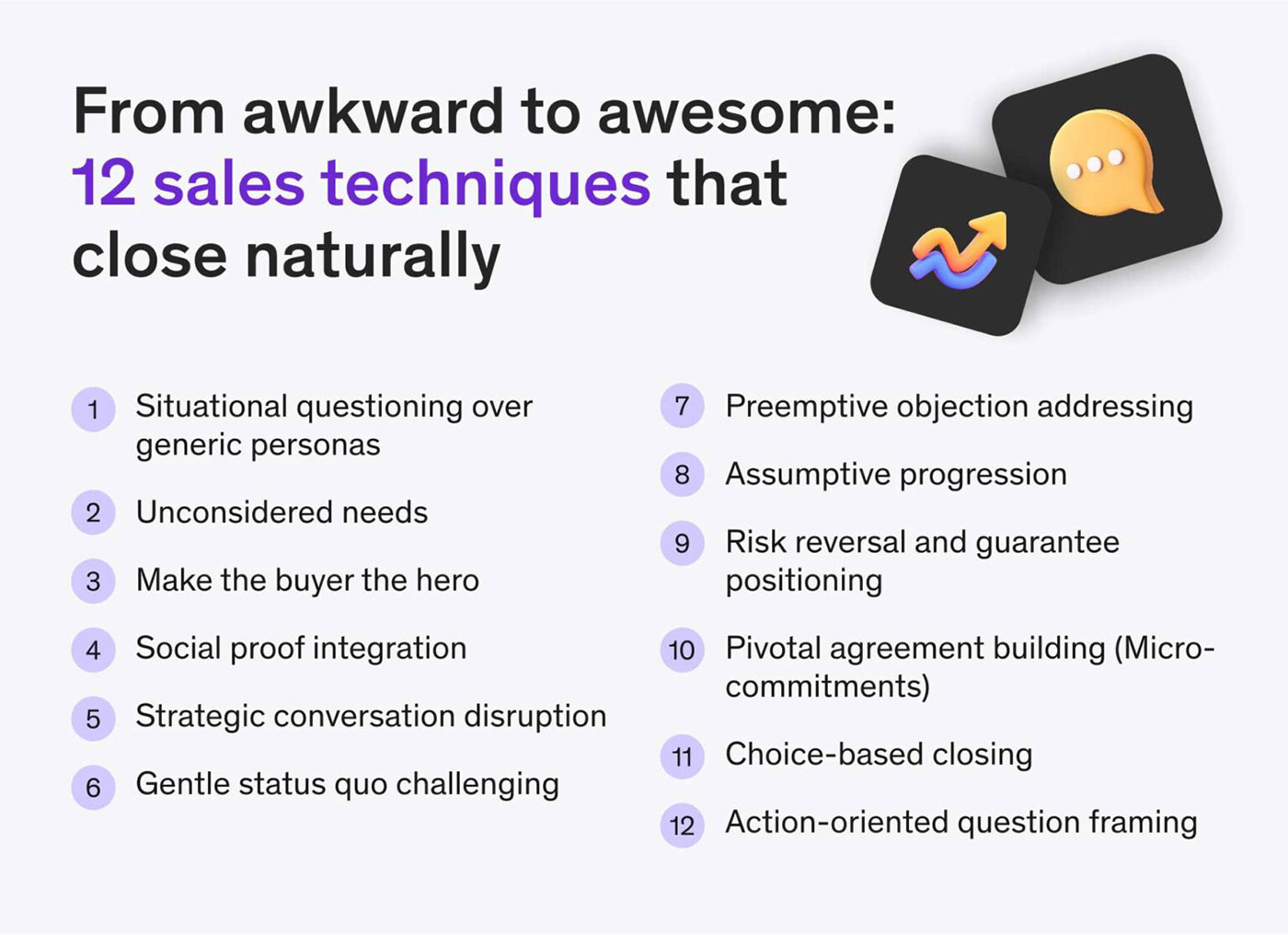
7. Anticipating And Neutralizing Objections
Objections are a natural part of the sales process, and how you manage them is crucial for closing new business. Instead of waiting for objections to surface, a proactive approach involves addressing potential concerns before they become full-blown objections.
When an objection arises, thank the prospect for sharing their concern, which builds trust. Then, empathize by validating their feelings and then guide the conversation back to what they liked most about your solution, which reframes their mind.
Example
If you’re presenting a marketing automation tool and you know cost is often the biggest objection, instead of waiting for the buyer to raise the concern, address it proactively:
“Some of our clients initially worried about the investment. That’s completely understandable, as budgets are always tight. What they found, though, was that by automating their email campaigns, they saved around 12 hours of manual work per week and increased lead conversions by 22% in the first quarter. The time savings alone more than paid for the platform.”
By acknowledging the concern before the buyer voices it, you build trust, validate their perspective, and shift the conversation back to measurable value. This approach reassures the buyer while keeping momentum moving forward.
8. Closing Through Subtle Progression
The assumptive close is a powerful sales technique that subtly guides potential customers towards a decision by assuming they intend to purchase. This isn’t about being pushy, but about confidently moving the conversation forward in a natural, seamless way.
Example
You’re selling a subscription-based fitness-app. Instead of asking “So, would you like to sign up?”, guide the conversation forward with an assumptive progression:
“Great, since you mentioned mornings work best for you, should we set your program to start next Monday, or would the following week be better?”
Notice how the language assumes the buyer is moving ahead; it removes the yes/no pressure and instead frames the choice around when to start. This makes the next step feel natural and inevitable rather than like a high-stakes decision.
9. Risk Reversal and Guarantee Positioning
One of the biggest barriers to purchase is the buyer’s fear of loss or making a bad decision. Risk reversal is a sales technique that directly addresses this by transferring some or all of the transaction risk from the buyer to the seller.
Reduce fear of commitment by offering guarantees or free trials. When buyers feel protected, they’re more likely to say yes.
Even if a seller occasionally loses money, the increase in closed sales typically far outweighs these losses. A strong, risk-reversing guarantee, extended as much as possible, almost always maximizes sales. By eliminating perceived risk, you position your solution as a safer, low-risk choice.
Example
If you’re selling a software platform for small business and the prospect hesitates and says “I’m just not sure if it will work for my team”, instead of pushing harder, use risk reversal sales technique:
“I completely understand, it’s a big decision. That’s why we offer a 30-day free trial with full access to every feature, plus a 100% money-back guarantee in the first 90 days if you’re not satisfied. That way, you and your team can try it with zero risk. If it doesn’t deliver the results you expect, you won’t pay a cent.”
By transferring the risk to yourself, you remove the fear of a bad decision. This makes the purchase feel safe, easy, and far less intimidating, ultimately increasing the likelihood of a “yes.”
10. Micro-Commitments
The sales process is not one giant leap, but a series of smaller steps. Micro-commitments are small “yeses” that create forward movement and build trust throughout the buyer’s journey. These don’t immediately generate revenue but signal engagement, trust, and intent, making the “big yes” almost inevitable.
The idea is to match small requests with where the buyer is emotionally and mentally, so they feel natural instead of forced. Each small ‘yes’ not only builds momentum but also helps reveal concerns early in the process.
This rhythm of small agreements fosters a partnership mindset, making the final close feel like the most obvious decision.
Example
You’re meeting with a potential client for a marketing platform. Instead of jumping straight to the purchase, guide them through a series of small agreements:
- Information Alignment: “Do you agree that tracking customer engagement is critical for growth?”
- Problem Recognition: “Would you say that manual reporting is taking up too much of your team’s time?”
- Solution Openness: “If there were a way to automate those reports and save hours each week, would you be interested in exploring it?”
Each “yes” is a micro-commitment, gently guiding the potential client forward while building trust and alignment. By the time you present the final proposal, the buyer has already mentally agreed with the logic and benefits, making the final decision far easier and more natural.
11. Choice-Based Closing
Instead of presenting a single option, offering multiple choices can significantly increase sales. In a study published in the Journal of Consumer Research, Marketing Professor Daniel Mochon found that the number of product options had a big influence.
One of Mochon’s most famous experiments was based on consumers who were asked to purchase a DVD player. When a single DVD player was shown, only 10% of consumers purchased. However, when Mochon introduced a second DVD player, the number of sales increased by 66%!
This sales technique works because it minimizes the buyer’s perception of risk and provides a sense of autonomy and control over their decision.
Ensure all choices lead to a positive forward movement, allowing the buyer to feel confident in their selection.
Example:
You’re selling a software solution. Instead of asking, “Do you want to buy our plan?” you offer:
- Option A: Standard Plan with core features for $99/month.
- Option B: Premium Plan with extra analytics and support for $149/month.
Both options move the buyer forward and make them feel in control of the decision. By giving two appealing choices, you reduce hesitation and increase the likelihood of a purchase.
12. Action-Oriented Question Framing
To subtly guide potential customers toward commitment without applying pressure, frame your questions in an action-oriented way. These questions help reduce hesitation by embedding subtle closing language, making forward movement feel natural rather than high-pressure.
Instead of asking, “Do you think this solution will work for you?” (which can trigger doubt), frame the question to guide action:
- “Which of your current processes would you start improving first with this solution?”
- “When would you like to begin seeing these results in your team?”
- “Who on your team should be involved in the first step of implementation?”
These questions assume progress and invite the buyer to visualize taking action. They shift the conversation from abstract evaluation to concrete next steps, making commitment feel like the natural choice.
How to Improve Sales Techniques Over Time
Mastering these effective sales techniques is an ongoing journey and the most successful salespeople never stop learning.
Here’s how to keep refining your skills:
- Regularly analyze your sales data: Review wins and losses to see which techniques work best.
- Ask for buyer feedback: Customers will tell you what resonates if you ask. This will help you understand their evolving needs and preferences.
- Practice regularly Role-Playing and Objection Handling: This will sharpen your delivery and ability to navigate challenging conversations.
- Invest in education and upskilling: Stay up to date on modern strategies through coaching and online courses. This can significantly impact performance in a positive way.
Common Mistakes That Kill Deals
Even with effective sales techniques, certain missteps can sabotage your success. Avoid:
- Rushing the close before trust is established. It often leads to resistance and dissatisfaction.
- Ignoring buyer cues or concerns. It can cause deals to stall.
- Sounding robotic with over-rehearsed scripts. When sales techniques come across as insincere or robotic, they violate the modern buyer’s need for authenticity and autonomy.
- Neglecting post-sale follow-up. The sale doesn’t end with the signature. Long-term relationships, follow-up, and continued support are vital for retention and future opportunities.
- Overselling or misrepresenting value. Prioritizing the sale over the customer’s needs, overselling features, or being dishonest about value will lead to dissatisfaction and a poor reputation.
- Overwhelming leads with too many messages. While consistency is important, overwhelming potential clients with too many calls or emails in a short period can turn them off.
Remember: modern selling is about relationships, not transactions.
Master Sales Techniques With Git
You already know the best sales techniques today aren’t about clever tricks or high-pressure tactics. They’re about listening, building trust, and guiding buyers through decisions that feel natural.
Ready to level up your sales techniques? Check out these Git course:
Get ready to become not just a salesperson, but a trusted advisor.
Please Log in to leave a comment.