Small Business Growth Strategies: How to Scale Without Burning Out

You did it! You’ve brought your idea to life, landed your first customers, and maybe even started seeing consistent revenue. But now comes the tricky part: learning small business growth strategies to scale.
The truth? Growth can feel like walking through a maze. For many founders, the journey leads to stress, inefficiency, or even burnout. Research shows that 78% of companies that find product-market fit still fail to scale successfully. They either plateau or collapse under the pressure of growth.
The good news is that with the right strategies, you can scale your business, grow your revenue, and protect your well-being along the way. Let’s explore how.
What the Data Reveals About Small Business Growth Challenges
The U.S. has more than 6 million employer-based small businesses, but fewer than 10% ever grow beyond 20 employees. What holds so many back?
Some common barriers include:
- No scalable systems: Many small businesses often rely on unorganized, temporary processes that collapse when demand increases. This often leads to a failure in developing strong, scalable technology and data systems.
- Funding challenges: Limited capital and tight credit remain major constraints. The data is clear: for 60% of small business owners, financing is their number-one stressor. Women founders, in particular, often face added barriers from gender bias when seeking funding.
- Weak marketing ROI: Too much spend goes to “vanity” channels instead of proven customer acquisition, as many business owners lack clarity on what truly drives their most profitable growth.
- Economic headwinds: Shifts in politics, consumer expectations, and supply chains can hit small businesses hardest.
On the flip side, high-growth small businesses usually share one thing in common: a formal growth strategy. Companies that create and review growth strategies regularly scale up to 30% faster than those that don’t.
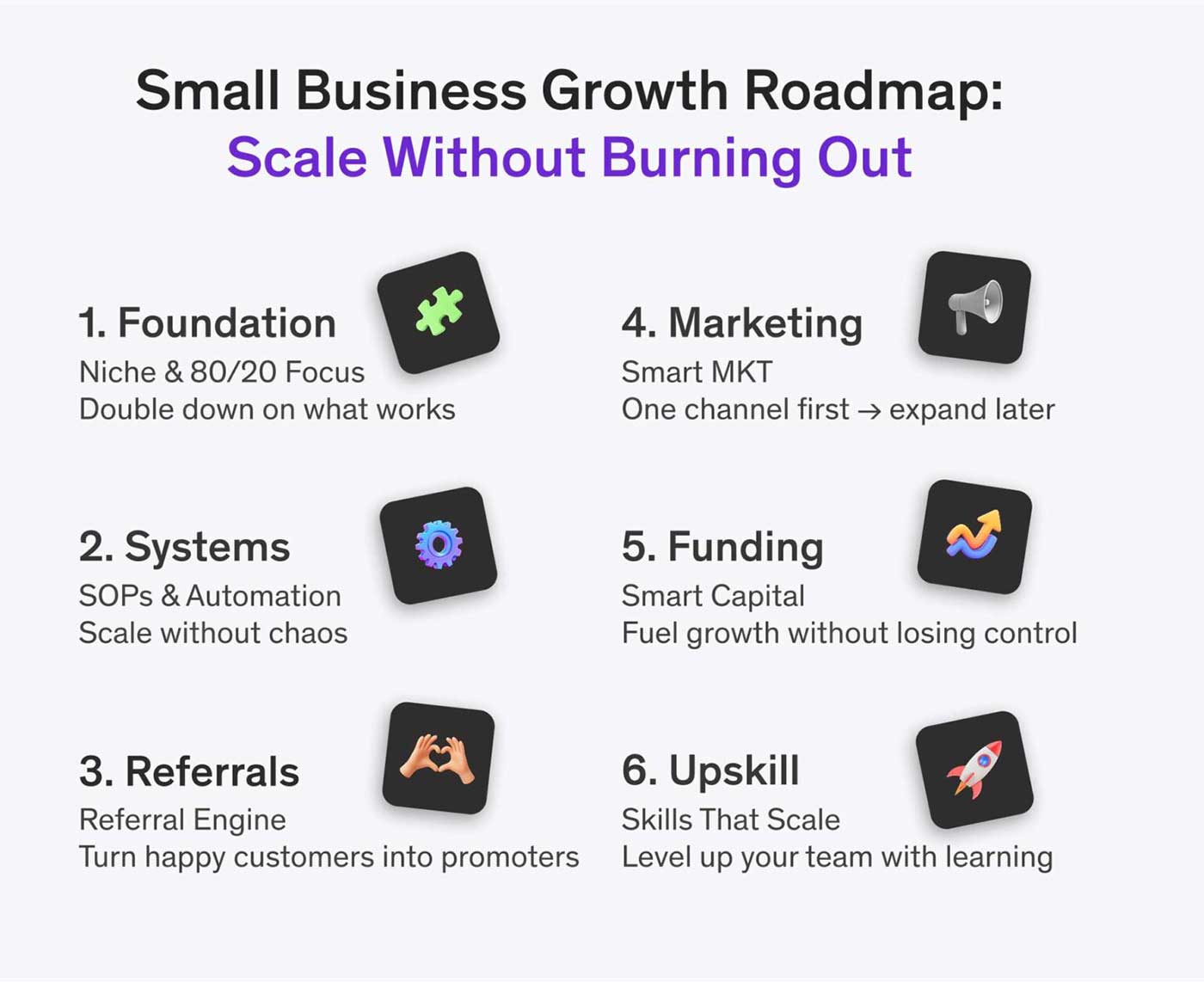
Foundation-First Growth Strategies That Prevent Scaling Chaos
Before chasing more leads or rolling out new products, you need a solid foundation. This means being deliberate about your offerings and systematizing your operations. More often than not, scaling chaos comes from trying to grow without tightening the basics.
1. Niche Before You Expand
One of the biggest mistakes early businesses make is trying to serve everyone. Instead, focus on the one audience and offer that delivers the best returns.
To avoid diluting your efforts:
- Define your ideal customer clearly.
- Specialize in what makes you different.
- Before adding new services or products, use the 80/20 Rule, best known as The Pareto Principle: usually, 20% of your products or customers generate 80% of profits. Double down on what works.
To find your 20% or your “hero offerings”, you need to analyze your data. Looking at revenue, customer acquisition, and product performance will help you find which products, services, or channels deliver the strongest returns.
Also, audit your time. Track where your hours go each week. Many business owners spend half their time on low-value tasks that don’t drive growth.
By focusing on your 20%, you’ll grow faster, reduce wasted effort, and avoid burnout.
2. Systematize Operations for Scalable Growth
Charisma and hustle can only take you so far. To grow, you need processes that run without you.
Here are some practical steps to achieve this:
- Document Standard Operating Procedures (SOPs): Create clear processes for sales, service, and delivery. This professionalization ensures quality as you scale.
- Use Simple Automation Tools: Reduce manual work and free up time by automating email sequences, customer communication, invoicing, and scheduling.
- Adopt a Customer Relationship Management platform (e.g. HubSpot, Zoho, Salesforce) to centralize customer data. CRMs streamline sales processes, manage sales territories, and provide teams with consistent, up-to-date information.
- Experiment with AI-powered tools for marketing automation: Use AI for marketing automation, lead scoring, and even customer support. This is crucial, especially for small teams, because it scales support without increasing headcount.
- Use project management tools (e.g. Trello, Asana, Airtable) to keep teams organized and aligned.
The goal: Reduce owner dependency while maintaining service quality. Also, documentation strategies prepare your business for team expansion, ensuring new hires can quickly integrate and contribute effectively.
3. Build a Customer Referral Engine
Referrals are gold for small businesses. In fact, 70% of small business owners say referrals drive more growth than social media or SEO.
This works because customer retention is more cost-effective than customer acquisition. Existing customers already trust the brand, which can lead to expedited growth through referrals. Leveraging this trust and loyalty through referrals is an efficient business growth strategy.
Here’s how to do it:
- Create “wow moments” that customers want to share.
- Launch a referral program with small but meaningful incentives.
- Make it easy: prewritten referral templates, links, or automated follow-ups.
- Track and manage referrals inside your CRM.
With limited resources, referrals give you high-quality leads at almost no cost.
Marketing Strategies That Drive Growth
This is where most small businesses spin their wheels. The key isn’t doing more: it’s doing things strategically.
1. Focus On One Core Marketing Channel First
Instead of spreading thin across Facebook, TikTok, Instagram, and LinkedIn, find the one platform your customers use most. Using marketing efforts across multiple platforms dilutes results and exhausts limited resources.
To identify the optimal marketing platform for your ideal customers, consider the following:
- Define your customer profile: age, location, income, interests, and buying habits.
- Match it with platform demographics.
- Review existing analytics to see where customers engage: check Google Analytics, social insights, or referral traffic.
- Test a couple of platforms with small ad spend.
- Double down on the one that delivers conversions (not just likes or follows).
Always measure ROI to ensure your marketing investments drive actual business growth, not just “vanity metrics”. This agility allows you to adapt and refine techniques that aren’t working.
2. Content Marketing for Authority and Lead Generation
Creating valuable content positions you as an industry expert and generates leads. It’s a way to build trust before the sales call.
Content is more than blogs, so try:
- Case studies showing your solutions and results.
- Short videos answering FAQs.
- Problem-solving social media posts that address your customer’s pain points.
- Develop repurposing strategies to turn one piece of content into multiple marketing assets, maximizing its reach. For instance, turn one blog post into a newsletter, LinkedIn post, and video.
3. Retargeting and Email Marketing For Maximum Conversion
It’s 5—10x easier to convert a warm lead than a cold one. Warm leads are already familiar with your brand, have engaged with your content, or even visited your website, which makes them more likely to convert compared to cold prospects who need to be educated from scratch. That’s why retargeting and email are essential!
Retargeting and email allow you to stay top-of-mind, deliver personalized offers, and guide leads through the buying process with minimal friction. This focused approach reduces marketing costs per conversion while increasing the likelihood of closing sales.
Try:
- Email automation: Build sequences that educate and nurture leads while you focus on other areas. Growing your email subscriber base is an affordable way to establish an engaged audience, lessening dependency on traditional marketing channels and allowing for personalized communications like anniversary, birthday, and promotional emails.
- Retargeting ads: Show ads to people who’ve already visited your site or engaged with your content.
- Customer Lifecycle Emails: Automate win-back campaigns, upsells, and repeat purchase reminders. The goal? Ensuring long-term customer relationships.
These strategies reduce wasted ad spend and keep you top-of-mind with prospects most likely to buy.
Smart Funding Strategies for Small Business Growth
You already know financial limitations and challenges in financial management are common for small businesses. The truth is you can’t grow without resources, but strategic funding for these businesses is about more than just securing capital; it’s about smart resource allocation.
Take a look at these strategies:
- Bootstrap Growth Using Strategic Reinvestment
Bootstrapping means funding growth primarily through your own profits. This requires careful cash flow management to prevent financial strain during growth phases.
Reinvest profits strategically into the areas that give the highest ROI to your business. To do so, track metrics like customer acquisition cost (CAC), lifetime value, revenue per channel and employee productivity.
Also:
- Evaluate systems & automation: invest in tools that save time, reduce errors, or streamline operations.
- Prioritize targeted marketing: focus on campaigns with proven conversion data for your ideal customers.
- Assess team expansion: hire for roles that directly drive sales, retention, or operational efficiency.
- Test and measure: start small, monitor results, and scale initiatives that deliver strong returns.
- Cut low-impact spending: eliminate or reduce investments that don’t meaningfully contribute to growth.
Embrace lean growth principles, avoiding overcommitment to unproven marketing channels or inventory.
- Alternative Funding Beyond Traditional Loans
When bootstrapping isn’t enough, look beyond traditional loans. These are alternative funding options:
- Crowdfunding & microloans: Great for product launches. Often don’t require traditional collateral.
- SBA loans (U.S) and local grants: Government-backed support that’s frequently overlooked.
- Revenue-based financing: Pay back as you earn.
- Invoice factoring: Turn unpaid invoices into cash.
- Peer-to-peer lending: Borrow directly from individual investors.
- When and How to Seek Outside Investment
There are some clear indicators that suggest when your business is ready for external funding or partnership, like consistent revenue and stable cash flow, healthy retention rates, scalable operations, and a clear growth plan.
But to do so successfully, your pitch materials and financial projections need to demonstrate your scaling readiness vividly.
How? Take a look:
- Organize financial statements: profit and loss statements, balance sheets, cash flow statements for at least the past 2–3 years.
- Prepare financial projections: project revenue, expenses, and cash flow for the next 1–3 years.
- Clarify business model: clearly explain products or services, target market, pricing, and revenue streams.
- Develop a growth plan: outline strategies for scaling, marketing, and operational expansion.
- Document legal structure: articles of incorporation, business licenses, permits, and ownership details.
- Compile tax records: business and personal tax returns for at least the past 2 years.
- Highlight key metrics: customer acquisition cost, lifetime value, sales pipeline, and retention rates.
- Prepare supporting documents: contracts, leases, supplier agreements, patents, or IP filings.
- Craft a compelling pitch: executive summary, funding needs, use of funds, and expected ROI.
- Show management capability: resumes of founders and key team members demonstrating expertise and experience.
Small businesses don’t have to give up control to grow. Options like revenue-based financing, smart use of debt, and reinvesting profits let you scale while keeping ownership intact. Limited, well-chosen equity partnerships can also provide a boost without diluting your vision.
And if you do bring in equity investors, structuring the deal around minority stakes and protective terms ensures you stay in the driver’s seat. By blending these approaches, you can fuel growth, attract resources, and expand confidently—without sacrificing control of the business you’ve built.
Common Growth Mistakes That Keep Small Businesses Stuck
Growth isn’t linear, and many pitfalls can derail your progress. Avoid falling into these traps:
- Scaling too fast before systems or demand are ready. Rapid growth without a solid foundation can break existing processes and lead to chaos.
- Hiring too early (or too late) without clarity on ROI. The team that launched your startup isn’t always the right team to scale it; be deliberate about talent.
- Over-marketing without converting or retaining leads. Focus on nurturing warm leads and ensuring your marketing efforts translate into tangible business growth.
- Ignoring operations: weak processes break faster under growth pressure. A siloed, workshop approach will eventually stagnate without integrated, industrialized processes.
- Neglecting customer relationships: churn kills growth.
- Tying your identity to the business: this is a recipe for burnout.
How to Future-Proof Your Small Business Plan
To achieve sustainable small business growth, you need a proactive, holistic approach that prioritizes both your business’s health and your personal well-being.
- Set stretch goals, but break them into manageable milestones.
- Review results quarterly and adjust before overcommitting.
- Remain agile to market changes and disruptive events, allowing your strategies to be re-evaluated and refined as business conditions evolve.
Upskill and Scale: Grow Smarter With Git
Growth without burnout requires more than just hustle, it requires skills. Whether you’re hiring more people, launching new marketing efforts, or optimizing operations, strategic learning pays off.
The most successful founders and teams treat upskilling as a growth engine. By sharpening your skills, you’ll not only solve today’s challenges but also unlock new opportunities for tomorrow.
That’s where Git for Business comes in. With thousands of affordable, on-demand courses, you can build the exact skills needed to grow without burning out. Whether it’s automating repetitive tasks, mastering growth marketing, or leveling up your leadership, Git makes it practical and accessible.
Start with courses like:
- Time-Saving Automation: Free up hours each week.
- Leadership & Management: Build a strong, resilient team that grows with you.
Ready to scale smarter, not harder? Explore Git for Business today and turn learning into your competitive advantage.
Please Log in to leave a comment.